The Rancid Circus Comes to Charlottesville

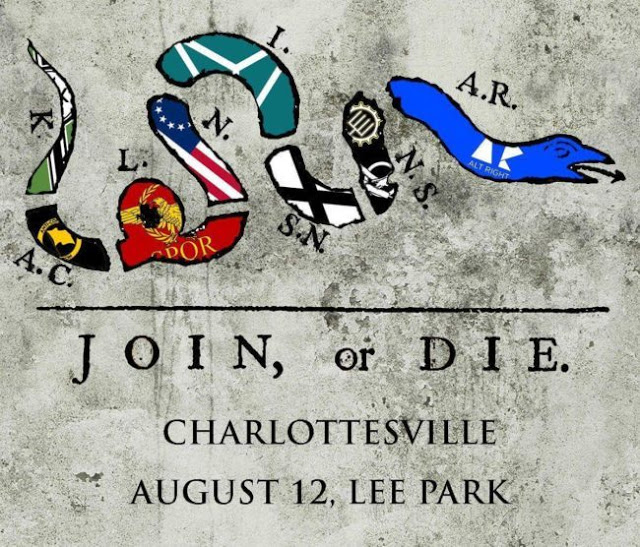
It’s still three days until the “Unite the Right” rally in Charlottesville, and it already seems to be unraveling in a mass of name-calling, accusations of bad faith, and blustery posturing by the groups involved. These include the League of the South, the Traditionalist Workers Party, the Kekistan Militia, the Three Percenters, Oathkeepers, Identity Evropa, the Nationalist Socialist Party, and various local self-described “militia” groups with names like “KK and the Pirates” and the “Fraternal Order of Alt-Right.” They’re arguing over whether open carry is allowed or not (and who really has the stones to defy the law if it’s not), whether or not the City of Charlottesville revoked their event permit, and whether or not they should move to a new, larger venue as ordered by the city or remain in the original, cramped location.
Some of these groups insist that they don’t have any political alignment or affinity with the Richard Spencer crowd, and are only there to show their support for the principle of Free Speech. None of them, as far as I can tell, have ever rallied to support the principle of Free Speech on behalf of Black Lives Matter or any group or cause on the left side of the political spectrum.
This event is nominally a rally in support of preserving Confederate monuments under threat in Charlotseville, but no one believes that’s what’s really going on here. The event is being promoted heavily on forums like Stormfront. Several heritage groups, including the Virginia Division of the SCV, denounced this event weeks ago.
AirBnB has cancelled the reservations of customers who they believe are going to Charlottesville to attend the event.
Both the Rutherford Institute, a libertarian-leaning think tank and legal resource center, and the ACLU have weighed in on the City of Charlotteville’s handling of this clusterfnck.
The local organizer, self-described “citizen journalist” Jason Kessler, appears to under a lot of stress, and posts unhinged, profanity-filled selfie video streams every time something goes wrong. In one of them he claims he’s being followed by a gang of trans women — and ZOMG he’s not even in a public restroom!
The evolving Charlottesville clown show is being covered in regular posts at the satirically-named Restoring the Honor blog (some language NSFW), that has been exposing the ties between the “Heritage not Hate” folks and white nationalist extremists for a while now. This morning, Restoring the Honor is asking, “Is Unite The Right going to be the Nazis’ Altamont?”
It’s gonna be interesting, y’all.
______

Tour USS Monitor Turret this Week Only
Sorry for the late notice on this, y’all. I hope slots are still available.
Behind-the-scenes tours with historian John V. Quarstein, Director of the Monitor Center, will be available for the public the week of August 7! See below for select times.
Tours include a walk through the award winning Ironclad Revolution exhibit, a behind-the-scenes look at the Batten Conservation Complex, a chance to go inside the turret tank and come within inches of this iconic object, and the ability to handle some rarely seen USS Monitor artifacts. Tours are $100 per person and may be booked online below.Tours are not suitable for children under the age of 10 and are limited to 10 people at a time. Don’t miss this chance to see conservation in action!Tour times, with links to register online:
http://www.marinersmuseum.org/turret-tours/
_______
Things that Go “Boom!”
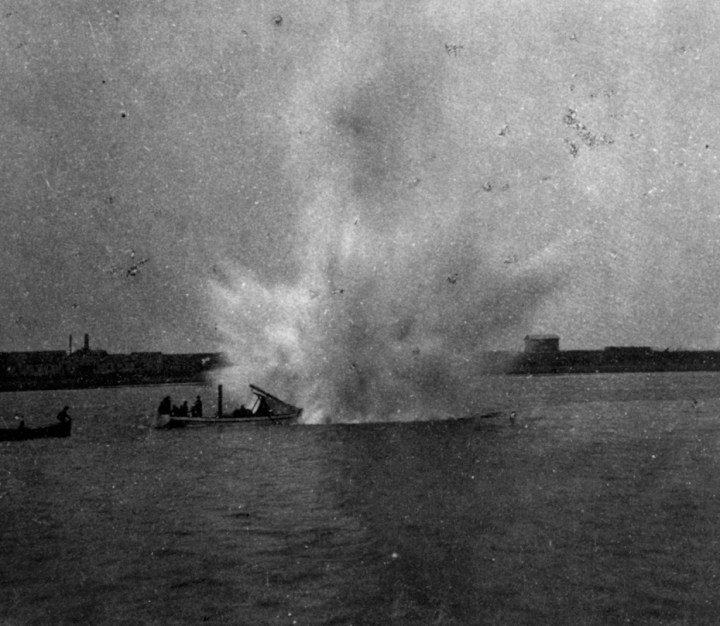

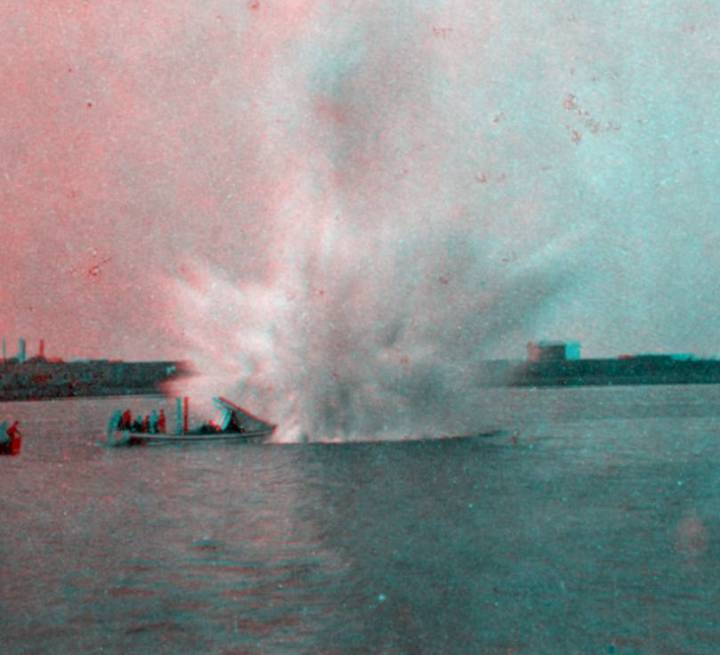
My colleague Chubacus from CivilWarTalk.com posted this image, subsequently identified by CWT user lordroel, of U.S. Navy tests of a spar torpedo at Newport, Rhode Island on September 11, 1871. The note on the back of the image gives the size of the charge as 160 lbs, about 20% more than used by the Confederate submersible H. L. Hunley in sinking USS Housatonic in February 1864. It was a steam launch very much like this that sank CSS Albemarle.
Presented in both flat and 3D anaglyph formats.
You can visit Chubacus’ photography blog here.
______
For the Ferroequinologists
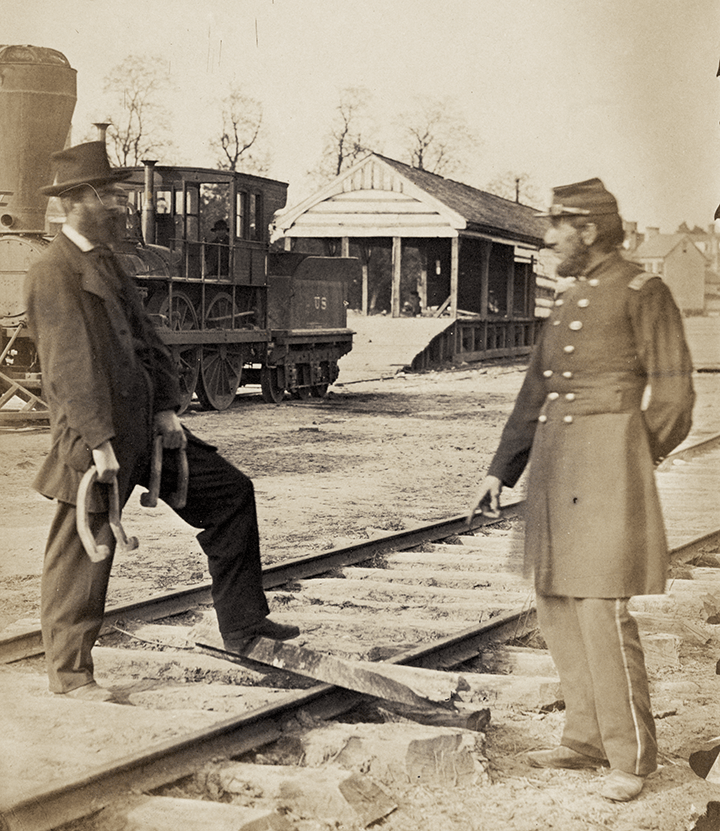
A few years ago I happened on this Library of Congress image, and wondered what the implements carried by the man at left were. My guess was that they were handles of some sort for carrying rail. I was on the right track (so to speak), but thanks to a colleague on Facebook, the answer is even more interesting for CW train buffs. It’s described (and this same image included) in Herman Haupt’s memoir:
Other experiments were made on old sidings near Alexandria to determine the best mode of rapidly destroying tracks. The usual mode adopted by the enemy had been to tear up the rails, pile the cross ties, place the rails upon them, set the pile on fire, and bend the rails when heated. I found this mode entirely too slow, as several hours were required to heat the rails sufficiently and, when bent, we could generally straighten them for use in a few minutes, in fact, in less than one-tenth of the time required to heat and bend them.
We had been experimenting for some time with no results that I considered satisfactory, when one day [E. C.] Smeed came into my office with a couple of U-shaped irons in his hands (see illustration on page 111) and exclaimed: “I’ve got it!” “Got what?” I asked. “Got the thing that will tear up track as quickly as you can say ‘Jack Robinson,’ and spoil the rails so that nothing but a rolling mill can ever repair them.”
“That is just what I want,” was my reply; “but how are you to do it with that pair of horseshoes ?”
He explained his plan. The irons were turned up and over at the ends so as firmly to embrace the base of the rail. Into the cavity of the U a stout lever of wood was to be inserted. A rope at the end of the lever would allow half a dozen men to pull upon it and twist the rail. When the lever was pulled down to the ground and held there, another iron was to be placed beside it, and another twist given, then the first iron removed and the process repeated four or five times until a corkscrew twist was given to the rail. After hearing the explanation, I said: “I think it will do; let us go at once and try it.” Smeed’s plan was found to answer perfectly, and the problem of the simplest and quickest mode of destroying track was satisfactorily solved.
I don’t know if the men shown are Smeed and Haupt, but I suspect they are.
_________
July 4, 1863: Vicksburg Falls


One hundred fifty-four years ago today, Vicksburg fell to General Grants army after a siege of 46 days. My great-great-grandfather, William Colder Demnan of the 30th Alabama Infantry, was one of the 18,000 Confederate troops surrendered on that day. The Confederate commander, Pemberton, later said he chose Independence Day to surrender because he felt he could get better terms of surrender on that day than on any other.
Grant wrote of the aftermath in his memoirs:
Pemberton and his army were kept in Vicksburg until the whole could be paroled. The paroles were in duplicate, by organization (one copy for each, Federals and Confederates), and signed by the commanding officers of the companies or regiments. Duplicates were also made for each soldier and signed by each individually, one to be retained by the soldier signing and one to be retained by us. Several hundred refused to sign their paroles, preferring to be sent to the North as prisoners to being sent back to fight again. Others again kept out of the way, hoping to escape either alternative. . . .
As soon as our troops took possession of the city guards were established along the whole line of parapet, from the river above to the river below. The prisoners were allowed to occupy their old camps behind the intrenchments. No restraint was put upon them, except by their own commanders. They were rationed about as our own men, and from our supplies. The men of the two armies fraternized as if they had been fighting for the same cause. When they passed out of the works they had so long and so gallantly defended, between lines of their late antagonists, not a cheer went up, not a remark was made that would give pain. Really, I believe there was a feeling of sadness just then in the breasts of most of the Union soldiers at seeing the dejection of their late antagonists.
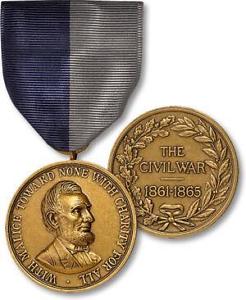
The painting above hangs in the Governor’s Suite of the Minnesota State Capitol in St. Paul. (It was one of several paintings that were recently threatened with relocation, but I understand that plan was shelved after public outcry.) It depicts the Fourth Minnesota Volunteer Infantry leading Federal troops into the city. It was painted by Francis D. Millet (1846-1912) sometime after 1905. Millet, one of the best-known American artists of the period, was himself a Civil War veteran. Millet died in April 1912 in the sinking of Titanic.
h/t Kevin Dally
Update: A blog reader notes that Millet also designed the Army Campaign Medal issued to CW veterans:
_______

Faugh A Ballabh – Clear the Way!

On the 154th anniversary of the Battle of Gettysburg, an Irish Brigade flag flies on a private residence in Galveston.
_____
Presentation Thursday — “Sailing a Square-Rigger”

Join us this Thursday evening, July 6, at Fisherman’s Wharf Restaurant in Galveston for guest speaker, Jamie White, past director of the Texas Seaport Museum and the historic 1877 Iron Barque Elissa and an Admiral in the Texas Navy Association. Captain White will give a presentation on “Sailing Elissa ~ a Square Rig Primer.” Captain White will present a lecture on the dynamics of setting sail aboard and maneuvering the official tall ship of Texas, Elissa, and how ships of the Texas Navy would have been similarly handled underway during battle.
Having worked in the traditional rigging and square-rig sail training industry since the early 1980s, Captain White has built an extensive knowledge and understanding of traditional sailing ships and their operational and restoration/maintenance and educational outreach requirements. He has sailed over 30,000 miles as bosun, mate, or master on many square-rigged & traditional vessels including: HMAV Bounty, the three-masted barque Elissa, topsail schooner Californian, galleon Golden Hinde, barque Star of India, brig Pilgrim, schooner Adventuress, 3 masted schooner Jacqueline, square-topsail ketch Hawaiian Chieftain, brig Lady Washington, schooner Atlantis, and the brigantine Soren Larsen. He served as Chief/Master Rigger on the three-masted barque Glenlee, the four-masted barque Moshulu, the three-masted ship Balclutha, and the three-masted schooner C.A. Thayer. Captain White has served as a rigging consultant on the the four-masted ship Falls of Clyde, the three-masted ship Discovery, and the three-masted barque Polly Woodside. Most recently he spent much of 2016 supervising and directing the $3.5 million rigging restoration of the largest wrought iron sailing ship in the world, the full rigged ship Wavertree, launched 1885. He has served as both Master and Education Coordinator on the brig Lady Washington in 1988-89.
The event will begin with a meet-and-greet and cash bar at 6:30 p.m., with dinner and the presentation beginning at 7:30. Attendees can order from the regular Fisherman’s Wharf menu, and will be responsible for purchasing their own food and drinks. Those wanting to attend should RSVP to Adm. Butch Spafford, (409) 239-three one eight two, or by e-mail to admspafford-at-gmail-dot-com
The planned agenda for the July 6 meeting is available here.
The Texas Navy Association is a private, 501(c)(3) organization, dedicated to preserving and promoting the historical legacy of the naval forces of the Republic of Texas, 1835-45. In Galveston, the Charles E. Hawkins Squadron was organized in the fall of 2016, and meets on the first Thursday evening in odd-numbered months at Fisherman’s Wharf Restaurant.
______
Godspeed, Brass Napoleon

This morning I learned of the passing last weekend of Ron Gorman of Columbia Station, Ohio. I had never met Ron, but I knew him online as user “Brass Napoleon” at the Civil War Talk discussion forum. Ron was one of the users that makes that such a great place, as his posts were invariably detailed, deeply informed, and often amusing to boot. He was a great contributor there, and we will all miss him. Ron was the second prominent member of CWT to go this year, after Hank Trent passed away a few months ago. You can read Ron’s obituary here.
Ron was a software engineer by profession, but his real passion was local and Civil War history. Ron was both a volunteer docent and a trustee of the Oberlin Heritage Center. One of his ongoing passions was to explore and tell the story of the antebellum Underground Railroad in Oberlin. So he probably had a lot of fun last fall, when he portrayed a villainous local man named Chauncey Wack (no, really) who was a staunch defender of southerners’ chattel property rights and welcomed slave catchers to stay at his inn when they passed through town.
Ron’s passing was sudden and unexpected. There will be a visitation with the family and celebration of Ron’s life on Saturday in Elyria. In lieu of flowers, the family suggested donations to the Oberlin Heritage Center or Lorain County Homeless Shelter.
______
Lieutenant Commander Jouett’s Prize
One important inducement for Union sailors was prize money. When a ship or other suspected enemy property was captured, the officers and enlisted crew members of the seizing vessel were entitled to a share of the cash value of enemy ship, or “prize.” (The Confederate Navy had rules governing prize money, too, but its crews were rarely in a position to bring captured ships into southern ports for adjudication.) The awarding of prize money was part of a long tradition in Europe and, later, in the U.S. Navy. When a suspect vessel was taken, its captors would put a skeleton crew on board to sail it to the nearest U.S. admiralty court for adjudication; for ships seized off the Texas coast, that was usually at New Orleans or Key West. There, the navy would present a “libel” against the prize, evidence that the vessel had, in fact, been caught running in or out of a blockaded southern port. The ship’s papers would be entered into the record, along with cargo manifests, logbooks and other records. Often one or more of the captured ship’s officers or crew would be brought in to give testimony as well.
The seized ship’s owners, or their representatives, were also permitted to present evidence of their own to show that the seizure had been unwarranted. Sometimes these challenges were successful on first hearing or, like any other legal case, were drawn out interminably by appeals that might go as high as the U.S. Supreme Court. It was not unusual for prize cases during the Civil War to drag on for many months or even years. Even when a case was quickly adjudicated and prize money assigned for allotment, it could be a very long time before the men entitled actually received their share. Francis Davenport, a former officer on USS Portsmouth, writing long after the war about the first prize his ship had captured, noted laconically, “I think I got some $43 prize money about twelve years afterward…”
In most cases the seizure was upheld by the court, and the vessel and all its contents were inventoried, appraised and put up for auction. After deductions for court costs and inventorying, appraising and auctioning the prize, half the proceeds was retained by the government and placed in a fund for disabled seamen, while the other half was divvied up between the officers and crew of the squadron that made the capture. The admiral commanding the regional squadron (e.g., the West Gulf Blockading Squadron) collected 5 percent of the total proceeds, the local commodore received 1 percent and the remaining 44 percent was split among the officers and men of the naval vessel(s) that had actually made the capture. In keeping with a U.S. law dating to 1800, the captain and officers aboard the capturing vessels claimed the lion’s share of the prize money, while the far more numerous enlisted sailors and Marines were left to divide a small part of the proceeds among themselves.
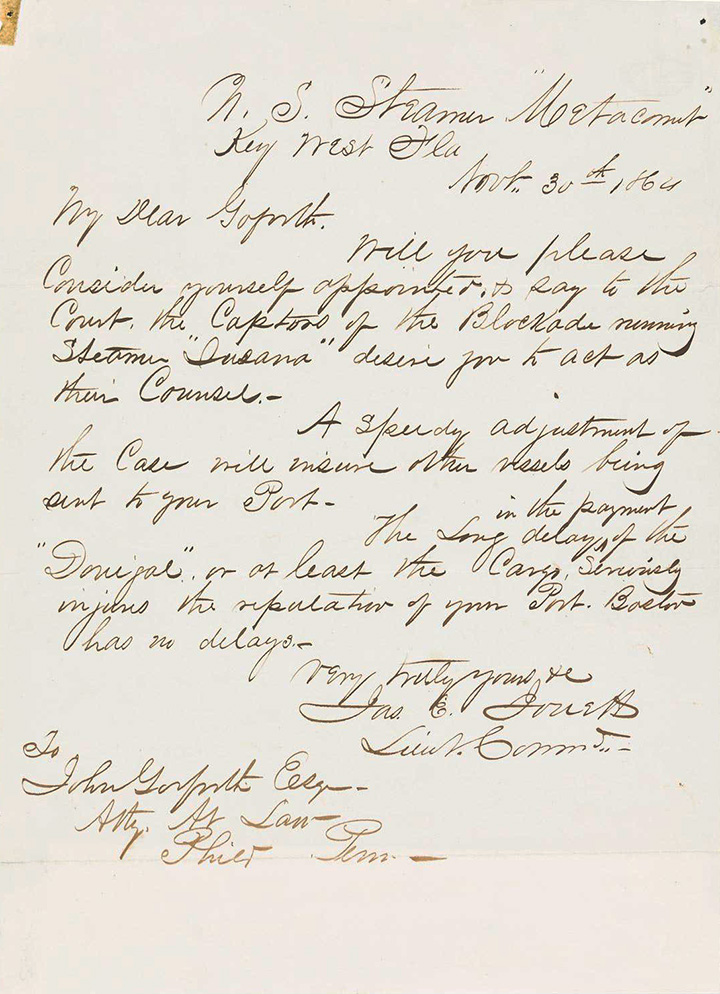
My friend Ed Cotham recently passed along this letter from an auction site, relating to blockade prize money and from an officer who had earlier participated in a rather notable exploit here early in the war, Lieutenant Commander James E. Jouett (1826-1902), when he led a boarding party that cut out the privateer Royal Yacht from Galveston harbor. The letter Ed sent me is from three years after that event, and is addressed to a Philadelphia attorney, John Goforth, asking the latter to represent Jouett’s interests in an upcoming prize case:
U.S. Steamer “Metacomet”
Key West Fla
Novb. 30th, 1864
My dear Goforth.
Will you please Consider yourself appointed to say to the Court, the captors of the Blockade running Steamer “Susanna” [sic.] desire you to act as their counsel.
A speedy adjustment of the Case will ensure other vessels being sent to your Port.
The long delays in the payment of the “Donegal,” or at least [of] the Cargo, Seriously injures the reputation of your Port. Boston had no delays.
Very truly yours, & c.
Jas. E. Jouett
Lieut. Commd.
To
John Goforth Esq.
Atty At Law
Phila Penn
You can read Jouett’s account of the capture here. But getting back to his letter to attorney Goforth, there are a number of interesting elements there.
Jouett’s interest in having a quick adjudication of the case (and subsequent distribution of prize money) was obviously an important consideration. In the same way that courts and particular judges are today perceived to be sympathetic or hostile to certain kinds of cases, naval prize courts during the Civil War developed similar reputations. Clearly in Jouett’s view, the prize court in Philadelphia wasn’t working through its caseload as fast as it might, and certainly not as fast as the one in Boston. Similarly, the amount of money capturing crew ultimately received depended on how much condemned vessel and its contents sold for at auction. Here, simple supply-and-demand came into play, because obviously the prize would be worth more in a local market where there was a high demand for vessels and whatever cargo they happen to be carrying when captured, then in a port where there was a market glut of either. A number of naval officers made small fortunes through serendipity when cargoes they had captured happened, by chance, to come up for auction in New Orleans in the fall of 1864, where the price of good quality cotton spiked to more than a dollar a pound.
Jouett (left) may also have w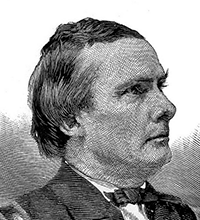 anted Susanna and her cargo to be adjudicated in Philadelphia because he had someone there (Goforth) who could directly represent his case before the prize court. While Goforth’s fee would come out of Jouett’s share of the prize money awarded, some officers found hiring personal attorneys to represent them to be a worthwhile investment. Samuel Phillips Lee, who commanded the North Atlantic Blockading Squadron off Wilmington, North Carolina, reportedly referred to his post as the “prize money command.” Lee was so protective of his perquisite that he hired his own attorney, acting on commission, to represent him in prize cases. The lawyer did his job well, helping Lee to collect $109,689.99 in prize money during his two years’ tenure in command, the highest of any Union officer.
So how much did Jouett collect — not counting his attorney’s fee — on the capture of Susanna? As if happens, we can know that amount to the penny.
Susanna was captured on November 27, 1864, and the case settled at Philadelphia on March 25, 1865 — a period of almost exactly four months, relatively quickly by the standard of the day. (The case of Donegal, about whose “long delays” Jouett complained in his letter to Goforth, had taken nearly five months. Jouett was clearly an impatient man.) The total amount raised by the sale of the ship and her cargo was $60,284.20, from which $5,297.60 was deducted to cover court costs, inventorying, and other expenses related to the case. This left $54,986.60 for disbursement to the various concerned parties. Half of that money — $27,493.30 — went to the U.S. government to support naval hospitals; and the other half was then set for distribution among various officers, Marines, and seamen.
Five percent of the total value of the prize ($2,749.33) went to Jouett’s Squadron Commander (Rear Admiral David G. Farragut), and another one percent ($549.87) went to his division commander. That left 44% of the total value of Susanna and her cargo, or $24,194.10, for Jouett and his crew.
That $24,194.10 was then split into 21 equal shares of $1,209.71. Jouett himself was entitled to three of those shares, or $3,629.13. His officers and midshipmen collected between them ten shares ($12,097.10), which probably came out to about $240 each. The enlisted seamen and Marines claimed the remaining seven shares, or $24,194.20. If Metacomet was at or near her full complement at the time of Susanna’s capture, each seaman and Marine probably stood to collect between $55 and $60.
As a Lieutenant Commander with a sea appointment, Jouett’s annual pay was $2,343, so his share of Susanna‘s value, $3,629.13, amounted to roughly a year and a half’s pay. For a Ordinary Seaman who normally earned $16 per month, his $55 or $60 prize money from Susanna amounted to about four months’ regular pay.
As Francis Davenport noted, however, it often took months or even years for sailors to collect the prize monies owed them. In response, there developed business opportunity for prize money brokers, who would advance seamen a portion of the money owed them in return for prize claim documents. It was an arrangement not unlike modern payday lending, and it took advantage of seamen who were unwilling or unable to wait an extended period to collect the funds owed them on the Navy’s slow and arbitrary schedule.
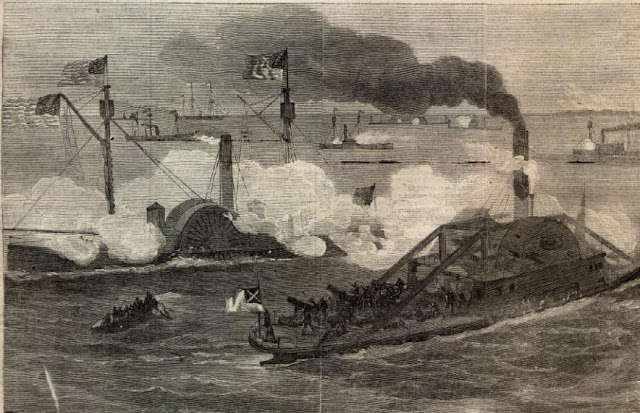
USS Metacomet (left) slugs it out with a Confederate gunboat in the Battle of Mobile Bay, August 5, 1864.
Over the course of the war, Jouett became one of the Navy’s more celebrated junior officers. Only a few months before capturing Susanna, Jouett’s Metacomet had been lashed alongside Farragut’s flagship, Hartford, as the West Gulf Blockading Squadron entered Mobile Bay. (If Farragut really said, “damn the torpedoes, full speed ahead,” James Jouett probably heard it live.) He eventually rose to the rank of Rear Admiral, and retired in 1890. He died in 1902 and is interred at Arlington National Cemetery. Three U.S. Navy ships have been named USS Jouett after him — a Paulding Class destroyer (1912), a Somers Class destroyer (1938), and a Belknap Class guided missile cruiser (1964).
________
Happy Birthday, Mr. Bearss!
Today, Monday, is Ed Bearss’ 94th birthday. It’s also a great time to contact your U.S. Representative to encourage them to support House Resolution 1225, to award a Congressional Gold Medal to Mr. Bearss, “in recognition of his contributions to preservation of American Civil War history and continued efforts to bring our nation’s history alive for new generations through his interpretive storytelling.”
_________




 Dead Confederates, A Civil War Era Blog
7 comments