Texas Navy to Recognize Lieutenant Munse Hitchcock, October 21
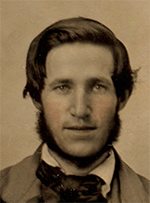 The Texas Navy Association will hold a medallion ceremony for Lent Munson Hitchcock, Jr. (right), on Saturday, October 21, at 10 a.m. at Old Episcopal Cemetery in Galveston.
Hitchcock served as a midshipman and lieutenant in the Republic of Texas Navy in 1836-37. The city of Hitchcock in mainland Galveston County is named in his honor.
“Munse” Hitchcock came from a seafaring family in Connecticut, and joined the Texas Navy as a midshipman aboard the schooner Independence at New Orleans in 1836. He was later commissioned as a lieutenant and served aboard the schooner Brutus.
After resigning his commission in 1837, Hitchcock became a pilot guiding vessels in and out of the harbor at Galveston. He became the first harbor master when Galveston was incorporated as a city in 1838, and went on to serve in multiple public offices.
Hitchcock died in 1869. Several years later his widow, Emily, donated land on the mainland to the Santa Fe Railroad for use as a right-of-way, on condition that they name the station there after her husband. That station stop later grew into the town of Hitchcock.
The Texas Navy Association is a private, 501(c)(3) organization, dedicated to preserving and promoting the historical legacy of the naval forces of the Republic of Texas, 1835-45. Membership in the Texas Navy Association is open to all persons age 16 and over who have an interest in Texas history and want to help support the goals of the organization.


Crowdfunding History: What Did 17th-Century Sailors Really Eat?
There’s a group of students at Texas A&M working on a project to recreate shipboard food from the 17th century, and they’re doing it here in Galveston aboard the 1877 Tall Ship ELISSA. They need only a modest amount of additional funding to complete the project, one that strikes me as both valuable in the sense of generating new knowledge, and simply a lot of fun, as well. I hope you will join me in making a contribution to this project. From their crowdfunding page:

About This Project
Were sailors actually ship-shape–or were they truly a sickly bunch? Find out with us! We are replicating shipboard food using the exact ingredients and methods from the 17th century. Then, a transatlantic voyage is simulated by storing the food in casks and keeping them on Elissa, the 19th century tallship. The nutritional and microbiological data from this project will offer a glimpse into the unique food situation, health, and daily life of past sailors.What is the context of this research?
“[Unsalted food] is rotten and stinking [so] it is necessary to lose your senses of taste and smell and sight just to [consume] it and not sense it,” wrote Eugenio de Salazar, a Spanish explorer to the New World, in 1573. Before canning technologies or refrigeration were invented, food was fermented, salted, or dried to prevent spoilage. Unfortunately, these methods of preservation also decrease the nutritional value of food on lengthy voyages. Previous attempts to gauge the nutritional value of shipboard diets were based on historical documentation or existing USDA nutrition charts that only reflect nutritional values from modern foods, not historical ones.What is the significance of this project?
This project hopes to understand the effects of shipboard diet on the health of sailors by determining the nutritional and microbial intake of seamen on 17th-century English ships by replicating the food items as close to possible as they were in the past.This project will give us great insight into humankind’s shared maritime history and answer some longstanding questions in archaeology and history. We hope to understand how this unique subset of society ate and how this impacted their health, as prior to airplanes, all immigrants who made the transatlantic voyage to the United States came here via ship. Yet, there is little knowledge on the precise conditions of the food 17th-century sailors consumed.
What are the goals of the project?
In this project, shipboard food will be replicated using the exact ingredients and methods of preparation from the 17th century, including non-GMO ingredients, the exact species of plant or animal, and the same butchery methods and cuts of meat. Archaeological and historical data will be used to replicate the salted pork and beef, ship biscuit, wine and beer, and other provisions aboard Warwick, an English race-built galleon that sank in 1619. We will also simulate a trans-Atlantic voyage by storing the food in casks and keeping these in a ship’s hull for three months. Representative samples of food will be sent for nutritional and microbial analysis, including species of microbes, their quantities, and toxins, to understand changes that the food undergoes.
The Experiment.com crowdfunding page is here. As of Saturday morning, they’re about $3,500 short of their goal. This is do-able, y’all!
__________
“That is how slave revolts work.”
Over at Talking Points Memo, Josh Marshall considers a proposal in Richmond, Virginia, to include Nat Turner in an anti-slavery monument:

Virginia had seen Gabriel’s rebellion in 1800 and Charleston, South Carolina had been rocked by the Denmark Vesey uprising in 1822. But critically, neither of these planned insurrections ever happened. The plots were uncovered before they could begin. Most of what we know about all these events either comes from whites or from the testimonies of free or enslaved blacks communicated through whites. They are often ‘confessions’ or under confinement, testimonies from people either facing death or trying to escape it. Most of what we know about Turner, his ambitions, goals, life history comes from a jailhouse interview conducted after he was captured by a lawyer named Thomas Ruffin Gray. Because of this, it is difficult to know how far along these plots were or, possibly, whether some of them were products of panics or paranoia among white slaveholders. But Turner’s rebellion was real and bloody. The write-up in the Richmond Times-Dispatch says Turner is “seen as a freedom fighter by many and a mass murderer by others.” The simple truth is that he was unquestionably both. That is how slave revolts work. . . .
Memorializing Turner or other slave rebels has simply been a step too far in the US, at least until now. In a sense, this is hardly surprising. The South is covered with monuments to men who fought a war to preserve slavery. They are only now starting to come down. Most still stand.
The state of Virginia executed Turner. The state must still consider him a criminal. He hasn’t been pardoned or exonerated. Now it’s memorializing him. That is a sea change and I suspect still a highly controversial one. There are many forms of slave resistance. Most are incremental and small – what the political scientist James C. Scott called the ‘weapons of the weak.’ The most tangible. The ones we know most about is running away.
But slave revolts are inherently violent and uncompromisingly brutal. That is hard for this country, which still honors a legal continuity with a long history of slavery, to grapple with. Because coming to the terms with the brutality of slave revolts brings the brutality and violence of slavery itself to the fore in a way America has seldom publicly faced. It’s like a tight and uncompromising algebraic equation. Honoring Turner means that his actions were laudatory and merit public memorialization. But his actions involved killing families and small children in their beds. If such actions, which are normally among the worst we can imagine, merit praise and public honor, the system they were meant to fight and destroy must have been barbaric and unconscionably violent beyond imagining. Very few of us would contest this description of slavery. But bringing Turner into the discussion of public commemoration will air these issues in a new (I think very positive) and jarring way.
I struggle with this, like Marshall does, like any thinking person does. It’s not easy to square this circle, and I suspect it’s not really possible anyway. What’s important is to have this discussion, which up to now mostly hasn’t happened. It’s high time it does.
_______
Houston Civil War Round Table’s 2017-18 Campaign
The Houston Civil War Round Table’s 2017-18 Campaign kicks off on Thursday, September 21, with a presentation by Brian Matthew Jordan, author of the finalist for the 2016 Pulitzer Prize in History, Marching Home: Union Veterans and Their Unending Civil War. It should be a fine program, but it’s just getting things started for this year. In October, Gary Gallagher will discuss “Another Look at the Generalship of Robert E. Lee,” and in November Eric J. Wittenberg will present “John Buford at Gettysburg.” It’s one helluva roster, y’all:
Sept 21, 2017, Brian Matthew Jordan, Marching Home: Union Veterans and Their Unending Civil War (2017 Vandiver Award Recipient)
Oct 19, 2017, Gary W. Gallagher, Another Look at the Generalship of Robert E. Lee
Nov 16, 2017, Eric J. Wittenberg, John Buford at Gettysburg
Dec 14, 2017, Dennis Trainor, VMI Cadets at New Market
Jan 18, 2018, Edwin C. Bearss, Brice’s Crossroads and Tupelo
Feb 15, 2018, Mark Christ, All Cut to Pieces and Gone to Hell’: Atrocities During the Camden Expedition
Mar 15, 2018, Scott C. Patchan, Second Manassas: Longstreet’s Attack and the Struggle for Chinn Ridge
Apr 19, 2018, Lesley J. Gordon. The 2nd Texas at Shiloh
May 17, 2018, To Be Determined, Holding for 2018 Vandiver Award recipient
I hope many of you will be able to brave the Galleria-area traffic and attend. The Round Table meets for dinner the third Thursday of each month from September to May (except December when the meeting is usually the second Thursday in December) at the Hess Club to hear renowned speakers from across the United States. The Round Table welcomes members and guests alike to any meeting, but it is always necessary to make reservations by 6:00 pm the Monday before a meeting for Dinner or Lecture Only.
6:00 – 6:45 PM: Social Hour with Cash Bar
6:45 – 7:30 PM: Dinner ($32.00)
7:30 – 7:45 PM: Meeting / Quiz / Raffle
7:45 – 8:45 PM: Guest Speaker
Lecture Only – Chairs are available for a small charge to persons who wish to attend the meeting without eating dinner. ($10.00)
The Hess Club’s address is 5430 Westheimer. The club is situated on the corner of Westheimer Way and Westheimer Court. Free, convenient, and handicap-accessible parking is across the street. Valet parking is also available.
The Hess Club
5430 Westheimer
Houston, Texas 77056
Phone: (713) 627-2283
Call Don Zuckero at (TwoEightOne) 479-OneTwoThreeTwo or email him at Reservations at HoustonCivilWar dot com by 6:00 PM the Monday preceding the Thursday meeting.
_______
Texian Navy Days Postponed
From TNA President Jerry Patterson:
Admirals and Friends of the Texas Navy Association:
In light of the effects of Hurricane Harvey, the leadership team of the Texas Navy Association and the hosting Hawkins Squadron in Galveston have decided to cancel the Texian Navy Days events scheduled for September 15-17, 2017, to be rescheduled at a later date to be announced. As of Friday, September 1, evacuations are still underway in flooded areas in East Texas and Louisiana, and we’ve received reports of TNA members with significant damage to their homes and businesses. One critical vendor to the event had to cancel as a result of the storm, and we have not been able to follow up with others. A number of TNA members who had reserved a place at the event have been forced by the situation to cancel their plans.
Although we’re disappointed to have to make this decision, it’s the correct and necessary one. In addition to the logistical challenges brought about by Harvey, the storm has inevitably caused all of us to realign our priorities respond to our own needs, those of our friends and families, and those of our neighbors.
We will be making arrangements to refund those monies already paid to the TNA for registration, and will provide details on that soon. Reservations for lodging at Moody Gardens or other locations must be cancelled by each of you separately; the TNA has no control over that part of the process.
I would like to thank everyone who’s been involved in organizing this event across the TNA. Although we won’t be gathering as planned in two weeks, we believe that we’ve developed a blueprint for a successful event, and look forward to having it on the calendar again soon.
In the meantime, we appreciate your ongoing support, and look forward to corresponding with you again soon. We all face difficult days and weeks ahead but, just as our for-bearers in the Texian Navy did 180 years ago, with diligence and determination we will not only persevere, but thrive.
Sincerely,
Jerry Patterson,
President, Texas Navy Association

_______







 Dead Confederates, A Civil War Era Blog
leave a comment