Christmas Picket
 [This post originally appeared on December 25, 2011.]
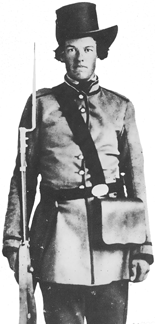
One hundred fifty years ago today, a nineteen-year-old Confederate soldier named Valerius Cincinnatus Giles (right, 1842-1915) went out on picket duty along the Potomac.
On Christmas morning a detail of twenty men was sent from the Fourth Texas Regiment to relieve the picket guard along the river. This detail was commanded by Lieutenant R. J. Lambert.
The post assigned me was on Cock Pit Point, about 100 yards from the masked battery. This battery of four guns was planted twenty feet back from the edge of the bluff. completely hidden from view by an abatis of pine brush felled and stacked, with the sharpened ends of the trunks pointing outward. as a crude defense. From my post I had a splendid view of the river for two or three miles in each direction. The low range of hills on the Maryland side opposite were covered with white tents and log cabins, the winter quarter of General Daniel E. Sickles’s New York Brigade.
The war had just fairly begun, and this was new to me. The novelty of the situation, the magnificent view before me, the river rolling majestically along between white hills and evergreen pines so charmed and captivated me at first that I felt not the bitter cold. The snow was gently and silently falling. deepening 011 the hills and valleys, melting as it struck the cold bosom of the dark river. I had been on post but a short time when I beard the signal corps man sing out from the crow’s-nest high up in a sawed-off pine tree, saying to the officer in charge: “Look out, Lieutenant, a gun boat is coming down the river!”
I could hear the artillery officer giving orders to his men, but from my position I could not see them. Looking up the river I saw a cloud of black smoke rising above the tops of the trees. All was excitement at the battery. and I could hear the artillerymen ramming home their shells, preparing to sink the approaching boat. Directly the steamer turned a bend in the river with volumes of black smoke pouring from her smokestacks. She was in the middle of the stream, coming dead ahead under full steam. It was really a disappointment to the fellows at the battery as well as myself, when the soldier in the crow’s-nest called out again: “0h, pshaw, Lieutenant, don’t shoot! She’s nothing but an old hospital boat, covered over with ‘yaller’ flags.”
Of course a Confederate battery would not fire on a yellow flag any more than on a white one.
The boat came steadily on down the river until she got nearly opposite Cock Pit Point, when she blew her whistle and turned toward the Maryland shore. As she made the turn she came within 200 yards of the Virginia bank and I could distinctly read her name on the wheel house. It was the old Harriet Lane. named in honor of the accomplished niece of President James Buchanan, who was queen of the White House during the administration of that eccentric old bachelor. In the winter of 1861 the Harriet Lane was in the employ of the Hospital Corps of the Army of the Potomac. A few days after that, she left her mooring on the Maryland side and pulled out down the river. She subsequently became a warship of some kind and met defeat at the Battle of Galveston in January, 1863.
After the boat bad landed and the excitement was over, a melancholy stillness settled around me. The novelty and fascination of my surroundings soon lost their charm. The lowering clouds above me and the white silence about me became monotonous and I began to feel restless and uneasy. If you are in a forest or on a prairie on a still summer day and will stop and listen attentively, you can bear the songs of birds, the chirping of crickets or the drowsy hum of insects. hut in a piney woods in midwinter, when the earth and green branches of the trees are covered with snow, with not a breath of air blowing, the stillness is oppressive. I must have bad a slight attack of homesickness, for I began to think of home and my mother and father away out in Texas waiting and praying for the safe return of their three boys, all in the army and all in different parts of the Confederacy — one in the Tenth Texas Infantry at an Arkansas post, one in Tennessee or Kentucky with Terry’s Rangers, and one in the Fourth Texas Infantry in Virginia. . . .
While I stood at my post on the banks of the Potomac I knew I was perfectly safe from any personal danger, yet something seemed to warn me of approaching evil. I tramped through the snow, half-knee-deep, although I was not required to walk my beat. I tried to divert my mind from the gloomy thoughts that possessed me, but all in vain. Suddenly I was startled from my sad reflections of home and kindred by distinctly hearing a voice I new — my brother Lew’s voice — calling my name. I turned quickly, looked in every direction, heard nothing more and saw nothing but the white world around me and the dark river below me. He was two years my senior, had been my constant companion and playmate up to the beginning of the war.
It was then 4 P.M., December 25, 1861. I was not sleeping or dreaming. and firmly believed at the time that I heard my brother calling me, but it must have been a delusion of the imagination.
However, Lewis L. Giles of Terry’s Texas Rangers, Troop D, Eighth Texas Cavalry, was mortally wounded at the battle of Mumfordsville, [Woodsonville] Kentucky, December 17, 1861, in the same charge in which Colonel Terry was killed. He was removed by his comrades to Gallatin, Tennessee. and died at the residence of Captain John G. Turner, a lifelong mend of my father. He breathed his last precisely at four o’clock on Christmas Day. 1861, while I stood picket on the banks of the Potomac.[1]

[1] Mary Lasswell, ed., Rags and Hope: The Memoirs of Val c. Giles, Four Years with Hood’s Texas Brigade, Fourth Texas Infantry, 1861-1865 (New York: Coward-McCann, 1961), 59-62. The compiled service record of Private Lewis L. Giles, Co. D, 8th Texas Cavalry, gives his date of death as Christmas Eve, December 24.
___________
Image: Private Val Giles in the spring of 1861, at the time of his enlistment in the Tom Green Rifles, a company later rolled into the Fourth Texas Infantry. From Voices of the Civil War: Soldier Life.

Christmas Eve Concert: John Hartford, “On Christmas Eve”

Here’s hoping all of you have a wonderful holiday season and a Happy New Year.
______

More Corroboration for the Richard Kirkland Story


The story of Richard Kirkland, the Confederate soldier who reportedly went across the wall after the battle of Marye’s Heights at Fredericksburg to bring water to wounded Union soldiers, is well known. It has also been often questioned, because it relied on secondhand testimony that was not recorded until many years after the battle. Then a few years ago, a researcher named Mac Wyckoff published a series of blog posts at the Mysteries and Conundrums blog, that fleshed out substantial evidence that corroborates the basic elements of the story. For me personally, Wyckoff’s posts moved the Richard Kirkland story from the “possible” column into the “probable” column. You can read the first of those posts here, with links to the second and third installments.
Earlier today, Mysteries and Conundrums posted an update by Wyckoff, that includes additional corroboration of the story, including the identification of a second Confederate soldier, Isaac Rentz, who assisted Kirkland in bringing water to the wounded Federals who lay on the field in front of Confederate lines.
A recently discovered article in The Bamberg Herald, a South Carolina newspaper, includes the story of a soldier who assisted Kirkland in giving water. The story is told by Confederate veteran J.B. Hunter, a childhood friend of Isaac Washington Rentz, of the 2nd South Carolina.
Hunter summarizes the basic story and then adds additional details. After Kirkland received permission to carry water to wounded Union soldiers and went to administer the liquid, Hunter states, “Just then, Isaac Rentz, seeing it, filled several canteens and carried water to Kirkland and they gave water to every crying man and was not hurt.”
Go read the whole thing.
_____
Image: “I Was Thirsty,” by Nathan Greene

Liberty and Pelícano: A Story of the Texian Navy
 On Tuesday I had the privilege of speaking to the Lone Star Chapter No. 58 of the Sons of the Republic of Texas in Conroe, on “Liberty and Pelícano: A Story of the Texian Navy.” It’s an amazing story, how the fledgling Texas Navy pulled off the capture of a Mexican schooner anchored in a small port on the Yucatán coast, hundreds of miles from Texas. And the story of what became of Pelícano‘s cargo later is even more remarkable.
The attack gets underway:
The first boat, under the command of First Lieutenant Hartwell Walker, was about 100 yards off Pelícano’s starboard side when it was spotted by the soldiers on board the schooner. They rushed to the rail, and let off a volley of musket fire at Walker’s boat. All the shots missed, and the crewmen bent to the oars to get alongside as quickly as they could. Hartwell and his crew scrambled up over the rail before the Mexican soldiers could reload and get off another volley, and began hacking and slashing their way across the deck. Just at that moment, the second boat, commanded by Sailing Master Oliver Mayo, thumped against the port side of the schooner.
It’s a great story, like something out of Forester or O’Brian.
________

Friday Night Concert: “Stay All Night,” Hill Country Cosmopolitans
The Hill Country Comspolitans are out of Hillsborough, North Carolina. That’s Jerry Renshaw at center on guitar and vocals, Glenn Jones at right on bass and vocals, and Robert Striegler at left on guitar and vocals. From their Facebook page:
Bringing a touch of Texas to Carolina, they decided to call themselves the Hill Country Cosmopolitans…and expanded their repertoire to include a little bit of country and honky tonk and even jazz as well. Danceable, catchy and infectious, Western Swing has a universal charm that people find irresistible…and the Hill Country Cosmopolitans want to share that fun with you at the next barn dance, beer joint, skull orchard, hoedown, shiv-a-ree, wedding, funeral, wake, bar mitzvah, cut ‘n shoot, pig pickin, BBQ, supermarket grand opening, car show, turkey shoot, party or family reunion near you.
Y’all have a great weekend. Gonna rain like hell here, which kinda sucks for the Dickens on the Strand festival.
________




 Dead Confederates, A Civil War Era Blog
14 comments