Dead Confederates, A Civil War Era Blog

Friday Night Concert: Ralph Stanley, “The Vacant Chair”

Posted in Memory by Andy Hall on February 28, 2014

Another track from the new album, Divided and United.

_______

GeneralStarsGray

Was Rock Island the “Andersonville of the North”? Um, No.

Posted in Memory by Andy Hall on February 24, 2014

Over at The Historic Struggle, Rob Baker notes that today is the 150th anniversary of the arrival of the first prisoners at Camp Sumter, better known today as Andersonville. Camp Sumter is the most infamous of all prisoner of war camps on either side during the Civil War.

One thing that is sometimes heard is that Rock Island was “the Andersonville of the North.” That assertion is something that interested me personally, since once of my relatives spent almost eighteen months there in 1864-65, a period that includes almost all of Rock Island’s time as a PoW camp. It was a terrible experience, made worse by the vindictiveness of Union authorities who ordered a reduction in rations in retaliation for the treatment of Union PoWs in the Confederacy, specifically at Camp Sumter.

But was Rock Island objectively as bad as Andersonville? I recently watched a documentary, The Rock Island Civil War Prison: Andersonville of the North? (available for purchase here, or streaming here), that laid out some of the data. The documentary is pretty good, although it has an “unfinished” or “almost there” feel to it; there were several subjects barely touched upon that would justify its expansion to a full hour, instead of just 30 minutes. Nevertheless, it’s worth your time if you have an interest in CW prisons.

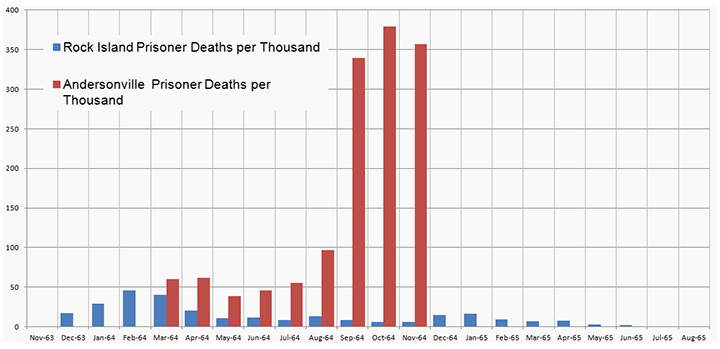
The documentary specifically challenges the claim that Rock Island was the “Andersonville of the North.” Taking a lead from that, I looked up some detailed numbers, broken out by month, that show the actual rate of deaths among the prisoners at the two camps, by month. Numbers for Rock Island are available for its entire existence from its opening in late 1863; Andersonville opened a few months later, and most of the prisoners were evacuated from the site in the fall of 1864. Although Andersonville remained in operation until May 1865, the vast majority of deaths among its prisoners occurred between February and November 1864. Death rates are calculated by comparing the number of fatalities with the prisoner population for each month:
RockIslandChartSmall

Click the little one to get a big one. You can download a spreadsheet of the numbers here. Rock Island data is from the Appendix of Otis Bryan England’s A Short History of the Rock Island Prison Barracks (Revised Edition) (Rock Island, Illinois: Historical Office, U.S. Army Armament, Munitions and Chemical Command, 1985). Andersonville data is from p. 321 of John McElroy’s Andersonville: A Story of Rebel Military Prisons (Toledo: D. R. Locke, 1879).

Of course, there’s a simpler way to look at this: more men died at Andersonville than were imprisoned at Rock Island during its entire time as a Civil War prison camp.

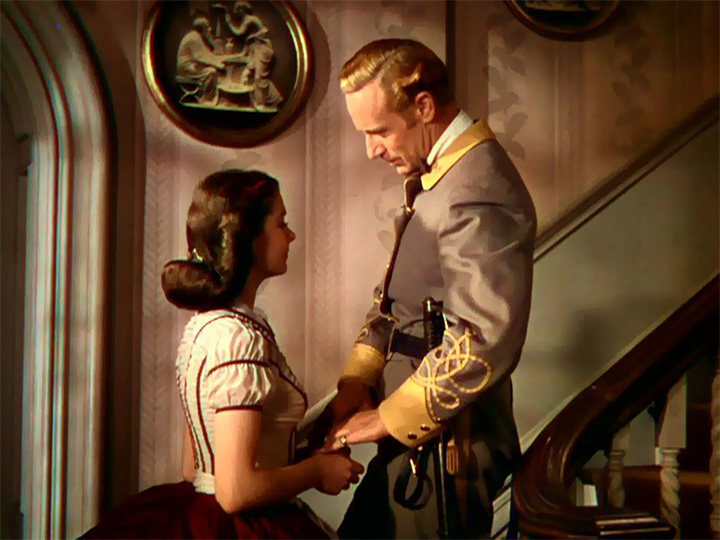
So where did this “Andersonville of the North” nonsense come from? The phrase doesn’t show up until the 1940s, and I suspect that, like so many other cherished themes about the war, it originated with Margaret Mitchell, who had Ashley Wilkes survive imprisonment at Rock Island. In Gone with the Wind, Chapter 16, she wrote:

Blank

Ashley was not dead! He had been wounded and taken prisoner, and the records showed that he was at Rock Island, a prison camp in Illinois. In their first joy, they could think of nothing except that he was alive. But, when calmness began to return, they looked at one another and said ‘Rock Island!’ in the same voice they would have said ‘In Hell!’ For even as Andersonville was a name that stank in the North, so was Rock Island one to bring terror to the heart of any Southerner who had relatives imprisoned there.​

Blank

No question, Rock Island was a bad place to be, with much unnecessary suffering. But it was not the horrific place Andersonville was, by any objective measure. Mitchell’s plot also underscores her shoddy research in this area: Rock Island was a camp for enlisted men only, and Ashley Wilkes was an officer.
Blank

ScarlettAshley

Blank

__________

GeneralStarsGray

Witnessing History from Third Base

Posted in Memory by Andy Hall on February 23, 2014
ROBINSON
Larry Miggins (No. 4) playing opposite Jackie Robinson of the Montreal Royals, April 18, 1946.

Blank

Last weekend I was treated to a wonderful lunch with the organizer of the annual Dick Dowling Commemoration, Patrick Miggins, and his parents, Larry and Kathleen. Larry established the event 44 years ago, but the annual cleaning of the statue goes back more than a century, to the original installation of the statue at the old Houston City Hall in 1905. That tradition was established by Mayor John T. Browne (1845-1941), himself a former Confederate veteran who had been part of Dowling’s wedding party after the war. Browne passed along the tradition of caring for the statue to former City Councilman Tom Needham, who in turn passed it along to Larry Miggins in 1963.

What I didn’t know until we met was that Larry was a professional baseball player in the late 1940s and early ’50s, diving his time between the majors and the minors. Although he was signed straight out of high school by the New York Giants, he entered the Merchant Marine instead and, after World War II ended, played for the Jersey City Giants and the Houston Buffaloes in the minors, and spent two seasons with the Buffs’ major league parent, the St. Louis Cardinals. While Larry Miggins didn’t have a very long baseball career, it was memorable — he went to high school with Vin Scully and worked out with Honus Wagner.

One of Larry’s more notable games, though, occurred on April 18, 1946. That was the day Larry’s Jersey City Giants took the field against the Montreal Royals, and their new player, a former Negro Leaguer named Jackie Robinson. The Royals were affiliated with Branch Rickey’s Brooklyn Dodgers, and 1946 would be a try-out season for Robinson, and two black pitchers, John Wright and Roy Partlow, for the majors. It was the first time an African American player took the field as a member of a professional team affiliated with any of the majors:

Blank

Card“His first time up, he grounded out,” Miggins recalled. “Then he hit a home run over the left field fence, which showed he was a pull hitter. His third time up, he dropped down a bunt and beat it out because I was playing back like the manager told me to do.
 
His fourth time up, he got another hit, and then he dropped another bunt in front of me, because I was still playing him back – which I never did again.”
 
For the day, Robinson had four hits in five trips with a homer, four runs scored, four runs batted in, two stolen bases and two forced balks in Montreal’s 14-1 win over Jersey City.
 
It was an auspicious debut in a career – and a life – that continues to amaze and inspire.
 
“Jackie Robinson led the league in hitting that year,” Miggins said. “Then he went to the Brooklyn Dodgers and was rookie of the year. He became the Most Valuable Player of the league, beat the Yankees in the World Series and went on to the Hall of Fame … “
 
At this point in the story, Miggins paused for dramatic effect – or, as it turns out, comic relief.
 
“And he was able to do all that because I played back and gave him two hits in that first game,” he said, breaking into laughter. “I got him off to a great start.”
Blank

The Montreal Royals walloped the Jersey City Giants that day, 14-to-1. When the Royals finally got back to Montreal for their own home opener, there were 14,000 people in the stands.

Blank

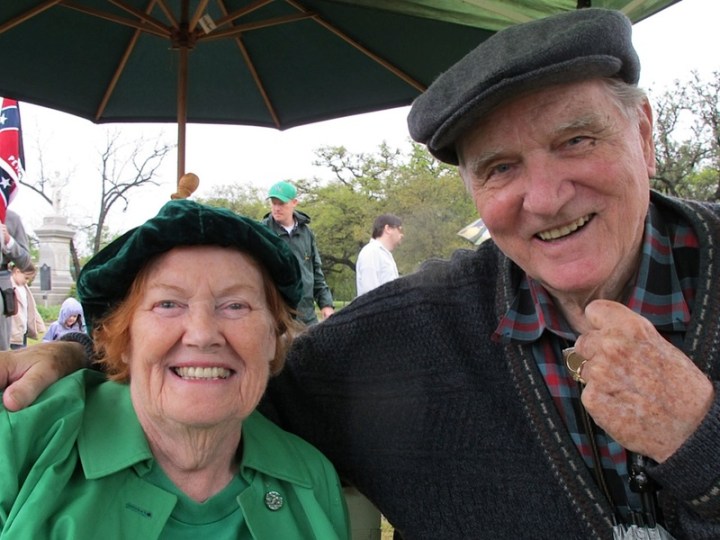
Katie_Dick_Dowling_Statute_cleaning_March_2012_Kathleen_and_Larry_Miggins
Kathleen and Larry Miggins at the Dick Dowling Ceremony in 2012. Photo by Katie Oxford via HoustonCultureMap.com.

Blank

Larry met Kathleen McMahon in 1952 while on a road trip with the Cardinals, while she was working at the Irish consulate in Chicago. Her parents in Ireland were none too impressed with the prospect of them getting married and moving to Texas.   “When I moved to Houston my parents were so scared. They said, ‘you’ll be living in a covered wagon. How will you get to Mass?'”

Covered wagon or not, Larry and Kathleen managed, in the process raising 12 children and 35 grandchildren. Larry retired after 21 years as the chief of probation and parole for the U.S. Southern District of Texas.

What wonderful people, who are still giving to their community. Thanks for the great time, folks. I look forward to seeing y’all around again soon.

___________

Sources: David Barron, “Best Seat in the House for History,” Houston Chronicle, April 12, 2013; Katie Oxford, “A Gullywasher Couldn’t Stop this Annual Irish Fete,” HoustonCultureMap.com, March 15, 2012.

generalstarsgray9

Florida’s Lost Fort Caroline Found — In Georgia

Posted in Memory by Andy Hall on February 22, 2014
FortCaroline
Re-enactors fire a rifle salute to a tall ship on the St. Johns River as it passes by Fort Caroline during Sail Jacksonville in 2004. Via Jacksonville.com.

 

Blank

From Heritage Daily:

 
In an announcement likely to rewrite the book on early colonization of the New World, two researchers today said they have discovered the oldest fortified settlement ever found in North America. Speaking at an international conference on France at Florida State University, the pair announced that they have located Fort Caroline, a long-sought fort built by the French in 1564.
 
“This is the oldest fortified settlement in the present United States,” said historian and Florida State University alumnus Fletcher Crowe. “This fort is older than St. Augustine, considered to be the oldest continuously inhabited city in America. It’s older than the Lost Colony of Virginia by 21 years; older than the 1607 fort of Jamestown by 45 years; and predates the landing of the Pilgrims in Massachusetts in 1620 by 56 years.”
 
Announcement of the discovery of Fort Caroline was made during “La Floride Française: Florida, France, and the Francophone World,” a conference hosted by FSU’s Winthrop-King Institute for Contemporary French and Francophone Studies and its Institute on Napoleon and the French Revolution. The conference commemorates the cultural relations between France and Florida since the 16th century.
 
Researchers have been searching for actual remains of Fort Caroline for more than 150 years but had not found the actual site until now, Crowe said. The fort was long thought to be located east of downtown Jacksonville, Fla., on the south bank of the St. Johns River. The Fort Caroline National Memorial is located just east of Jacksonville’s Dames Point Bridge, which spans the river.
 
However, Crowe and his co-author, Anita Spring, a professor emeritus of anthropology at the University of Florida, say that the legendary fort is actually located on an island at the mouth of the Altamaha River, two miles southeast of the city of Darien, Ga. Darien is located near the Georgia coast between Brunswick and Savannah, approximately 70 miles from the Jacksonville site.​
Blank

When told of the discovery of Fort Caroline near Darien, Zombie Colonel James Montgomery announced his intention to burn that, too.

__________

GeneralStarsGray

Friday Night Concert — “Rollin’ in My Sweet Baby’s Arms”

Posted in Memory by Andy Hall on February 21, 2014

“Lay ’round the shack, ’til her husband comes back. . . .”

With the Yes Ma’am String Band in (where else?) New Orleans.

I think those are sparks coming off that steel guitar at the end.

_____________

GeneralStarsGray

Hunley on the Road

Posted in Memory by Andy Hall on February 18, 2014

Blog reader Woodrowfan passes along this image, another way to remember Hunley:

UHaulHunley

___________

GeneralStarsGray

150 Years Ago this Evening. . .

Posted in Memory by Andy Hall on February 17, 2014

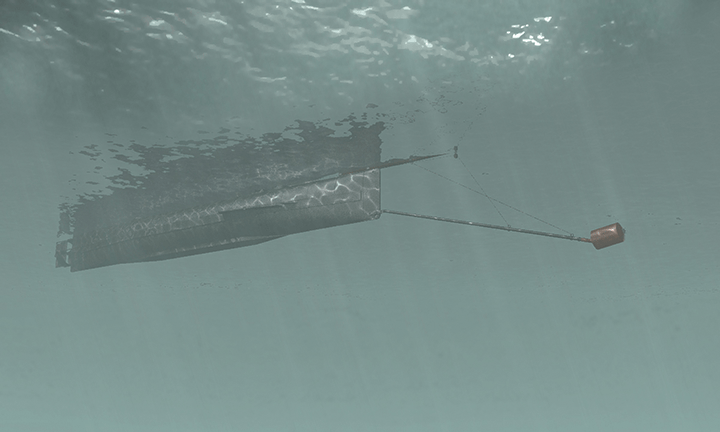
Hunley with Torpedo 720

. . . the Confederate submersible H. L. Hunley sank the Federal warship Housatonic in the Atlantic Ocean off Charleston.

HunleyCutawayWhite01 720

____________

Update, February 17, 3 p.m.: My colleagues Craig Swain and Robert Moore both have reflections on this day. Craig shares some thoughts on the the sinking of Housatonic, and its place in the Charleston campaign and the larger war effort. He closes with this:

Blank

Another point, and this is more a personal rub, is how we frame this event for interpretation.  The headlines are “Hunley-centric” as if the Housatonic was just a hulk out there on the waters.  There were men on board the Housatonic that night.  These were not nameless, faceless entities.  Rather men serving for cause and country.  Five those men did not see the next day.  And they are still out there.  Should we not mention Ensign Edward Hazeltine, Clerk Charles Muzzey, Quartermaster John Williams, Second Class Fireman John Walsh, and Landsman Theodore Parker on this day?

Blank

And as it happens, Robert Moore was thinking exactly along those lines.

____________

GeneralStarsGray

New in the Civil War Monitor

Posted in Memory by Andy Hall on February 14, 2014

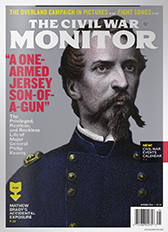
CWM Spring 2014The new issue of the Civil War Monitor is now available online, and will be arriving in subscribers’ mailboxes and on newsstands soon. In this issue:

FEATURES
“A One-Armed Jersey Son-of-a-Gun”
An unquenchable thirst for war transforms a restless son of privilege into a fearless but controversial commander. By Stephen W. Sears

Fight Songs
From inspiring anthems to humorous ditties, Civil War soldiers crafted a variety of musical lyrics to help pass the time, air laments, amuse comrades, and share their struggles. By Christian McWhirter

Rivers, Roads, & Regiments
The 1864 Overland Campaign in pictures. By Garry Adelman

The Ubiquitous Mr. Tanner
Grievously wounded during the conflict, Union soldier James Tanner went on to achieve both fame and infamy during his remarkable postwar life. By James Marten
 
DEPARTMENTS
Editorial: Personal Favorites
Salvo: Facts, Figures & Items of Interest
Travels: A Visit to Frederick, Maryland
Voices: Hardtack
Preservation: Interpretation: Half the Battle
Figures: A Ticket Home
Disunion: The Freedmen of Wisconsin
In Focus: Brady’s Accidental Exposure
Casualties of War: Albert Moses Luria
Battlefield Echoes: The Wilderness, Body Counts, and Fading Hopes
 
Books & Authors:
Voices From the Army of the Potomac, Part 2, by Gary W. Gallagher
Civil War Personal Journals, by Robert K. Krick

Parting Shot: Take Me Out to the … Battlefield
 
________

h/t to Mark Jenkins for the heads-up on this.

GeneralStarsGray

Hunley Sesquicentennial Activities this Weekend

Posted in Memory by Andy Hall on February 12, 2014

This weekend marks the 150th anniversary of the famous, fatal mission of the Confederate submersible H. L. Hunley at Charleston. Over at To the Sound of the Guns, Craig Swain has compiled an extensive list of commemoration activities going on there this weekend, including Monday, the sesquicentennial of the boat’s loss. Check it out.

__________

GeneralStarsGray

The Daily Show Meets the Old West

Posted in Memory by Andy Hall on February 10, 2014

After I put up that post the other day about Newman Haynes “Old Man” Clanton, I pulled out Casey Tefertiller’s biography of Wyatt Earp, and skimmed the section that deals with the famous gunfight at the OK Corral. It seems the local coroner, one Henry M. Matthews, studiously avoided saying anything of substance about the incident, including (most importantly) whether a crime had been committed:

Blank

William Clanton, Frank and Thomas McLaury, came to their deaths in the town of Tombstone on October 26, 1881, from the effects of pistol and gunshot wounds inflicted by Virgil Earp, Morgan Earp, Wyatt Earp and one — Holliday, commonly called ‘Doc’ Holliday.”

Blank

The Tombstone Nugget pounced:

Blank

Glad to Know
The people of this community are deeply indebted to the twelve [actually eight] intelligent men who composed the coroners jury for the valuable information that the three persons who were killed last Wednesday were  shot. Some thirty or  forty shots were fired, and the whole affair was witnessed by probably a dozen people, and we have a faint recollection of hearing someone say the dead men were shot, but people are liable to be mistaken and the verdict reassures us. We might have thought they had been struck by lightning or stung to death by hornets.

Blank

Heh.

__________

GeneralStarsGray