No, this is Not a Monument to “Black Confederate Regiments”
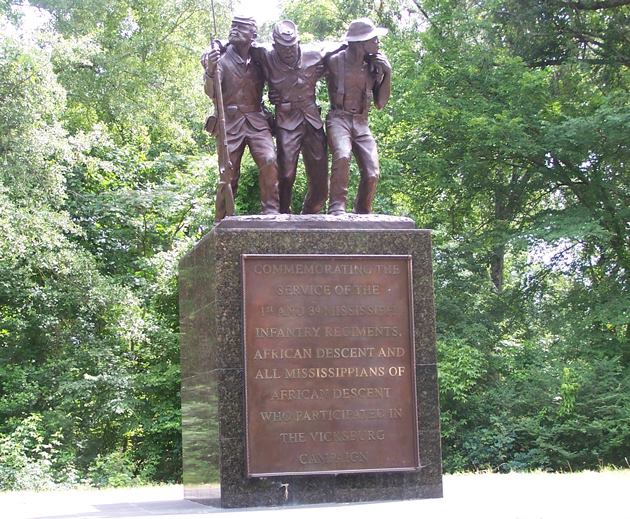


This monument stands in Vicksburg National Military Park. It was dedicated in 2004 to two Union regiments, the 1st and 3rd Mississippi Infantry (African Descent), that were later reorganized as the 51st and 53rd U.S. Colored Infantry, respectively.
____________

Real Virginia Flaggers

Veterans of R. E. Lee Camp No. 1, Richmond, Virginia, at the reunion at Gettysburg, 1913. Library of Congress photo.
___________
“Where they shoot cross-eyed men and red-headed women at sight”
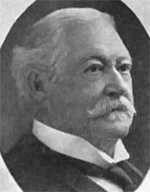 Benjamin Cummings Truman (right, 1835-1916) was a journalist and author who, after a stint as a war correspondent, accepted a position as a staff aide to Andrew Johnson, then military governor of Tennessee. After the war, he returned to journalism before settling in California and eventually embarking in the 1880s on a career in what today we’d call public relations.
Truman remained close to Johnson, and during Reconstruction, traveled extensively in the South, filing regular reports for the New York Times. Truman was not impressed much with Texas, with Texans, or with Galveston. A friend passed along this letter of Truman’s from the front page of the February 19, 1866 edition of the New York Times:
[1] This is a spoof on F.F.V.s, “First Families of Virginia,” a sort of Tidewater nobility in the Commonwealth, much derided during the war by Northerners.
[2] This is a reference to the “Murrell Excitement” of 1835, when rumors of a slave insurrection spilled over into a general vigilante action against brothels, gamblers and other perceived sources of vice.
[3] Horatio Gouverneur Wright, (1820-99) commanded the Army of Texas from July 1865 to August 1866, succeeding General Gordon Granger.
Deep Gulf Shipwreck Project Wraps
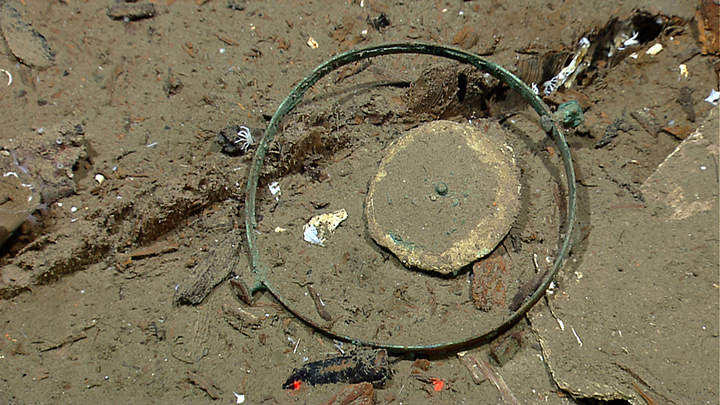 Several pieces of the ship’s compass were found in the aft part of the vessel [during a site survey in 2012]. The compass card inside the gimbaled mount, shown here, is in an area where the ship’s binnacle would have been located. The two red dots at the bottom of the picture are laser lights that come from the ROV Little Hercules. ROVs often mount two parallel lasers to take measurements and these laser lights are 10 centimeters [2.54 inches] apart. Image courtesy NOAA Okeanos Explorer Program.
Work on the Monterrey Wreck site wrapped earlier today, and the crew of E/V Nautilus is heading for the barn:
Coolness. Now the really revealing-but-un-glamorous work begins, with months of work in the lab to conserve, document and identify the artifacts recovered.
To get an idea of the depth at which this team was operating, check out a scale diagram of E/V Nautilus, the sled Argus and ROV Hercules after the jump.
Set in Stone
The Atlantic has an essay up today that begins with the shrill headline, “You Won’t Believe What the Government Spends on Confederate Graves,” and carries that tone all the way through. The essay includes some useful data on the Veteran Administration’s expenditures on markers for Civil War veterans (about 60% of which goes to Confederate stones), but otherwise contains little new information. Naturally it contains quotes from both Jamie Malanowski, who recently called for the renaming of U.S. military installations named for Confederate generals, and the peripatetic Ed Sebesta, who’s always good for a provocative line or two about “neo-Confederates.”
The article, though, buries what I think is the real scandal here. It’s not the amount of money involved (which is very small by government standards), nor that the federal government is providing the stones, which is codified by federal law. Rather, it’s this foolishness:


My emphasis. Placing headstones more-or-less randomly in a cemetery, where they may or may not be within a hundred yards of the actual interment of the person they ostensibly honor, pretty much makes a mockery of the point of a cemetery in the first place. It is effectively creating a fake grave. Given that the whole purpose of the VA headstone program is explicitly to provide markers for otherwise unmarked graves, it amounts to fraud for heritage advocates to obtain these markers, and then place them in whatever convenient, otherwise unoccupied spot they can find.
I suspect this happens quite a bit more often than heritage organizers let on, especially in small cemeteries where detailed interment records are lacking. The goal for folks like Linda Hallman and Jack Grubb really does seem to be less about marking actual graves than to have an opportunity for a ceremony to salute the Confederacy, underwritten by the taxpayers. The individual soldiers being so “honored” merely provide the excuse. How else to explain the SCV/UDC’s creation of a faux cemetery in Pulaski, Tennessee, with granite headstones — in this case, paid for with private funds — inscribed with the names of nineteen “black Confederates,” not a single one of whom is actually buried there?
Both present-day taxpayers and long-dead Civil War veterans deserve more respect from the “heritage” crowd.
__________
Deep Gulf Shipwreck Live, July 18-25
UPDATE: Live broadcast available here:
__________________
From the Underwater Archaeology Mailing List, SUB-ARCH:
Note that the name, “Monterrey Wreck,” does not indicate the identity of the vessel, which is unknown. Deep water sites in the Gulf are commonly named for nearby pipelines or oil lease tracts. From the website:
___________
Thanks, Y’all!

I’d like to post a quick note of thanks to the Liberty County Historical Commission and the Fort Bend County Archaeological Society for hosting me on Monday and Tuesday evenings (respectively). It’s always a pleasure to be able to present on little-known local maritime history, especially with engaged and interested folks like those!
_______________ Image: Snags on the Trinity River, 1997.
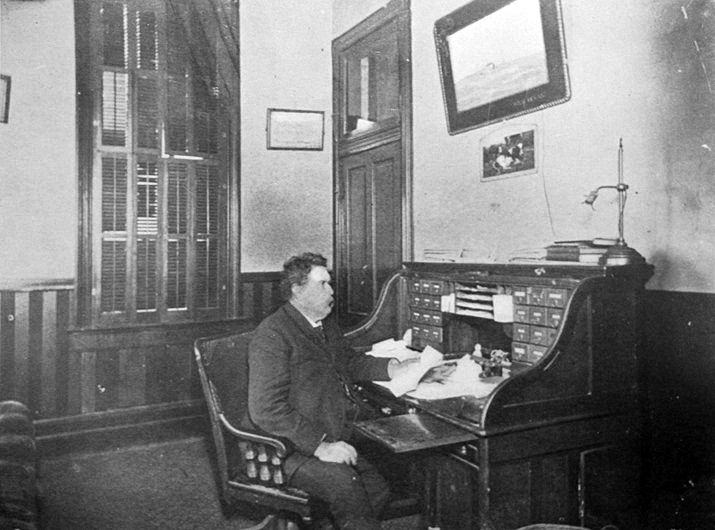
The Klansman
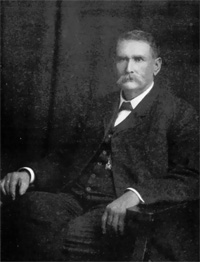 Lawrence Aylett Daffan (right, 1845-1907) is a collateral Confederate ancestor of mine, one of a few who left behind any detailed account of his wartime service. He led a remarkable life. His family moved to Texas from Conecuh County, Alabama in 1849. After his father died in July 1859, fourteen-year-old Lawrence went to work to help support his widowed mother, carrying the mails between Montgomery and Washington Counties, Texas, in 1859. Later, at the time of the 1860 U.S. Census, Lawrence was working as a wagoner. In the spring of 1862, shortly after his 17th birthday, he enlisted at Anderson, Texas in Company G of the Fourth Texas Infantry. He fought in the major engagements of his regiment, part of the famous Texas Brigade, including Second Manassas, Sharpsburg, Gettysburg, and Chickamauga. It was in this last action that he received what he jokingly described as his only wartime injury, a very slight one, when a Minié ball struck his rifle and knocked him down. It was at Chickamauga, too that he witnessed the incident where John Bell Hood was wounded, that Daffan believed to be a case of friendly fire. Private Daffan was captured at Lenore Station in November 1863, during the Chattanooga Campaign, and spent the remainder of the war as a prisoner at Rock Island, Illinois.
Returning to Texas in July 1865, Daffan soon found a job as a brakeman on the Houston & Texas Central Railroad. The postwar decades were boom times for the railroads in Texas, which expanded rapidly. Daffan moved his way up steadily through the company, successively serving as conductor, train master, station agent, and, from 1889, superintendent of the railroad’s Second Division.
In 1872, he married a local girl from Brenham, Mollie Day, and together they had six children, four sons and two daughters. All of their children survived to adulthood, all of them had good educations, and the eldest, Katie, became a noted author in her own right. Although he had little formal schooling himself, Lawrence Daffan valued education highly, and reportedly was an avid reader, though mostly of conventional tastes — Shakespeare, Milton, Dickens, and, of course, the Bible. He was active in a wide range of fraternal organizations, and especially dedicated to Confederate veterans’ activities, including the Hood’s Texas Brigade Association, an effort which earned him the honorific title of “Colonel,” which he carried proudly until his death.
Lawrence Daffan was seriously injured in a train derailment near Corsicana in September 1898, losing two fingers and being severely banged up. Though he recovered, his health was much more precarious after that. He stepped down as superintendent of the H&TC’s Second Division in 1904, to become General Agent for Transportation for the entire railroad, a position he held until his death. In January 1907, at the age of sixty-one, Daffan was suddenly taken ill at his office in Ennis. Carried to his home a few blocks away, he died there that evening. Obituaries were printed in newspapers across the state, and tributes, floral arrangements and formal resolutions from groups he belonged to were published in the paper. His funeral was one of the biggest events Ennis had seen. The H&TC ran special, free trains from Denison at the northern end of the line, and Houston at the southern, to Ennis to accommodate hundreds of mourners who came to town just to pay their last respects at the funeral.
Lawrence Daffan as Superintendent of the Second division of the Houston & Texas Central Railroad, Ennis, Texas. c. 1900. This photo, and the one at top, are from Katie Daffan’s My Father as I Remember Him.
Daffan was, by all accounts, a respected and admired member of his community — multiple communities, in fact: civic, professional and veteran. He was a self-made man in the best, 19th-century sense of the term, starting out after the Civil War as a twenty-year-old veteran with little education and few prospects, worked his way up to the top levels of his profession. He provided for his widowed mother, his siblings and his own family, saw to his children’s education, and worked for the growth and betterment of his community. He was, in almost every respect, an exemplar of 19th century success through hard work and dedication to traditional values of home, family and church.
He was also a member of the Ku Klux Klan.
Judge John A. Batts: Epilogue
One of my readers was good enough to pass along a link to Judge Batts’ will and associated documents, on FamilySearch. They do shed some additional light on the scope of Batts’ property holdings and — possibly — on his state of mind at the time of his death. You can read a copy of Batts’ will and associated legal filings here.
Following Batts’ death in May 1878, his family filled his will with the local court. The will, executed in April 1877, a little over a year before his death, is straightforward in its bequests:
The four named children were John and Mary Batts’ youngest, their approximate ages at the time of the will’s execution being John, 21; Mittie (Mitalena) , 19; Lula (Tallulah), 17; and daughter Willie, 15. All four were still living at home with their mother three years later, at the time of the 1880 U.S. Census.
It makes sense that John Batts would want to provide some financial security for his younger children, who in 1877 had not yet struck out on their own. This would be especially important for the girls. But Judge Batts’ bequest may not have been appreciated by everyone, for he had older children as well, who inherited nothing. In November 1878, several months after Judge Batts’ death, W. B. Paul filed a lawsuit to block the provisions of the will. Paul was the husband of John and Mary’s daughter Eliza, and was challenging the will on behalf of his own children (i.e., the judge’s grandchildren), Sarah, John, Nora and Lulah. In filing his suit, Paul was joined by the judge’s eldest surviving son, Joseph L. Batts who, as we saw last time, had been handling the day-to-day operations of his father’s plantation. Under the circumstances, it is perhaps understandable that Joseph would be unhappy about being cut completely out of the inheritance.
W. B. Paul and Joseph Batts challenged the old judge’s will on two points:
The case was ultimately tried in Lee County Superior Court in late 1881, and the jury ruled in favor of Batts’ original will.
But were W. B. Paul’s and Joseph Batts’ claims factually true? We don’t — can’t — know for sure. But their second assertion, about the judge having been of unsound mind and incapable of handling his own affairs, does echo claims from the time of his death that he had been in a deep depression, even suicidal, for months, and that his “many family troubles. . . had partially dethroned his reason.” What emerges through the mist of decades is a somewhat sombre portrait of a large and maybe fractious family, with John Batts — older, perhaps with diminished capacities — caught in the middle. It’s a sad story.
___________
 Read about it at the



 Dead Confederates, A Civil War Era Blog
17 comments