Waite Rawls Pwns the Southrons
There’s a hoary anecdote among museum staffers – invariably told as one personally witnessed by the speaker – about a tired parent, dragging an even-more-tired kid through the galleries. At one point the parents stops, turns, and snaps at the child, “how are we going to see the whole museum if you keep stopping to look at things?”
I thought about that anecdote recently watching the reaction to the brief installation (now removed) at the Museum of the Confederacy’s new annex at Appomattox of an image of the cross-dressing entertainer RuPaul in a sequined dress patterned after the Confederate Battle Flag. Over at Simpson’s Crossroads blog, Jackie Haddock was in full pearl-clutching mode, demanding to know “what were small children to make of this?” When I replied that it was extremely doubtful that many small children would even recognize RuPaul, much less know enough about him to find the image confusing/offensive/troubling, Haddock replied, “for the record in order to learn whom Ru Paul was I had to do a google search.”
Nothing puts the faux in faux outrage like having to go digging around the Internet to sort out why you’re supposed to be outraged in the first place. I’m furious about this, and if you’ll just give me a minute I’ll be able to tell you why! What a joke.
There are a couple of points worth making here. The first is that nothing the MoC does, short of full-out hagiography of the Confederacy and its heroes, would ever satisfy the small-but-loud group of critics who’ve been carping about the institution for years. If it weren’t RuPaul, it would be something else. They would be unhappy to discover a mention that Lee owned slaves, or that there’s a section devoted to Lincoln’s visit to Richmond a few days before his death. If the flag display out front that’s caused so much heartburn, was to feature (say) Union and Confederate national flags of April 1865 flying side-by-side, they’d be bitching about the presence of the “Yankee rag.” Outrage is what these folks do. Fish gotta swim.
The second thing is that, because they’re always looking for a new excuse to take righteous offense, they’re also easily trolled. This latter point causes me to think that, with this RuPaul thing, MoC Director Waite Rawls may have intentionally yanked the Southrons’ chain.
Sure, it may be exactly as he told Martha Boltz the other day, that it was an idea they’d been kicking around to emphasize the outrageous ways the flag has been used, and then removed it within hours when they received complaints. But it could equally have been Rawls and his staff never intended for it to be up more than a few hours regardless.
I’ve never met Waite Rawls, nor corresponded with him. But it’s clear that he’s not a stupid man, nor one to be intimidated easily. Given the ridiculous vitriol that man’s received — everything from being called “traitor” and “scalawag” to having Southrons urge their comrades to “get in ‘these peoples’ face and spit and spit again” and hint (repeatedly) that he should be lynched — I’d be surprised if Rawls didn’t also have a pretty cynical sense of humor about the fools who carry on like that. He’d have to. Given the unwarranted crap he’s had to put up with in recent years from people who should be working to support that institution, Waite Rawls is entitled to have a little fun at their expense. I’d like to think that’s what happened here, and wouldn’t be a bit surprised if it did. Well played, sir.
I hope to visit the Museum of the Confederacy at Appomattox sometime soon. I kinda wish I’d been there to see the RuPaul picture, too — not for the sake of the picture itself, but to watch visitors’ reactions. It must have been fabulous.
_________

Readin’ Blockade Runners
 I’d like to thank the folks who came out to the Houston Museum of Natural Science Tuesday evening to attend my talk on blockade runners. It was a good time — folks laughed where intended to, not where they weren’t, and there was lots of good Q&A at the end. I did get a little too technical on ship construction and machinery, though, and I oughter watch out for that in the future. Not everyone is that interested in frame spacing and entrance lines.
I’d also like to thank the folks who made my talk possible, particularly Amy Potts from HMNS and Ed Cotham. Thanks, y’all!
One thing that I didn’t have a chance to do, using the format of the talk, was to provide a list of suggested readings. And so:
- J. Barto Arnold III. The Denbigh‘s Civilian Imports: Customs Records of a Civil War Blockade Runner between Mobile and Havana. College Station, Texas: Institute of Nautical Archaeology, 2011.
- W.T. Block, Schooner Sail to Starboard: The US Navy vs. Blockade Runners in the Western Gulf of Mexico. College Station, Texas: Institute of Nautical Archaeology, 2007.
- Eric J. Graham. Clyde Built: Blockade Runners, Cruisers and Armoured Rams of the American Civil War. London: Birlinn Ltd, 2008.
- Thomas E. Taylor, Running the Blockade: A Personal Narrative of Adventures, Risks and Escapes during the American Civil War. Annapolis: Naval Institute Press, 1995.
- Rodman L. Underwood, Waters of Discord: The Union Blockade of Texas During the Civil War. McFarland, 2008.
- William Watson, The Civil War Adventures of a Blockade Runner. College Station, Texas: Texas A&M University Press, 2001.
- Stephen R. Wise. Lifeline of the Confederacy: Blockade Running during the Civil War. Columbia, South Carolina: University of South Carolina Press, 1991.
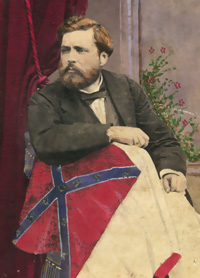
Image: Unidentified Confederate blockade runner, hand-tinted portrait taken in Matanzas, Cuba after the war. Lawrence T. Jones III Texas Photographs, DeGolyer Library, Southern Methodist University.

Petersburg Battlefield Looter Gets Prison

This guy was not a visitor who, on a whim, pocketed a couple of Minié balls he found lying on the ground. He also kept a detailed, day-by-day journal of his looting activities. From the Richmond Times-Dispatch:
By his own account, Santo wrote that he recovered more than 18,000 bullets, 68 fuses, 31 cannonballs and shells, 13 buckles, seven breastplates, five saber tips and 91 buttons over 1,014 days.
“The defendant’s journal is a tell-all of his misconduct, identifying with a high degree of specification where he engaged in metal detecting/relic hunting and when and what he recovered,” wrote Assistant U.S. Attorney N. George Metcalf in federal court papers. “He even kept a running tally of the items he found from day to day on a yearly basis.”
Santo’s handwritten journal, recovered during a July 10, 2011, search of his Petersburg home, proved to be his undoing. On Wednesday, the 52-year-old unemployed Pennsylvania native was sentenced in U.S. District Court in Richmond to one year and one day in a federal prison.
He pleaded guilty in December to two counts of damaging archaeological resources and one count of pillaging Petersburg National Battlefield Park.
Santo is regarded as the park’s most prolific relic thief.
Unfortunately, Santo’s conviction still leaves important, unanswered questions:
[Park historian Jimmy] Blankenship said one of the issues that concerned the court was the amount of relics Santo apparently sold. “We know he found over 18,000 bullets,” Blankenship said. “We only confiscated something like 8,500. So what happened to the other 10,000 bullets?”
But archaeology, as opposed to private treasure hunting on public land, remains a hard sell to the general public. As one archaeologist notes on the Historical Archaeology e-mail list,
If you want to see where the public perception of archaeology is, or if you have wondered who would watch and champion shows like Digger or American Digger, just read the comments at the end of the article. To nearly all commenters, the perpetrator is a hero who has rescued the artifacts from the ground, something the power-loving authorities and archaeologists have no desire to do so.
Trust me, professional archaeologists would love to have the resources to devote to a systematic study of sites like Petersburg, but they don’t. (And note that comprehensive study of a battlefield site can completely revise our understanding of well-known engagements, as Doug Scott’s study of the Little Bighorn and the THC’s work to reconstruct the Red River War both attest.) But there’s little public support for investing in that sort of work, which requires a lot of time by highly-trained people, and is therefore expensive. Buckets of Minié balls and uniform buttons, looted from public land — which is to say, stolen from us — don’t do a damn thing to improve our knowledge or understanding of the conflict.
One additional note: Santo’s 366-day sentence is common in the federal system for low-level, non-violent criminals. The federal system does not have parole, but does allow some credit for inmates with good behavior or who participate in rehab or educational programs while incarcerated. This can knock, I believe, about 15% off the time they actually spend in jail. But to be eligible for this, the law requires that the prisoner be sentence to “more than a year” behind bars — thus the sentence of 366 days. Santo will likely serve about ten-and-a-half months, and then be put on some form of supervised release.
______________Image: Containers of Civil War era bullets and park boundary markers (enclosed in plastic that he took as trophies). Via Petersburg National Battlefield Park.

Canister!

Small stories that don’t warrant larger posts all their own.
- The City of Lexington, Virginia has filed a petition to dismiss the Virginia SCV’s lawsuit against the city, which seeks to overturn a 2011 ordinance that bars all non-governmental flags from city property, including light poles. (The ordinance does not prohibit the flag on private property, nor parades or other displays of the Confederate flag, as is sometimes claimed.) This latest filing is a standard motion that doesn’t add much significant to the case. My earlier thoughts on the plaintiff’s likelihood of prevailing in court are here.
- The long-running lawsuit of Candice Hardwick (above, with Confederate activist/performance artist H. K. Edgerton in 2006) appears to have come to an end, with the dismissal of her federal lawsuit against the administration of Latta High School, in Latta, South Carolina. In 2006, then-fifteen-year-old Hardwick was suspended twice from school for wearing a Confederate flag shirt. She sued, and her case became a cause celebré among heritage groups.
- Near Raleigh, North Carolina, volunteers spent six hours digging up the graves of two brothers, Joseph and Joel Holleman, to move the remains to a nearby cemetery to be reburied alongside other Civil War veterans. This story is the most ghoulish thing I’ve read in a long time; it reeks of necro-voyeurism. The original graves were marked, identified, and not threatened by development or erosion. Nor, as far as I know, was there any wish on the part of these men’s descendants to have this done. So they dug them up anyway, because (in the words of the event’s organizer), ““my heart says this is the right thing.” The folks who scream “GRAVE DESECRATION!” and “SPITTING ON THE GRAVES OF AND DISHONORING AMERICAN VETERANS!” when a cemetery owner removes Confederate stick flags ought to be up in arms about this foolishness. But they ain’t gonna say boo about it.
- Speaking of disturbing graves. . . .
- It looks like Kentucky will finally shut down its Confederate Soldiers Pension Fund, a mere fifty years after anyone was eligible to receive benefits from it. Don’t do anything precipitous, y’all.
- Union County, North Carolina, is moving one step closer to putting up a monument to local African American men who went into the field with the Confederate army as personal servants of soldiers. The description of the men in question by historians interviewed is reasonably accurate, but it’s still all very muddled. Earl Ijames doesn’t help by observing that “history has attempted to negate what they did. . . .They would die for their freedom before freedom was available for their own people. . . .For Union County, Jesse Helms’ (home) county, this makes a big statement that we are a society that has evolved into a more integrated society.” I have no idea what he’s saying, but it sure sounds good.
- Fed up with Waite Rawls, John Coski and the Museum of the Confederacy, the SCV is soliciting money to build and operate the Confederate Museum at Elm Springs in Columbia, Tennessee to counter the “forces of political correctness,” who are attempting “to ban any and all things Confederate through their ideological fascism.” The first 20 camps or divisions to contribute $1,000 or more will each receive a commemorative gavel, “made from wood taken from the damn [sic.] at Fredricksburg [sic.] during the War.“

Finally, I’d like to remind folks that I’ll be speaking on Civil War blockade runners in Texas at the Wortham MAX Theater at the Houston Museum of Natural Science on Tuesday at 6:30 p.m. It should be fun.
_______Image: Candice Hardwick, 15, walks to Latta High School with H.K. Edgerton, a former NAACP leader from North Carolina who is board chairman of the Southern Legal Resource Center. Photo by Mary Ann Chastain, Associated Press.

Talkin’ Blockade Runners

I’d like to extend my thanks to the SCV John Bell Hood Camp No. 50 for hosting my talk on blockade runners Monday evening. A few members recalled my earlier talks on the subject from 10+ years back, and came armed with questions. I talked a little long (surprise!), but I got a lot of solid info in there. I even got in a plug for Jim Schmidt’s upcoming book on Galveston during the war. It’s going to be a good one.
Tuesday evening at 6:30 my friends Bob Gearhart, Amy Borgens, and Edward T. Cotham, Jr. will present “U.S.S. Westfield, A Civil War Shipwreck in Galveston Bay” in the Wortham Theater at the Houston Museum of Natural Science:
In the fall of 2009, a team of marine archeologists working under the direction of the U.S. Army Corps of Engineers supervised the recovery of artifacts from USS Westfield, a Staten Island ferryboat that had been converted into a Civil War gunboat after its purchase by the U.S. Navy in 1861. Westfield saw significant Civil War action, participating in battles at New Orleans, Vicksburg and other places along the Gulf Coast. Its destruction at the Battle of Galveston on January 1, 1863, was one of the most important and dramatic events of the Civil War in Texas. This audiovisual program uses rare historic documents and images to describe the conversion of a ferryboat to armored warship and examine the military career of this unique “fighting ferryboat” and its impact on the war in Texas. It retraces the series of events that led to the relocation of Westfield’s wreck and the challenging project that resulted in recovery of tons of artifacts undergoing conservation at the Conservation Research Laboratory at Texas A&M University. Among the artifacts being conserved is a more than 4 ton Dahlgren cannon capable of firing a projectile almost 2 miles.
And next Tuesday, March 27, I’ll be presenting my own talk there, “For-Profit Patriots: Civil War Blockade Running on the Texas Coast.” Hope to see y’all there!
____________Image: Andy Hall and marine archaeologist Amy Borgens prepare to dive on the site of a wreck believed to be that of the Civil War blockade runner Will o’ the Wisp, July 2009.


Canister!

Small stories that don’t warrant larger posts all their own.
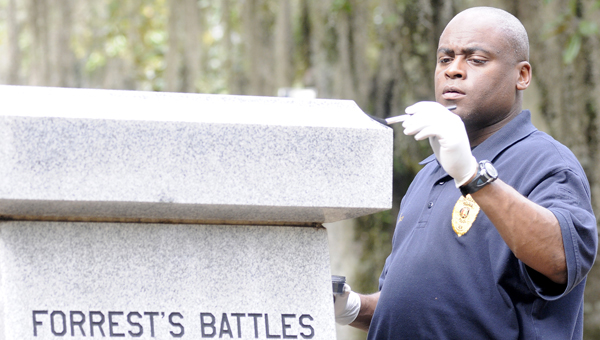
- A life-sized bust of Nathan Bedford Forrest was stolen last weekend from the Old Live Oak Cemetery in Selma, Alabama. Police reported no leads, and it’s unclear whether the Forrest monument was specifically targeted, or if the bronze was stolen for its metal value.
 Ron Wilson (right), a coin and precious metals dealer from South Carolina, is under investigation by the state for allegedly running a multimillion dollar Ponzi scheme involving the purchase of silver securities. Wilson, a former National Commander of the SCV, was one of the so-called hard-liners that came to prominence within that organization in the early 2000s, bent on a more aggressive, politically-engaged course for the group. Wilson remains prominent in local Confederate heritage circles, and apparently hawked his dubious investments among his butternut friends. Wilson has a history of skeevy business dealings dating back to his tenure as a local elected official, some of which involved steering favors to his SCV buddies.
- Also in South Carolina, State Senator Glenn McConnell has agreed to serve as that state’s Lieutenant Governor. McConnell has been invaluable in raising funds and public support for the recovery and conservation of the Confederate submarine H. L. Hunley, but he’s also caught grief for posing for some seriously ill-advised photos. Cartoonist Kate Salley Palmer wonders whether McConnell, who’s been a fixture in South Carolina state politics for decades, is really enthusiastic about relinquishing his senior post in the State Senate. John Courson, the new South Carolina Senate Pro Tem, was (with McConnell) one of the Senate Republicans that negotiated the compromise by which the Confederate flag was removed from the State House in Columbia and placed at the Confederate memorial, where it remains today. (Update: the claim about Cleburne’s coat is being the one in which he was killed is in dispute, as noted in the comments below.)
- The coat worn by Confederate General Patrick Cleburne when he was killed at Franklin in November 1864 will be one of the centerpiece artifacts on display at the new Appomattox site of the Museum of the Confederacy. Cleburne is, after Jackson, Lee and Forrest, probably the most-celebrated Confederate general officer today, but his prominence at the museum is being overshadowed by the controversy surrounding that institution’s decision not to fly a Confederate flag out front.
- Cole Grinnell has a great new blog post up at the Civil War Monitor, “How I tried and failed to escape the Civil War.”
- Finally, ninety-two year-old Pete Seeger sings (what else?) “Forever Young,” part of an album celebrating Bob Dylan’s 50-year career. More about the song here.
___________
Image: Sgt. Tori Neeley with the Selma Police Department dusts the top of the Nathan Bedford Forrest Monument for fingerprints Monday after a large, bronze bust of Bedford was discovered missing. — Tim Reeves, Selma Times-Journal.
Happy St. Patrick’s Day

Detail of “Sons of Erin,” by Don Troiani. Father Corby rides across the advancing line of the Irish Brigade at Sharpsburg.

On a day when everyone’s just a little Irish, the Very Rev. Dr. Stephen Duncan of Galveston is marching in New York:
Next weekend I will travel to New York City and march with my Civil War re-enactment group the 69th New York State Volunteers Historical Society as a part of the famous Irish Brigade from the Civil War. This unit traditionally leads the St. Patrick’s Day Parade in New York and this year will be in two of the parades — one for the old Cathedral and the other, larger parade in the afternoon.
The men of the Irish Brigade and their chaplain, Father Corby, helped change the perception of Americans about the Irish.
During the Civil War, many Irish immigrants and Irish Americans enlisted and served with distinction on both sides. There were more Irish serving in Union blue, but there were significant numbers with the harp of Erin under the gray.
Many had joined as members of the Fenian Society. They were determined to gain experience in modern warfare so they could return to Ireland and free it from the yoke of England.
Their fathers and grandfathers had served in the last Irish rebellion and many had fallen on Vinegar Hill.
In the end, the fact that England tacitly supported the South by continuing to buy cotton and sell supplies fueled the fervor of the Irish love for the Union and the freedom it represented for Ireland.
It was how well the Irish performed their duties as soldiers that got the attention of the (non-Irish) American officers.
The Irish as a unit were fearless in battle. They did what they were told even in the face of insurmountable odds, such as at Fredericksburg.
The soldiers closest to the Confederate lines at the end of that dreadful battle wore the green sprig of boxwood in their kepis — reminders of the green of Ireland that Gen. Meagher had asked them to wear as they marched off to the strains of the Garryowen.
At Gettysburg, Father Corby, later president of the University of Notre Dame, climbed on a rock and asked the unit to kneel to receive general absolution before the battle.
The men dropped to their knees, their hats off in prayer. He exhorted them to do their duty and to make a full confession later if they were able and then pronounced the Latin words absolving them of their sins.
The non-Catholic officers nearby were impressed. Certainly this was not the first time general absolution had been given on an American battlefield, but something about the men of the Irish Brigade, en masse, going to their knees in prayer affected the Union officers greatly.
It began a notice that these Irish Catholics were somehow more human, more God-fearing, more American and more like themselves than they had been told all their lives.
Though there were terrible losses, the unit continued through the entire war.
After the Civil War, many of the young soldiers followed Father Corby back to Notre Dame where they became students and loaned their moniker “the Fighting Irish” to that French-founded University de Notre Dame du Lac (founded by the Holy Cross Fathers from France).
To this day, Notre Dame is a symbol of Ireland and Catholicism here in the United States — more than a great football team, more than a fantastic school — a place where the Irish in America found their home.
I think it is a good thing indeed that on every St. Patrick’s Day everyone is at least a wee bit Irish. Erin Go Braugh.
_____________

Virginia Flaggers, Manufactured Outrage and the UDC

The hot new topic this week in Confederate Heritage™ is an incident that happened last Saturday in Richmond, where the Virginia Flaggers, a group that protests perceived slights to the Confederate flag, was put off the property of the national headquarters of the United Daughters of the Confederacy, with the assistance of local law enforcement. You can watch a video of part of that encounter, above.
The video went viral on the Internet machine, as the kids say these days, among Confederate Heritage groups, spurred on by posts by folks like Billy Bearden and Mark Vogl. It prompted the vitriolic hyperbole one has learned to expect from such quarters, including comments like these, posted at the Southern War Room:
the guardians embrace treason
The South has been betrayed by her very daughters, the United Daughters of the Confederacy!
Sucking the breast of the PC crowd!
Well for me, they have Sold Their Soul To The Devil, they are Traitors Of The Highest Measure…
Maybe we could convince the UDC chapters to secede from the National Chapter.
If it sleeps with the enemy, acts like enemy, talks like the enemy…. It IS the enemy!
The SCV National & your camp…. Should have their hands around the necks of those that don’t up-hold the charge.
And of course, there’s the casual, sort-of-joking-but-maybe-not-really reference to lynching:
Well, we all knew what the founders did to treasonous leaders……..there was usually rope involved. The founding fathers would roll in they’re graves if they could see what we’ve allowed. Please understand I’m talking about federal leaders…..but some of our UDC are giving in to liberals and their ideas.
While Bearden, who argues that the UDC leadership are trying to “sell out their birthright!!,” claims to have witnessed the incident himself, he leaves no hint that Saturday’s confrontation has been one brewing for months, and one that went entirely according to script, at least from the perspective of the Flaggers. In fact, none of the righteous outrage over this incident acknowledges that was a long time coming, and in fact was set up by the Virginia Flaggers themselves — or at least one of the group’s leaders — knowing full well that they would be removed from the property by the police.
On Wednesday, UDC President-General Martha Rogers Van Schaick posted a lengthy response to the allegations being made by the Flaggers, including a detailed chronology of the UDC’s interactions with Susan Hathaway of the Virginia Flaggers, going back to late 2011. Van Schaick’s account makes it clear that the UDC had repeatedly declined to participate in, endorse or host any of the Flagger’s activities. Hathaway subsequently acknlowledged that “the account in the the statement today by Mrs. Van Schaick, with a few minor exceptions, is accurate, and in fact, is almost exactly as has been previously reported.” But she didn’t specify what her “few minor exceptions” were, so we’re left with is President General Van Schaick’s account as the only detailed description of the events leading up to Saturday. It’s long, but worth reading in detail:
On December 14, 2011, an email was received from Ms. Susan Hathaway by the UDC Office Manager requesting that the VA Flaggers be allowed to use two flag poles outside the UDC Memorial Building to fly one Confederate Battle Flag on each. The email was forwarded to me for action.
On December 26, 2011, I responded to Ms. Hathaway advising that Pelham Chapel is not a UDC memorial and that our involvement in this issue could be construed as a ‘political activity’ that would possibly put our 501(c)(3) tax-exempt status at risk. I further advised that our Bylaws prevent our involvement in ‘political activity’ and for that reason; the UDC was unable to allow the use of the flag poles located on the front of our UDC Memorial Building. I reminded her that the First National Flag flies daily in front of the UDC Memorial Building in perpetual honor of our Confederate ancestors.
On Wednesday afternoon, March 7, 2012, Ms. Hathaway came to our building and asked to speak with me. Mrs. Lucy Steele, Chairman of the Memorial Building Board of Trustees (who was in the building on other business) and I met with Ms. Hathaway. The request was that they be allowed to ‘gather’ on the front of our property. She was advised that we would not allow that.
The request was then made to allow them to ‘gather’ on the back corner of our property. Mrs. Steele pointed out that the property at the back corner belonged to VMFA but that we did not have a problem with it but she would have to seek approval from VMFA.
Ms. Hathaway then asked if the “No Trespassing” signs that had been posted recently were because of them and if they gathered on our property would the police be called. She was told that, as with any trespasser, we would call the police.
We explained to Ms. Hathaway that there have been instances of people sleeping under the bushes around the building. Recently during a work day, a man was seen crouching between the bushes and the building with binoculars which raised questions as to his intentions. The police were called at that time. “No Trespassing” signs were placed on our property in an effort to protect not only our building but our employees as they come and go, often times during early morning and evening hours.
On Saturday, March 10, 2012, during our Annual Spring Board Meeting, the VA Flaggers gathered on the sidewalk in front of the UDC Memorial Building. A short time later, they were observed leaning and perched on the cannons ignoring signs stating do not climb on the cannons. They then moved from the cannons to the steps leading to our building for a group photo. At this point, Mrs. Steele went out to ask them to move from the steps to the sidewalk – some moved immediately. Others remained on the steps. During this time, the Richmond City Police were called.
Reasonable people can disagree on whether or not the presence of the Virginia Flaggers on their property threatened the UDC’s tax-exempt, 501(c)(3) status. But whether on not the UDC had a good reason to reject the Flaggers is immaterial; they’re a private organization and they chose to do so. The bottom line remains: the UDC had (1) repeatedly denied the Flaggers authorization to use the UDC headquarters property, (2) explained that any such activity by the Flaggers would be considered trespassing, and (3) stated that such a circumstance would be handled according to the UDC’s usual practice, which is to call the Richmond Police Department. According to Van Schaick, Ms. Hathaway was told this in person at the UDC headquarters by herself and the Chairman of the Memorial Building Board of Trustees, Lucy Steele, on the Wednesday preceding the rally.
So, of course, the Flaggers went anyway. And the UDC did exactly what it said it would, which is to order them off the site and call the po-po. And then the Flaggers — without mentioning any of the events or discussions that had gone before — tossed it up on YouTube and various Southron social media sites. Dodging bullets…FROM BEHIND! The guardians embrace treason!
It was a set-up, staged and orchestrated to make the Virginia Flaggers look like victims of PC oppression. It’s ludicrous. Oh, there are victims here, but they ain’t the Virginia Flaggers; they are President General Van Schaick, Chairman Steele, and other members of the UDC leadership who’ve made clear their unwillingness to get dragged into the dispute over the Pelham Chapel next door, and for their troubles have now been framed by the self-appointed Defenders of Southron Heritage™ as traitors to the memory of their Confederate ancestors, and made the target of “jokes” about lynching.

I haven’t posted much about the Virginia Flaggers, because until recently I was ambivalent about them. I like the idea of peaceful protest; in general, it’s a healthy thing. It’s small-d democracy in action. While I think the Flaggers are wrong about Lexington, I’ve also thought they had a legitimate case to make for the Pelham Chapel.
But they’ve also proved to be mendacious and dishonest in promoting their efforts, eager to depict themselves as victims, and constantly trying to stir the pot. Take this video from last fall on their YouTube channel, for example, titled “Black woman attacked for carrying Confederate Flag.” What “attack” are they referring to? The passerby on the street engages another Flagger, Karen Cooper, in a discussion about their protest. There’s no shouting, no name-calling; no one gets all in anyone else’s face — where’s the “attack,” exactly? It’s dishonest, self-serving navel-gazing, in which the True Southrons™ are always the victims. “Attacked,” really?
Then there’s this video, “Va Flagger Tossed off State Property at VMFA for Carrying “That” Flag! 2-18-2012,” where Flagger Jimmy Jones is set up to confront a security guard at the Virginia Museum of Fine Arts, the main target of the Flaggers. The video is shot from a distance, but — by remarkable and fortuitous coincidence — Jones is wearing a mic to catch the dialogue with the guard. Perhaps the Flaggers were looking to record the security guard saying something incendiary, but the best they got was him saying, “because I said so.” Now there’s an outrage for you!
And now we have this foolishness with the UDC. Hathaway claims she wasn’t looking to pick a fight with the UDC, and I doubt she’ll get one — if for no other reason, because the leadership of the UDC has consistently sought to avoid getting dragged into the rough-and-tumble over display of the Confederate Battle Flag, as is their right. The UDC had made their position very clear, well in advance. So why deliberately force a confrontation? Perhaps posing in front of the UDC headquarters was perceived as a win-win; if the UDC did nothing, the image might imply UDC support of the Flaggers; if the UDC had them removed from the premises (as warned, and as actually happened), the Daughters could be depicted as the unreasonable aggressors in the incident, arbitrarily bringing down the boot heel of the PC police (literally, police) on innocent protesters, just out to display their pride in their Confederate heritage. And of course, that latter narrative is exactly how the Flaggers ended up depicting it. It’s a spiteful, manipulative and cynical approach, but it works, at least for folks who aren’t paying attention.
Of course, that narrative only works when listener doesn’t know the long backstory of the discussions and communication that went on before last Saturday. President General Van Schaick managed to put the lie to that narrative when she provided the actual context of Saturday’s event, a context that Hathaway acknowledged is “with a few minor exceptions. . . accurate.” If the Virginia Flaggers — or rather, the leadership of the Virginia Flaggers — set out to make the UDC look bad, they only ended up making themselves look shrill and desperate. Somehow, I think the United Daughters of the Confederacy will survive.
If the Virginia Flaggers, and the larger Confederate heritage movement, really believed themselves to be under siege, they’d be trying to build alliances with others, not seek conflict with them. They’d look to find common ground with folks like the United Daughters of the Confederacy, and the Museum of the Confederacy, and all the rest. But they don’t because, at some deeper level, folks like Martha Van Schaick, Waite Rawls and the rest are more useful as exaggerated, cartoon-like enemies, a common foe against whom the true believers can unite in shared resentment and carefully-stoked outrage. Even in the short time I’ve observed it, it’s clear that the Confederate heritage movement defines itself as much or more by whom they oppose, as by what they believe. It’s an ever-tightening spiral of anger and bile, and it won’t result in any positive outcome; it puts off people more than it attracts. It’s an approach that unites them, but also increasingly isolates them from the rest of American society — Southerners, Civil War buffs, the general public, everybody — and that’s a dead-end road. These folks may feel like they’re circling the wagons, but increasingly it looks like they’re circling the drain.
___________

Why the SCV will Lose in Lexington, and Win in Texas
Several weeks ago the Virginia Division of the Sons of Confederate Veterans filed a lawsuit in federal court in Roanoke against elected officials in the City of Lexington, in response to that community’s adoption of a new ordinance barring anything other than official U.S., Virginia and city flags being flown at public facilities downtown and on the Veterans Memorial Bridge.
Concurrently, the Texas Division of the SCV is pursuing legal action against the state here, challenging the state’s rejection of a special license plate promoting the SCV. Both lawsuits lean heavily on the Equal Protection Clause of the 14th Amendment. While both these cases are only beginning their journey through the courts, and there are plenty of arguments yet to be made on both sides, I believe the SCV will lose in Lexington, but prevail in Texas. And the Equal Protection Clause lies at the core of both outcomes.

 Lexington first. The lawsuit names the City of Lexington and eight individuals, in their “official capacity,” as defendants. These include Mayor Mimi Elrod, City Manager Jon Ellestad, and all six members of the current City Council. Mary P. Harvey-Halseth, a council member who voted against the ordinance, and David Cox, another member who was absent from the meeting, are also included as defendants. You can read the SCV’s federal complaint here (which includes the text of the new ordinance on p. 6), and the minutes of the September 1, 2011 Lexington City Council meeting here.
Public display of Confederate flags — as Brooks Simpson points out, there’s not just one — has long been a contentious issue in Lexington. Twenty years ago, the city tried to ban displays of the Confederate flag on public property, and lost their case in 1993 (Sons of Confederate Veterans, Virginia Division v. City of Lexington, Virginia, et al.,). At that time, the court ruled that the city could not prevent others
to wear, carry, display or show, at any government-sponsored or government-controlled place or event which is to any extent given over to private expressive activity, the Confederate Flag or other banners, emblems, icons, or visual depictions. . . .
The emphasis here is mine, and it’s central to the court’s decision. The ruling in 1993 is based not only on the First Amendment right of Free Speech, but also on the Equal Protection clause of the 14th Amendment, that requires governmental entities to enact laws and policies in an equitable way, without making exceptions, good or bad, for any particular group. That’s clearly what the court had in mind when ruled that the Confederate flag could be displayed in any forum that “is to any extent given over to private expressive activity.” If you do it for one, you have to do it for another.
The Equal Protection Clause is important here because the First Amendment, on its own, is insufficient when it comes to government-sponsored or government-hosted expression. The First Amendment, by itself, is not enough. Freedom of Speech has never been absolute; it does not extend to libelous speech, or direct incitement to violence. And there’s nothing about the First Amendment that obligates Lexington to host on its property any private organization’s emblem or banner — not mine, not yours, and not the Virginia SCV’s. First Amendment concerns only become relevant here if the City of Lexington extends that privilege to some, but not others.
The City of Lexington understood this when crafting the ordinance to exclude all flags except those of select government entities — federal, state and local. The ordinance bars Confederate flags, but only because it bars all others, including those of the two universities in town, the Virginia Military Institute and Washington & Lee. There’s no question that, embarrassed by the conjunction on the calendar of Lee-Jefferson Day and the MLK federal holiday, they were seeking to find a legal way to resolve future conflicts, and so adopted an ordinance that would bar all other flags. That’s a calculation the city council in Lexington chose to make, and they’re on solid legal ground. Even one of the leaders of the “Virginia Flaggers,” a group that protests perceived slights to Confederate symbols and who’s an outspoken critic of the Lexington ordinance, acknowledged at the time of its passage that the “ordinance is air tight.” I agree.
The Texas case, by contrast, presents an entirely different set of facts – namely, that the state already offers dozens of different plate designs for private organizations and causes. Like dolphins? There’s a plate for that. Proud of your alma mater? There’s a plate for that. Are you a Master Gardener? A Dallas Mavericks fan? Do you love red grapefruit? There are plates for all those things. Why, we have plates for schools that aren’t even in Texas. And that’s why, in my view, Texas will be unable to defend its decision last November to deny the SCV plates. If you do it for one, you have to do it for another. And when it comes to specialty license plates, Texas already does it for damn nearly everybody.
As it happens, my own county’s Tax Assessor-Collector, Cheryl Johnson, sits on the TxDot board that considers plates, and voted in favor of the plate the first time it came up for a vote. She later explained her vote by saying that the SCV “have sued before to get the license plate [in other states] and have won. I voted in favor because I didn’t think the state would win any lawsuit.” She’s right about that last part, in my view. (That first vote, in which Johnson voted in favor of the proposal, was a tie; she was not present for the November meeting where it was voted down, 8-0.)
The Lexington and Texas cases bear some similarities; both challenge governmental entities’ decisions to bar the Confederate Battle Flag from display on a public venue. Both lawsuits also base their core arguments on the Equal Protection Clause of the 14th Amendment. But the specific facts of the two cases are miles apart. So long as Lexington continues to bar all outside banners, their ordinance almost certainly falls in line with the Equal Protection Clause, and so passes constitutional muster. Texas, on the other hand, has a years-long history of granting specialty plates to just about any organization that seeks one.
They haven’t got a legal leg to stand on.
____________
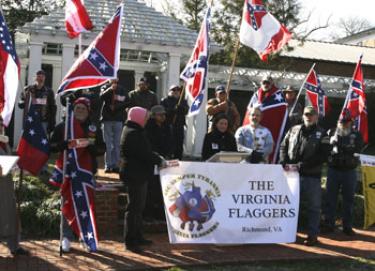
Image: Virginia Flaggers rally in January 2012 at Hopkins Green in Lexington to call for the defeat of Mayor Mimi Elrod. Image via thenews-gazette.com.

“Sponge, load, fire.”
Yesterday the Civil War Monitor presented another segment in the magazine’s “Voice from the Past” series, this one highlighting the account of Samuel Dana Greene, Monitor‘s executive officer, who commanded in that ship’s turret until forced to take over command of the ship when his captain, John L. Worden, was temporarily blinded by a shot from C.S.S. Virginia.
What follows here is another account of the action, this one from the Acting Chief Engineer of the Confederate ironclad, Henry Ashton Ramsay (1835-1916). Ramsay’s perspective on the action is unique; he probably knew the ship better than anyone else aboard, have spent most of the previous three years operating, maintaining, repairing and rebuilding the ship’s machinery. He’d joined U.S.S. Merrimac as Second Assistant Engineer at Panama in 1859, and sailed with her around Cape Horn. During this passage he reported to Merrimac‘s Chief Engineer, Alban C. Stimers. Engineer Stimers would later assist John Ericsson in constructing Monitor, and would serve as that ship’s Chief Engineer during the Battle of Hampton Roads.
Upon Merrimac‘s return to Norfolk, her engines were condemned and the ship laid up. There she remained until the spring of 1861, when she was burned to the waterline during the evacuation of the Navy Yard. When the war came, Ramsay cast his lot with the Confederacy, and soon found himself in Norfolk, working to convert the burned-out hull of Merrimac into a casemate ironclad.
While steaming out into Hampton Roads on the morning of March 8, Flag Officer Franklin Buchanan, commander of the rebuilt ironclad, now rechristened Virginia, called Ramsey up to the pilothouse and asked him how secure the ship’s machinery was in the event of a hard collision. When Ramsay assured him that the boilers and engine well-braced, Buchanan replied, “I am going to ram the Cumberland.” Fifty years later, in an article for Harper’s Weekly, Ramsay described what happened next:
The crux of what followed was down in the engine room. Two gongs, the signal to stop, were quickly followed by three, the signal to reverse. There was an ominous pause, then a crash, shaking us all off our feet. The engines labored. The vessel was shaken in every fiber. Our bow was visibly depressed. We seemed to be bearing down with a weight on our prow. Thud, thud, thud, came the rain of shot on our shield from the double-decked battery of the Congress. There was a terrible crash in the fire-room. For a moment we thought one of the boilers had burst. No, it was the explosion of a shell in our stack. Was anyone hit? No, thank God. The firemen had been warned to keep away from the up-take, so the fragments of shell fell harmlessly on the iron floor-plates.
We had rushed on the doomed ship, relentless as fate, crashing through her barricade of heavy spars and torpedo fenders, striking her below her starboard fore-chains and crushing far into her. For a moment the whole weight of her hung on our prow and threatened to carry us down with her, the return wave of the collision curling up into our bow port.
The Cumberland began to sink slowly, bow first, but continued to fight desperately for the forty minutes that elapsed after her doom was sealed, during which we were engaged with both the Cumberland and the Congress, being right between them.
We had left our cast-iron beak in the side of the Cumberland. Like the wasp we could sting but once, leaving the sting in the wound.
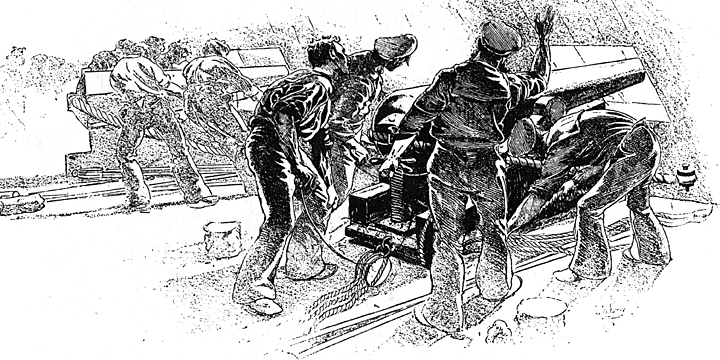
Our smoke-stack was riddled, our flag was shot down several times and was finally secured to a rent in the stack. On our gun-deck the men were fighting like demons. There was no thought or time for the wounded and dying as they tugged away at their guns, training and sighting their pieces while the orders rang out: “Sponge, load, fire.”
Virginia pulls away from U.S.S. Congress after setting her afire, March 8, 1862. Painting by Tom Freeman.
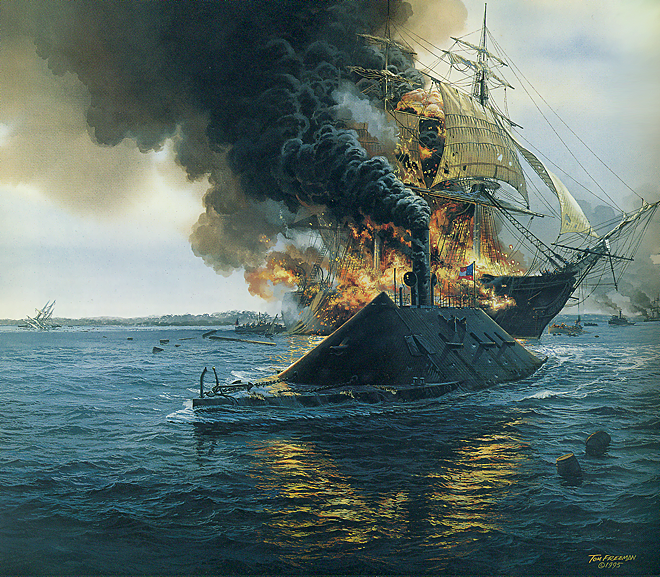
Virginia‘s score for the day included U.S.S. Cumberland, sunk, and Congress, abandoned and fully ablaze. Two more Federal vessels, St. Lawrence and Roanoke, had grounded themselves in trying to escape the guns of the ironclad. U.S.S. Minnesota had moved into shallow water where Virginia could not pursue, so the Confederate ironclad hauled off to her mooring at at Sewall’s Point. Ramsay continues:
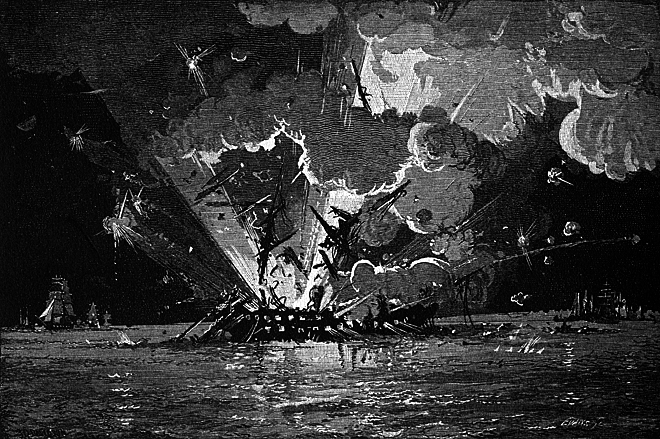
All the evening we stood on deck watching the brilliant display of the burning [U.S.S. Congress]. Every part of her was on fire at the same time, the red-tongued flames running up shrouds, masts, and stays, and extending out to the yard arms. She stood in bold relief against the black background, lighting up the Roads and reflecting her lurid lights on the bosom of the now placid and hushed waters. Every now and then the flames would reach one of the loaded cannon and a shell would hiss at random through the darkness. About midnight came the grand finale. The magazines exploded, shooting up a huge column of firebrands hundreds of feet in the air, and then the burning hulk burst asunder and melted into the waters, while the calm night spread her sable mantle over Hampton Roads.
U.S.S. Congress explodes around midnight on the night of March 8-9, 1862. Battles and Leaders.The Monitor arrived during the evening and anchored under the stern of the Minnesota, her lighter draught enabling her to do so without danger. To us the ensuing engagement was in the nature of a surprise. If we had known we were to meet her we would at least have been supplied with a solid shot for our rifled guns. We might even have thought best to wait until our iron beak, lost in the side of the Cumberland, could be replaced. Buchanan was incapacitated by his wound and the command devolved upon Lieutenant Jones.
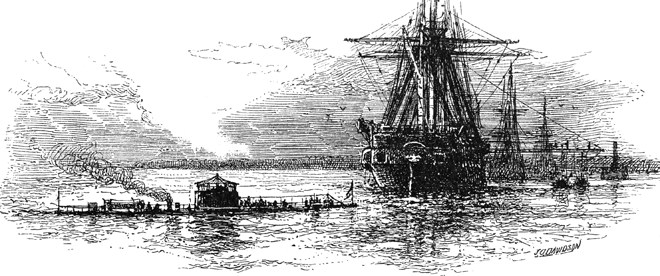
Monitor arrives alongside U.S.S. Minnesota, late on the evening of March 8, 1862. Battles and Leaders.We left our anchorage shortly before eight o’clock next morning and steamed across and up stream toward the Minnesota, thinking to make short work of her and soon to return with her colors trailing under ours. We approached her slowly, feeling our way cautiously along the edge of the channel, when suddenly, to our astonishment, a black object that looked like the historic description, “a barrel-head afloat with a cheese-box on top of it,” moved slowly out from under the Minnesota and boldly confronted us. It must be confessed that both ships were queer-looking craft, as grotesque to the eyes of the men of ’62 as they would appear to those of the present generation.
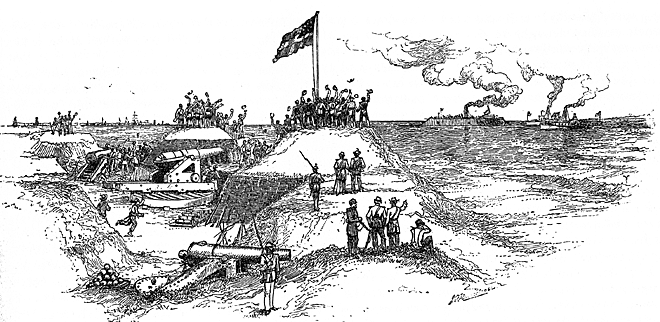
Virginia steams out into Hampton Roads, past the Confederate batteries on Craney’s Island. Battles & Leaders.And now the great fight was on, a fight the like of which the world had never seen. With the battle of yesterday old methods had passed away, and with them the experience of a thousand years “of battle and of breeze” was brought to naught. The books of all navies were burned with the Congress, by a conflagration as ruthless as the torch of Omar. A new leaf had been turned, a virgin page on which to transcribe and record the art of naval warfare.
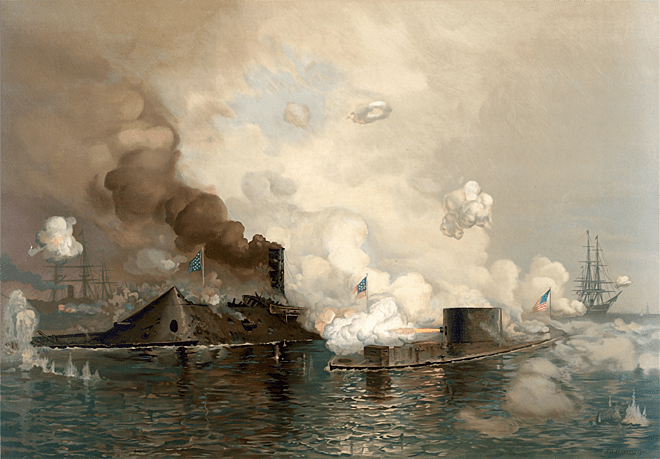
We hovered about each other in spirals, gradually contracting the circuits, until we were within point-blank range, but our shell glanced from the Monitor’s turret just as hers did from our sloping sides. For two hours the cannonade continued without perceptible damage to either of the combatants.
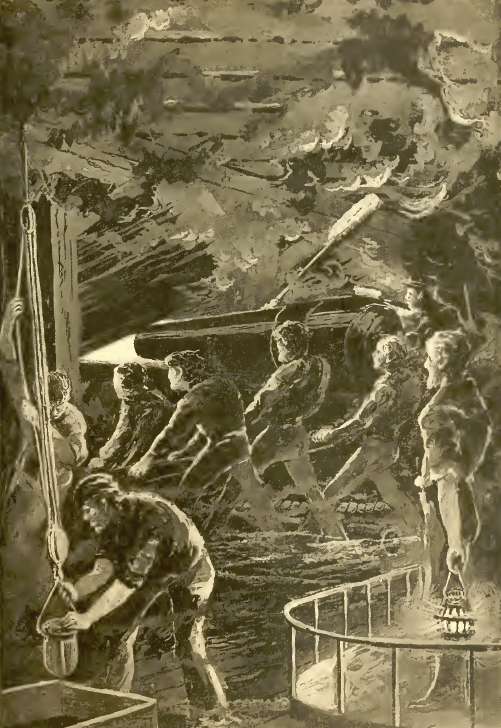
On our gun-deck all was bustle, smoke, grimy figures, and stern commands, while down in the engine and boiler rooms the sixteen furnaces were belching out fire and smoke, and the firemen standing in front of them, like so many gladiators, tugged away with devil’s-claw and slice-bar. inducing by their exertions more and more intense heat and combustion. The noise of the crackling, roaring fires, escaping steam, and the loud and labored pulsations of the engines, together with the roar of battle above and the thud and vibration of the huge masses of iron being hurled against us, altogether produced a scene and sound to be compared only with the poet’s picture of the lower regions.
Inside Virginia’s casemate during the action. From Blue Jackets of ’61: A History of the Navy in the War of Secession.And then an accident occurred that threatened our utter destruction. We stuck fast aground on a sandbar.
Our situation was critical. The Monitor could, at her leisure, come close up to us and yet be out of our reach, owing to an inability to deflect our guns. In she came and began to sound every chink in our armor–every one but that which was actually vulnerable, had she known it.
The coal consumption of the two days’ fight had lightened our prow until our unprotected submerged deck was almost awash. The armor on our sides below the water-line had not been extended but about three feet owing to our hasty departure before the work was finished. Lightened as we were, these exposed portions rendered us no longer an ironclad, and the Monitor might have pierced us between wind and water had she depressed her guns.
Fearing that she might discover our vulnerable “heel of Achilles,” while she had us “in chancery,” we had to take all chances. We lashed down the safety valves, heaped quick-burning combustibles into the already raging fires, and brought the boilers to a pressure that would have been unsafe under ordinary circumstances. The propeller churned the mud and water furiously, but the ship did not stir. We piled on oiled cotton waste, splints of wood, anything that would burn faster than coal. It seemed impossible the boilers could long stand the pressure we were crowding upon them. Just as we were beginning to despair there was a perceptible movement, and the [Virginia] slowly dragged herself off the shoal by main strength. We were saved.
Before our adversary observed we were again afloat we made a dash for her, catching her quite unprepared, and tried to ram her, but our commander was dubious about the result of a collision without our iron-shod beak and gave the signal to reverse the engines long before we reached the Monitor. As a result I did not feel the slightest shock down in the engine-room, though we struck her fairly enough.
1886 chromolithograph of the Battle of Hampton Roads, by J. O. Davidson.The carpenter reported that the effect was to spring a leak forward. Lieutenant Jones sent for me and asked me about it.
“It is impossible we can be making much water,” I replied,” for the skin of the vessel is plainly visible in the crank-pits.”
A second time he sent for me and asked if we were making any water in the engine room.
“With the two large Worthington pumps, beside the bilge injections, we could keep her afloat for hours, even with a ten-inch shell in her hull.” I assured him, repeating that there was no water in the engine and boiler rooms.
We glided past, leaving the Monitor unscathed, but got between her and the Minnesota and opened fire on the latter. The Monitor gallantly rushed to her rescue, passing so close under our submerged stern that she almost snapped off our propeller. As she was passing, so near that we could have leaped aboard her, Lieutenant Wood trained the stern-gun on her when she was only twenty yards from its muzzle and delivered a rifle-pointed shell which dislodged the iron logs sheltering the Monitor’s conning tower, carrying away the steering-gear and signal apparatus, and blinding Captain Worden. It was a mistake to place the conning tower so far from the turret and the vitals of the ship. Since that time it has been located over the turret. The Monitor’s turret was a death-trap. It was only twenty feet in diameter, and every shot knocked off bolt-heads and sent them flying against the gunners. If one of them barely touched the side of the turret, he would be stunned and momentarily paralyzed. Lieutenant Greene had been taken below in a dazed condition and never fully recovered from the effects. One of the port shutters had been jammed, putting a gun out of commission, and there was nothing for the Monitor to do but to retreat and to leave the Minnesota to her fate.
Captain Van Brunt, of the latter vessel, thought he was now doomed and was preparing to fire his ship when he saw the [Virginia] also withdrawing forward Norfolk.
It was at this juncture that Lieutenant Jones had sent for me and said: “The pilots will not place us nearer to the Minnesota and we cannot afford to run the risk of getting aground again. I am going to haul off under the guns of Sewall’s Point and renew the attack on the rise of the tide. Bank your fires and make any necessary adjustments to the machinery, but be prepared to start up again later in the afternoon.”
I went below to comply with his instructions, and later was astonished to hear cheering. Rushing on deck I found we were passing Craney Island on our way to Norfolk, and were being cheered by the soldiers of the battery.
Our captain had consulted with some of his lieutenants, and explained afterward that as the Monitor had proved herself so formidable an adversary he had thought best to get a supply of solid shot, have the prow replaced, the port shutters put on, the armor belt extended below water, and the guns whose muzzles had been shot away replaced, and then renew the engagement with every chance of victory. I remember feeling as if a wet blanket had been thrown over me. His reasoning was doubtless good, but it ignored the moral effect of leaving the Roads without forcing the Minnesota to surrender.
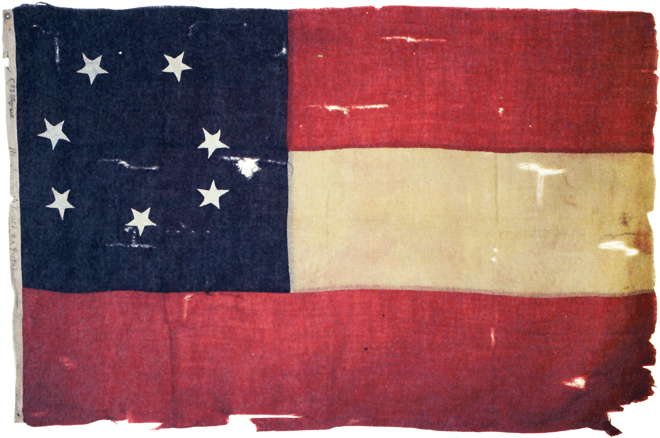
One of C.S.S. Virginia’s ensigns. This ensign was reportedly replaced with a variant with 11 stars during the March 9, 1862 action against U.S.S. Monitor. Time-Life, Arms and Equipment of the Confederacy.As the [Virginia] passed up the river, trailing the ensign of the Congress under the stars and bars, she received a tremendous ovation from the crowds that lined the shores, while hundreds of small boats, gay with flags and bunting, converted our course into a triumphal procession.
We went into dry-dock that very afternoon, and in about three weeks were ready to renew the battle upon more advantageous terms, but the Monitor, though reinforced by two other ironclads, the Galena and the Naugatuck, and every available vessel of the United States Navy, was under orders from Washington to refuse our challenge and bottle us up in the Roads. This strategy filled us with rage and dismay, but it proved very effective.
____________






 Dead Confederates, A Civil War Era Blog
6 comments