Battle of Galveston Weekend, 2012

This weekend is the annual commemoration of the Battle of Galveston, in which that city was retaken by the Confederates on New Year’s Day, 1863. The events held were similar to last year, which I blogged about then. I don’t have any long-winded commentary about today’s event, but I do want to extend my thanks to blogger and author Jim Schmidt and Hood’s Texas Brigade Association officer Rob Jones, for making it a memorable outing. Thanks, gentlemen!
More photos after the jump:
Virginians at Gettysburg, Fifty Years On

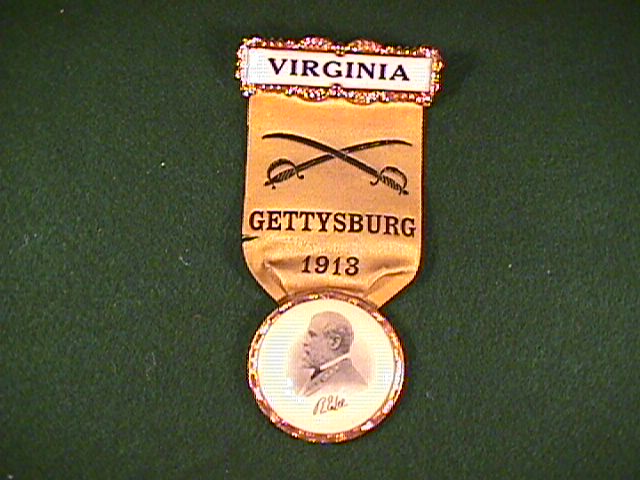
 Three unidentified Confederate veterans at the Gettysburg reunion, 1913. The event, held between June 29 and July 4, 1913, the 50th anniversary of the battle, was the largest Civil War reunion ever held, with over 50,000 veterans in attendance. These three unidentified Virginians were among the approximately 8,750 former Confederates at the event. Each wears a ribbon (long, with fringed end) marked “R. E. Lee Camp / No. 3 / Hampton, Va.” Each also wears a reunion badge similar to this one, though possibly with stacked rifles in place of the cavalry’s crossed sabres. The man at center, directly facing the camera, wears a single metallic bar on each collar, while the one at right wears two stars. These correspond, respectively, to Confederate officer ranks of Second Lieutenant and Lieutenant Colonel; do these indicate wartime ranks, or perhaps posts within the UCV? I don’t know. The two men at right also appear to wear the Southern Cross of Honor on their lapels, presented to veterans by the UDC. Photo by Harris & Ewing, via Library of Congress.
_____________

Hey, I Know that Guy. . . .
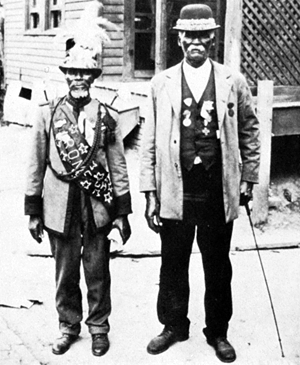 While looking for something else, I came across this photo of Steve Perry, a.k.a. “Uncle Steve Eberhart,” and another, unidentified man at a Confederate reunion in Houston, Texas. The image is undated, but I believe it to be from the time of the big United Confederate Veterans reunion at Houston in October 1920. Although Perry appeared as “Uncle Steve Eberhart” at reunion activities for more than 20 years, his costume here closely matches that worn in photographs of him like this one, appearing in a 1922 history of Rome and Floyd County, Georgia. In that book, Perry is quoted as saying about the 1920 Houston reunion,
I want to thank the good white people of Rome for sending me to Texas to the Old Soldiers’ Reunion. I am thankful. I shall ever remain in my place, and be obedient to all the white people. I pray that the angels may guard the homes of all Rome, and the light of God shine upon them. I will now give you a rest until the reunion next year, if the Lord lets me live to see it. Your humble servant. Steve Eberhart.
As I’ve said before, such framing is painful to modern ears, but it reflects the difficult line African Americans had to tread not so many generations ago. It makes clear how these men, even as they swapped old tales and enjoyed themselves with the white veterans, were also expected to reinforce specific, stereotyped roles of African Americans in the Jim Crow South — obsequious, grateful, and non-threatening to the status quo antebellum. It’s a difficult, multi-layered dynamic that defies simple tropes of egalitarian patriotism.
_______________
Image credited to Houston Metropolitan Research Center, Houston Public Library.

Diamonds are a Trooper’s Best Friend
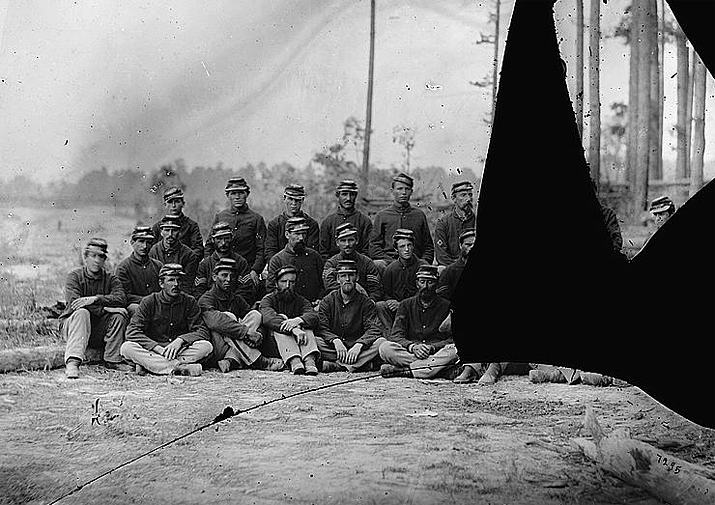
The historic photo blog Shorpy put up an image Sunday of Company C, 1st Massachusetts Cavalry. The original image, on a broken glass plate negative, is from the Library of Congress. It’s identified as “Petersburg, Virginia. Company C, 1st Massachusetts Cavalry,” and is one of four images (others here, here and here) taken of this unit in August 1864. Shorpy has a lot of CW images on the site.
One of the neat things about Shorpy is that it offers images in high resolution, allowing users to pick out all sorts of detail. In this case, I noticed the man seated in the back row, next to the break in the plate. On the sleeve of his sack coat he wears a single diamond, properly termed a lozenge, where the chevrons would be — like that of a first sergeant, but without the stripes. I know that cavalry units had designations that infantry and artillery units didn’t — farriers, saddlers, etc. — but the chevrons I’ve seen with those ranks all carried stripes and (I think) weren’t introduced as having distinct insignia until sometime after the war.
Here is a closeup of the man in question, along with a another closeup of the same man from this image (standing, far left), labeled as “Petersburg, Va. Commissioned and noncommissioned officers of Cos. C and D, 1st Massachusetts Cavalry”:

So what’s a solitary diamond signify?
The Angry Politics of Confederate Heritage

Later this evening the famous Iowa caucuses will be held, the first major event of the 2012 presidential primary season. Over at the Civil War Monitor‘s Front Line blog, I take a look at how Confederate heritage advocates make their mark on the current political landscape, and how well-meaning candidates often find themselves caught between two difficult choices when forced to commit themselves on divisive symbols like the Confederate Battle Flag.
_______________
Image: The secessionist League of the South’s endorsement of Rick Perry for Texas Lieutenant Governor in 1998, describing him as “a member of the Sons of Confederate Veterans.” In 2011, Perry’s spokesperson stated the he had never “joined that group nor has he ever paid any dues to it.” Somebody’s fibbin’. Via Salon.com.

“Amanda” Sure Gets Around. . . .
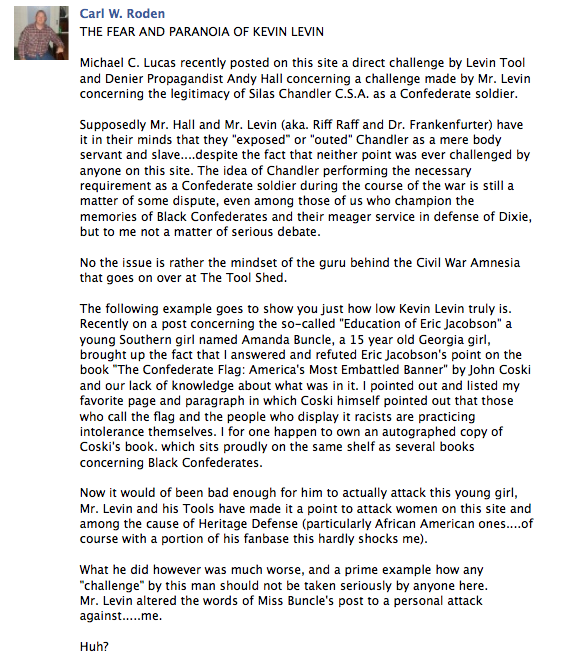
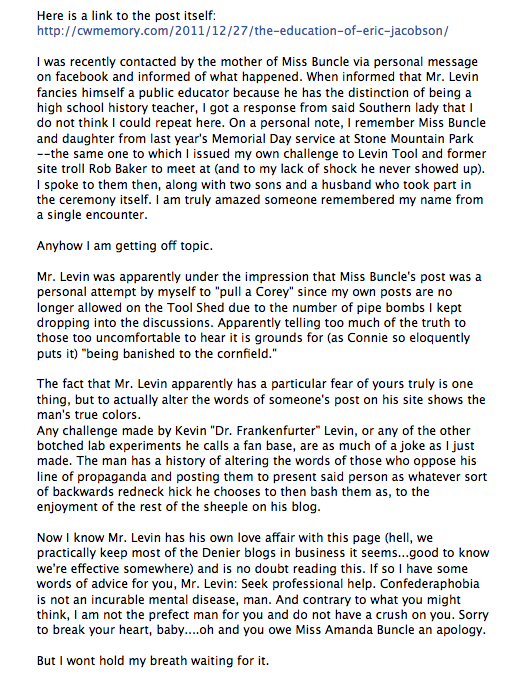
Over at Civil War Memory, Kevin addresses a post at SHPG by Carl Roden, taking Kevin to task for supposedly editing the comment on his blog made by one “Amanda Buncle, a 15 year old Georgia girl.” The Facebook post has been taken down (surprise!), but Kevin’s put up screen captures here and here. Kevin admits editing the comment, saying “The last thing I want to do is alienate a young adult who expresses an interest in American history. . . .With this in mind I want to offer a sincere apology to young Amanda. I encourage you to share your ideas on this site in the future if you are moved to do so.” Then, he goes in for the kill:
Two things before I close: First, let me suggest that you change your email identification to something other than dixibytch. It is not fitting for a young Georgia girl. And I wonder if you can explain why your comment and those of Mr. Roden, who has been banned from this site, have the same IP Address? I found it strange that your first and only comment on this blog, which references Mr. Roden specifically, include the same IP address.
As it happens, a few months back I also got a comment posted from someone giving a return address of dixiebytch95-at-yahoo-dot-com, also with an IP address identical to the one Carl Roden used before he was blocked from commenting here. Because Roden had been previously blocked from commenting here, it went directly into the spam filter, and never appeared online. But I did keep a copy. It begins:
My name isn’t important, but Amanda will do. I read your stuff on Carl Roden and I have some really interesting details about Mr. Roden from personal dealings I have had. I think you should know what you’re dealing with exactly. Believe me when I say he’s not somebody you want to just look the other way with. In fact I think he may be among the most radical and dangerous folks on that site you mentioned. I went there and—wow its pretty far out there. I had to post under a different name and make a new profile to come here so I could tell you. Sorry I don’t really have an account. . . .
It goes on like that for another 1,650 words.
I won’t share the rest, but it concludes, “you also need to be careful.”
Get some professional help, Carl. You need it.
__________________





 Dead Confederates, A Civil War Era Blog


3 comments