“One of them was a better soldier than I was.”
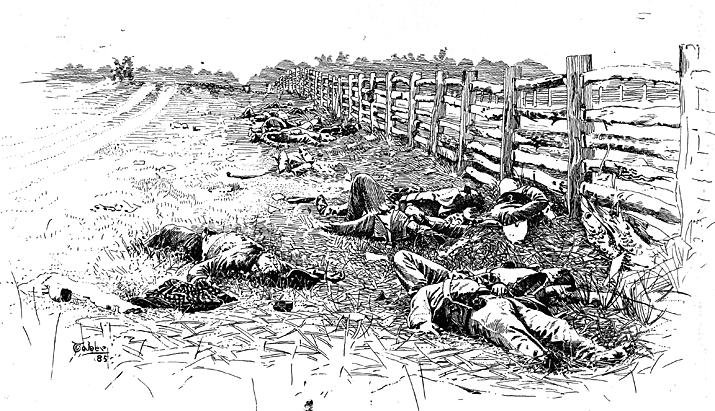
Private Lawrence Daffan, Co. G, Fourth Texas Infantry, at Sharpsburg (Antietam), September 17, 1862:
Then the Texas Brigade was ordered to charge; the enemy was on the opposite side of this stubblefield in the cornfield. As we passed where Lawton’s Brigade had stood, there was a complete line of dead Georgians as far as I could see. Just before we reached the cornfield General Hood rode up to Colonel [Benjamin F.] Carter, commanding the Fourth Texas Regiment (my regiment), and told him to front his regiment to the left and protect the flank. This he did and he made a charge directly to the west. We were stopped by a pike fenced on both sides. It would have been certain death to have climbed the fence.
Hays’ Louisiana Brigade had been in on our left, and had been driven out. Some of their men were with us at this fence. One of them was a better soldier than I was. I was lying on the ground shooting through the fence about the second rail; he stood up and shot right over the fence. He was shot through his left hand, and through the heart as he fell on me, dead. I pushed him off and saw that “Seventh Louisiana” was on his cap.
The Fifth [Texas], First [Texas] and Eighteenth Georgia, which was the balance of my brigade, went straight down into the cornfield, and when they struck this cornfield, the corn blades rose like a whirlwind, and the air was full.
Lawrence Daffan was seventeen years old at the time. He survived this fight, and the assault on Little Round Top at Gettysburg the following year, only to be captured in late 1863 and spend the remainder of the war as a prisoner at Rock Island, Illinois.
Quotation from Voices of the Civil War: Antietam (Time-Life, Inc., 1996). Image: “The Hagerstown Pike,” by Walton Taber.
Now We’re Finally Getting Somewhere.

Over the last few weeks there’s been a good bit of discussion about Ann DeWitt and her website on Black Confederates, particularly since the announcement of a new novel for young adults, written by her and Kevin M. Weeks, Entangled in Freedom. The discussion has been pretty volatile over at Levin’s place — who coulda’ seen that coming? — but I’ve tried to steer a little clear of criticizing Ms. DeWitt personally, because she seems a sincere, if ill-informed, advocate for the idea, and because at this point anything else will be perceived as “piling on.” But now, I think, she’s actually (and unwittingly) done us all a favor, by acknowledging explicitly what skeptics have been saying for a long time: that at the core of Black Confederate lies a definition of the word “soldier” that is so broad, so vague and nebulous that the word can be taken to mean virtually anything, and is applied to any person who had even the remotest connection to the Confederate army.
This morning, I noticed her project home page now opens with a definition:
Merriam Webster Dictionary defines a soldier as a militant leader, follower, or worker.
If we’re going to quote the dictionary, let’s be clear: she’s quoting the secondary, alternate definition. By citing it, Ms. DeWitt tacitly acknowledges that the primary definition of the word — “a: one engaged in military service and especially in the army b : an enlisted man or woman c : a skilled warrior” — does not generally apply, or is at least too narrow to describe, Black Confederates as she identifies them. It is not too much to say, I think, that in citing such a broad definition, Ms. DeWitt just knocked over the whole house of cards that comprises most of the “evidence” for Black Confederates.
There’s an old saying that a “gaffe” is what happens when a politician accidentally speaks the truth. This is a gaffe. This is the truth that forms the foundation of most Black Confederate advocacy. To qualify as a Black Confederate, one needs only to qualify as a follower or a worker. In short, the term “soldier” applies to anyone — enlisted man, musician, teamster, body servant, cook, hospital orderly, laundress, sutler, drover, laborer, anyone — involved with the army in any capacity.
A long time ago, I learned a rule that has stood me in good stead ever since: any time a writer or public speaker starts off his or her essay by quoting a definition from the dictionary, you can safely stop reading or listening, because nothing worthwhile or new is likely to follow. That’s still true, but it this case Ms. DeWitt’s use of the technique does do us all a genuine service, by admitting what Black Confederate skeptics have been saying all along — that the movement’s advocates are so loose with the their definitions, so willing to conflate service as a volunteer, enlisted soldier under arms with a slave’s compelled service as a cook and body servant to his owner and master, that the narratives they offer cannot stand close historiographical scrutiny at all. To borrow an analogy allegedly coined by Lincoln himself, Black Confederate advocacy is like shoveling fleas across the barnyard — you start with what seems to be a shovelful, but by the time you get to the other side, there’s very little actually there.
Update, August 22: I just noticed this on the website, as well:
Another challenge is the fact that 19th century CSA enlistment forms and pension applications did not include race, so unless all current SCV members come forward with more historical accounts, the world may never know the total number of African-Americans (Blacks) who served in any and all capacities of the American Civil War.
If I’m reading this correctly, Ms. DeWitt views any Confederate enlistment or pension document that doesn’t explicitly state otherwise to be potential evidence of a Black Confederate. Wowza!
Not sure what the call for “all current SCV members come forward with more historical accounts” means.
David Blight’s “The Civil War and Reconstruction Era, 1845-1877”
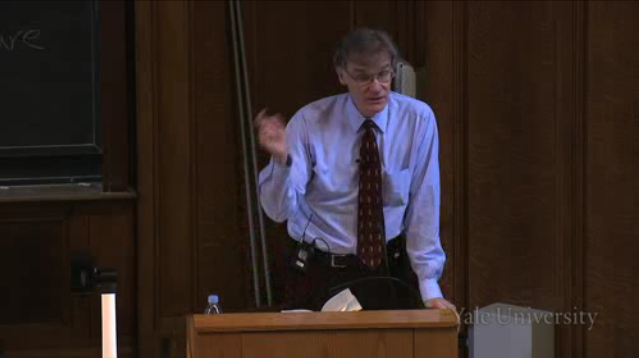
For anyone not familiar with the work of David Blight, you could do worse than to spend some time in the audience for his undergraduate course, recorded during the spring semester of 2008. I had some great instructors — Roger Bilstein, Maury Darst and Alex Pratt, I’m lookin’ at y’all — but none like this. If you watch the entire series, you won’t get academic credit, but you’ll sure get an education.
Site of Ft. Lawton PoW Camp in Georgia Found
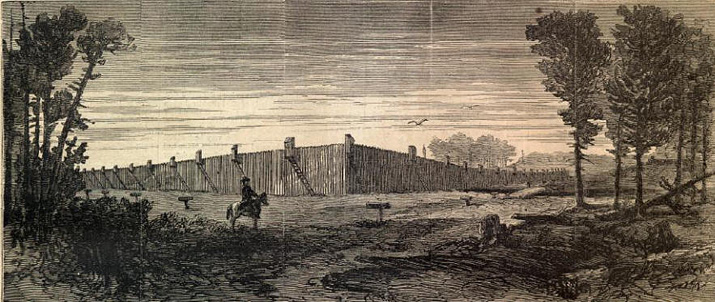
Via RCWEC Dummy Blog, archaeologists in Georgia have found the site of Camp Lawton, near the Georgia-South Carolina border:
Outside of scholars and Civil War buffs, few people have heard of the Confederacy’s Camp Lawton, which replaced the infamous and overcrowded Andersonville prison in fall 1864.
For nearly 150 years, its exact location was not known, the U.S. Fish and Wildlife Service, the Georgia Department of Natural Resources and Georgia Southern University said.
Georgia Southern students earlier this year began their search at a state park and federal fish hatchery for evidence of the wall timbers and interior buildings. . . .
Life at Lawton, described as “foul and fetid,” wasn’t much better than at Andersonville, with the exception of plentiful water from Magnolia Springs.
In its six weeks’ existence, between 725 and 1,330 men died at the prison camp. The 42-acre stockade held about 10,000 men before it was hastily closed when Union forces approached.
There are no photos of Lawton and few visual stockade details, although a Union mapmaker painted some important watercolors of the prison. He also kept a 5,000-page journal that detailed the misery at Camp Lawton, which was built to hold up to 40,000 prisoners.
“The weather has been rainy and cold at nights,” Pvt. Robert Knox Sneden, who was previously imprisoned at Andersonville, wrote in his diary on Nov. 1, 1864. “Many prisoners have died from exposure, as not more than half of us have any shelter but a blanket propped upon sticks. . . . Our rations have grown smaller in bulk too, and we have the same hunger as of old.”

Images: Exterior and interior views of the Lawton PoW compound, from the January 7, 1865 issue of Harper’s Weekly. Via SonoftheSouth.com.
“We are all officers now!”
Almost a hundred years ago, an old Texas veteran with the improbable name of Valerius Cincinnatus Giles passed away, leaving a sprawling, fragmentary memoir of his Civil War service. A half-century and a lot of editing later, it was finally compiled and published as Rags and Hope, a volume that has since become a classic among Civil War enlisted soldiers’ autobiographies. In closing Giles wrote:
It is over, and we are all officers now!
It’s General That and Colonel This
And Captain So and So.
There’s not a private in the list
No matter where you go.The men who fought the battles then,
Who burned the powder and lead,
And lived on hardtack made of beans
Are promoted now—or dead.
I suspect that, in writing these lines, Giles may have been thinking of a relative of mine, Lawrence Daffan. They must have known each other well. Both served in the Fourth Texas Infantry (Giles in Co. B; Daffan in Co. G), both were captured within a few weeks of each other in late 1863 during the Chattanooga Campaign, and both were active in veterans’ organizations after the war. Lawrence’s daughter Katie, who was prominent in UDC activities and served at the time as superintendent of the Confederate Woman’s Home in Austin, made a big show at Giles’ funeral of placing a small Confederate flag in the dead man’s hands. Cou’n Katie always did have a flair for dramatic gestures.
But beyond Giles’ amusing (and somewhat poignant) rhyme, Daffan is a perfect example of the pitfalls that await the modern researcher, and it underscores the importance of searching out contemporary records. In Lawrence Daffan’s case, everyone in the family “knew” that he had served as an officer, and even his obituary gave his name as “Col. L. A. Daffan.”
But he was never actually an officer. In fact, he wasn’t even a non-com. He was a buck private from the day he enlisted in March 1862 to the day he was released from the PoW camp at Rock Island, Illinois in 1865. He came to be known as “Colonel” Daffan because he was active in veterans’ groups after the war, and the UDC gave him that as an honorary title. He apparently liked it, and used it, to the extent that by the time he died in 1907, everyone in town as well as his family “knew” that he’d served as an officer. Lots of contemporary publications repeat the title. That was accepted as a given for over a century until, just recently, I bothered to look up his actual service record and discovered it wasn’t true.
This is important to would-be researchers because in Daffan’s case, because family oral tradition, Daffan’s obituary and other postwar sources all confirm one another, that he was a former officer. But he wasn’t, and one has to go back to the original records to determine that.
So genealogists and would-be historians, perform due diligence. Don’t assume you “know” something about your ancestor unless you can document it, because there’s a good chance you’re wrong. Do the research. Your work will be better for it when you do.
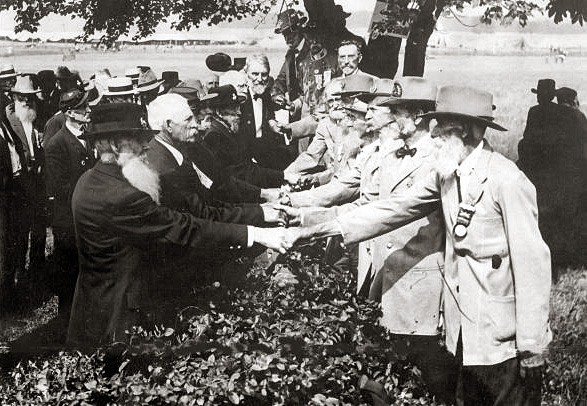
Image: Veterans of the Philadelphia Brigade Association and the Pickett’s Division Association shake hands across the stone wall over which they’d fought fifty years before, July 3, 1913. Pennsylvania State Archives.
In the Field with the Golden Horde
As some of you know, I spent last week blogging about the Civil War over at Ta-Nehisi Coates’ place at The Atlantic. It was a huge honor to be asked, and it’s gratifying that my efforts have been generally well received. That’s a vocal, well-read and scary-smart crowd over there, and they don’t suffer fools. You can read some of my longer posts here:
- Small Truth Papering Over a Big Lie — fisking the myth that very few Confederate soldiers had any connection to the institution of slavery.
- Susie King Taylor — on the autobiography of a slave girl who learned to read and write in Savannah, and went on to found schools in post-Civil War Georgia
- ‘We Have Received Provocation Enough’ — an expansion of my earlier piece on the seizure of slaves during the Gettysburg campaign
- Arlington, Bobby Lee, and the ‘Peculiar Institution’ — looking at the evidence presented in Elizabeth Brown Pryor’s masterful Reading the Man for Lee’s views on slavery.
Yep, there’s a theme there. Didn’t plan it that way. When TNC invited me to blog, I started thinking about Civil War topics that had been discussed on the blog before, that I thought hadn’t been fully explored, or that I thought I could address in a meaningful way. I also wanted to push back explicitly against some of what I believe are some of the more pernicious misunderstandings and myths about the war, just as I have tried to do here at Dead Confederates. Many of these revolve around the institution of slavery, and its complete infusion into all aspects of the South in the antebellum period, including the Confederate military and its leaders. My intent was to use the opportunity of guest-blogging at The Atlantic to say some things that, in my view, needed to be said. And I’m very grateful for the having been given the opportunity to do so.
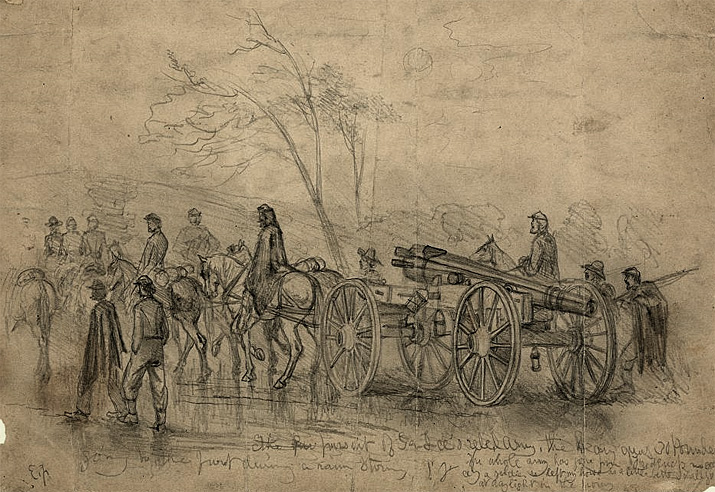
Image: “The pursuit of Gen. Lee’s rebel army. The heavy guns – 30 pounders – going to the front during a rain storm.” Library of Congress. I like this drawing for several reasons. First, it’s a relatively unusual depiction of soldiers on the march; most contemporary drawing either show soldiers in battle or in camp. Second, it shows soldiers in miserable weather, a driving rainstorm — note the reflections in the wet, muddy ground and the wind-whipped trees. (The soldiers look pretty damn miserable to me.) Third, it shows heavy artillery configured for transport, including having the gun tube shifted back on the carriage to provide a more stable center-of-gravity. All in all, it’s highly unusual image that depicts an all-too-common scene familiar to soldiers in both gray and blue.
That Was Nice to See

Had a great, if much too short, trip to Austin this weekend, and got to do some of the things I’ve come to enjoy there — breakfast at Star Seeds Cafe, browsing at the best toy store ever, and seeing some old (but never old) friends. I even found my new favorite place for Mongolian Beef. But I think the highlight was late Saturday afternoon, when I get to see for myself that that rancid old klansman’s name is gone — note the bare pole at right — from what is now officially termed Creekside Residence Hall.
Pontoon Bridge, Petersburg

A. R. Waud, “Ponton [sic.] Bridge on the Appomattox below Petersburg–Point of Rocks–Butler’s headquarters.” Library of Congress. Original here.
A Secessionist Surcharge?
 So over the weekend I picked up a second-hand set of Wiley’s Billy Yank and Johnny Reb. Classic works, ought to be on every CW reference shelf, yadayadayada. Johnny Reb was priced $2 more than Billy Yank, but I initially attributed that to inattention at the shop. No, turns out that the original list price had Johnny Reb $3 higher than its mate, $14.95 to $11.95. And even now on Amazon — which sells them in paperback for the same price, $17.12, the hardback list price for Johnny Reb is $1.60 more than Billy Yank. I have no idea why. There should be no significant difference in actual production cost; both books are almost exactly the same length, and have similar numbers of images. I’m guessing the pricing reflects either (a) a slightly stronger sales market for works about Confederate soldiers than Union, or (b) it’s yet another example of liberal, academic-type Yankee publishers wielding an economic cudgel to oppress God-fearing, hard-working, patriotic Southrons.




 Dead Confederates, A Civil War Era Blog
leave a comment