As many of you know, the race to be the next Governor of Texas is one of the most closely-watched in the country right now. Rick Perry, the longest-serving governor in the state’s history, has declined to run for another term. Although we’re still the midst of the party primaries right now, it’s looking like Attorney General Greg Abbott (R) will be squaring off against State Senator Wendy Davis (D) come November.
There haven’t been many competitive female candidates for governor in Texas over the decades. There was Ann Richards, of course (served 1991-95), and Miriam “Ma” Ferguson served two non-consecutive two-year terms in the 1920s and 1930s. Although Ma Ferguson was Texas’ first female governor, she’s not generally thought of as a trailblazer for women, having entered politics after her husband, Governor Jim Ferguson, was impeached and made ineligible to hold public office in the state. Ma campaigned explicitly on the platform of “two governors for the price of one.”
Then in the early 1970s there was Frances “Sissy” Farenthold, who twice sought the Democratic nomination for governor, but was defeated both times by Dolph Briscoe, who went on to win the general election. This was at a time when both the Democratic and Republican parties were in transition, and statewide office in Texas has increasingly been a Republican prerogative ever since.
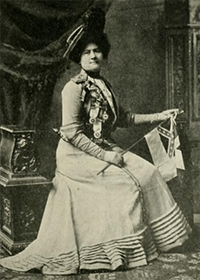 So with that as a little bit of background, I was surprised to learn not long ago that Katie Daffan (right, c. 1906) ran briefly for governor in 1930. Oddly, an important fact like that doesn’t appear in her Handbook of Texas biography. Cousin Katie, who I’ve mentioned frequently here, was my grandmother’s first cousin, although Katie was some years older. My mother knew Katie when she was a child and Katie was in her mid-fifties, about in the same period she ran for governor. My mother thought the world of Cousin Katie, who seems to have been a sort of Auntie Mame character to her, who took her on shopping trips to Houston, where Katie was literary editor for the Houston Chronicle at the time, and generally indulged her in all sorts of ways my grandmother wouldn’t. Katie apparently cut quite a figure; my mother recalled that Katie had apparently decided that the styles of her young adulthood in the 1890s were just about right, and wore them for the rest of her life. The dresses were not a particular challenge, because those could always be made up from old patterns, but she never could figure out where Katie got new, high-button shoes decades after they went out of style.
It is not an exaggeration to say that Katie Litty Daffan was the living embodiment of the the Lost Cause and Confederate memory in Texas in the first part of the Twentieth Century. She served five terms as president of the Texas Division of the United Daughters of the Confederacy, was Secretary (and only female member) of the Hood’s Texas Brigade Association, served for seven years as Superintendent of the Confederate Women’s Home in Austin. She enjoyed considerable success as an author and newspaper columnist, writing a textbook that was used for many years as a standard text in public schools across the state.
Katie was married, very briefly, in 1897 to Mann Trice, the Texas State Assistant Attorney General. That marriage folded within a few months, though, and Katie resumed using her maiden name, and never remarried. Katie died in 1951, at age 76, when she was hit by a car while walking home from an all-night diner at 4:30 in the morning. She walked in the middle of the street because there weren’t any streetlights and the sidewalks were broken and uneven.
At any rate, I came across this newspaper item outlining Katie’s platform for her campaign. It’s full of happy bromides that few would challenge — who doesn’t endorse Texas having “a good highway system”? — but it’s quite a collection of positions that certainly don’t line up easily with either of today’s two major parties. Dallas Morning News, March 25, 1930:

Formally announcing her candidacy for the Democratic nomination of Governor, Miss Katie Daffan of Ennis Monday made public the platform on which she will make the race. She stresses liberal State assistance for Confederate Veterans, their wives and widows and adequate appropriations for the Confederate and Confederate Women’s Home.
“I wish in the beginning,” Miss Daffan said, to express my appreciation and respect for the present executive of our State, Governor [Dan] Moody, and of those executives of our State, now living, who have preceded him in office. Each one has left the imprint of his service upon the heart of Texas. Each one has served our State to the highest point of his ability and strength and Texas praises, as she remembers, the loving service of each one.”
If elected Governor, Miss Daffan said she will do all possible to see that the laws are obeyed “in the spirit and in the letter.” She believes the Governor should not interefere with nor dictate to other officers of the government, but “attend very closely to the business of the office to which elected.”
To Help Education.
“Opportunity will be sought and sacrifice made, of necessary, to promote the substantial progress of education in our State,” the platform says, mentioning all phases of education and advocating increased pay for instructors. Conferences with the State Department of Education and the Texas State teachers’ Association would be invited to see how best the schools may be served. The best textbooks possible are advocated with special accuracy insisted on in matters of biography and history.
No religious tests shall be required of those seeking appointive office, Miss Daffan says, except the acknowledgement of the existence of a Supreme Being.
Miss Daffan would have laws passed making exempt from taxation farm homes, not to exceed $4,000 in value, and the home of every widow which does not exceed in value $5,000. She would favor a tax on luxuries, including tobacco, toilet articles and perfumes.
Labor would be given such legislation as is needful. For farm relief, laws are suggested requiring crop rotation and diversification.
Better price for farm products are advocated. Special care will be given toward a solution of this problem, Miss Daffan says.
Placing of the State prisons on a self-sustaining basis is urged, along with a “firm, impartial business management.” No stand is taken on any of the proposed prison sites, Miss Daffan saying her prison plank “will solve the problem, wherever our prison is located.”
Justice and mercy both will be invoked, the candidate says, in reference to the issuance of pardons.
Opposes State Road Bonds.
Miss Daffan does not favor the issuance of State highway bonds at this time, advocates a reduction in the tax on cars, the retention of the 3¢ gasoline tax, the barring of extra-wide vehicles from the roads and the steady building of a good highway system. She also urges especial attention to the mapping of airways and building of airports.
Establishment of more State parks, playgrounds and recreation centers is urged. An athletic commission is advocated, to serve without salary, to have general supervision over clean sports and games.
Assistance to World War veterans, wherever possible, is urged. Miss Daffan favors taking the best of care of those in various eleemosynary [charitable] institutions.
Miss Daffan closes her announcement by appealing to the women of the State to support her cause, so that she can aid in bettering conditions, and by appealing to men to vote for her, promising, with their assistance, to place Texas in the forefront of all States.
“We begin our journey forth with faith in our hearts,” Miss Daffan says in her closing paragraph, “and love combined with faith, was we approach our “lions of difficulty” we find them chained fast, unable to disturb or destroy. A voice in my heart calls, ‘Go on.’ It is a still, convincing, ever-present voice. It is too persistent to be set aside. I accept the call and offer myself, my service, my heart’s strength and life work to my native State, one and indivisible in the glory of its past and the greater glory of its present.”
Miss Daffan is president of the Texas Division, United Daughters of the Confederacy.

In the end, Katie didn’t file the paperwork for the Democratic primary, so her name never appeared on the ballot. There ended up being twelve candidates in the primary anyway, and Ross Sterling went on to win the general election that fall. He was succeeded two years later by — wait for it — Ma Ferguson again.
As far as I know, Katie never offered any specific reason for not following through on her announced run for Texas governor, choosing instead to publicly thank her friends and supporters once the filing deadline for the primary had passed and she was officially off the ballot, in early June. A bigger question, that I can’t answer, is why she announced for governor in the first place. It’s yet another curious story about Cousin Katie that leaves as many questions as it answers. Wherever she is, though, I’m pretty sure Katie’s still enjoying the attention.
________

 Larry Miggins (No. 4) playing opposite Jackie Robinson of the Montreal Royals, April 18, 1946.

 “His first time up, he grounded out,” Miggins recalled. “Then he hit a home run over the left field fence, which showed he was a pull hitter. His third time up, he dropped down a bunt and beat it out because I was playing back like the manager told me to do.
His fourth time up, he got another hit, and then he dropped another bunt in front of me, because I was still playing him back – which I never did again.”
For the day, Robinson had four hits in five trips with a homer, four runs scored, four runs batted in, two stolen bases and two forced balks in Montreal’s 14-1 win over Jersey City.
It was an auspicious debut in a career – and a life – that continues to amaze and inspire.
“Jackie Robinson led the league in hitting that year,” Miggins said. “Then he went to the Brooklyn Dodgers and was rookie of the year. He became the Most Valuable Player of the league, beat the Yankees in the World Series and went on to the Hall of Fame … “
At this point in the story, Miggins paused for dramatic effect – or, as it turns out, comic relief.
“And he was able to do all that because I played back and gave him two hits in that first game,” he said, breaking into laughter. “I got him off to a great start.”
“His first time up, he grounded out,” Miggins recalled. “Then he hit a home run over the left field fence, which showed he was a pull hitter. His third time up, he dropped down a bunt and beat it out because I was playing back like the manager told me to do.
His fourth time up, he got another hit, and then he dropped another bunt in front of me, because I was still playing him back – which I never did again.”
For the day, Robinson had four hits in five trips with a homer, four runs scored, four runs batted in, two stolen bases and two forced balks in Montreal’s 14-1 win over Jersey City.
It was an auspicious debut in a career – and a life – that continues to amaze and inspire.
“Jackie Robinson led the league in hitting that year,” Miggins said. “Then he went to the Brooklyn Dodgers and was rookie of the year. He became the Most Valuable Player of the league, beat the Yankees in the World Series and went on to the Hall of Fame … “
At this point in the story, Miggins paused for dramatic effect – or, as it turns out, comic relief.
“And he was able to do all that because I played back and gave him two hits in that first game,” he said, breaking into laughter. “I got him off to a great start.”

 Re-enactors fire a rifle salute to a tall ship on the St. Johns River as it passes by Fort Caroline during Sail Jacksonville in 2004. Via Jacksonville.com.





 The new issue of the Civil War Monitor




 Dead Confederates, A Civil War Era Blog

5 comments