C.S. Signal Corps Items Donated — Galveston
Forgot to post this — it’s a pretty big deal here locally. Galveston County Daily News, June 1, 2014:

_________

Canister!

Posts have been spare ’round these parts lately, in large part because I’ve been distracted by other things over the last few months. In addition to wrapping up the blockade running book, I’ve got some other projects going on that I’ve been focused on. One of the minor ones is reconstructing the sidewheel from the British paddle steamer Cornubia (above), that was a notable blockade runner on the Atlantic coast before being taken into the U.S. Navy and used as a gunboat on the blockade off Galveston. Cornubia was part of what Commodore Sands called “the closing act of the great rebellion.” More images of the wheel here. Hopefully this will end up with a digital model of the entire ship sometime down the road. Past projects include the runners Denbigh and Will o’ the Wisp, and the blockader Hatteras. More items that don’t warrant a full post:
- Cops in Cary, North Carolina are hot on the trail of a tagger who’s been writing “booger” all over town. Unnamed police sources, speaking on condition of anonymity, say Dr. Johnny Fever “is not a suspect at this time.”
- The white nationalist League of the South’s new “SECEDE!” billboard in Montgomery, Alabama was taken down by the billboard company after receiving complaints. League President Michael Hill, who recently called on “Mr. & Mrs. White Southerner” to take a stand against “blacks, Hispanics, Jews, etc.“, demands to know if Montgomery has become “Stalin’s Russia.” It fact, it’s quite the opposite — it’s the invisible hand of the free market, dumbass.
- Speaking of Southern nationalism, I see that Michael Cushman of the Southern Nationalist Network recently took the surname O’Neil. Congrats on the nuptials, Michael!
- NPR had a story the other day on why it’s so hard to cut the Pentagon budget. As it turns out, it’s not always the generals that are the problem.
- A candidate for governor in Illinois is taking heat because he shook hands with a man wearing a jacket with a Confederate flag patch on the sleeve. That’s about as dumb as the time someone from Buzzfeed tweeted that Mitt Romney’s motorcade drove past a Confederate flag. Get some perspective, folks.
- Over at Defending the Heritage, Robert Mestas calls on Lexington to “bring back the flags” with an historic “then and now” image of the town that includes no Confederate flags. Do’oh!
Got anything else? Put it in the comments below.
_____________
D-Day, Sixth of June
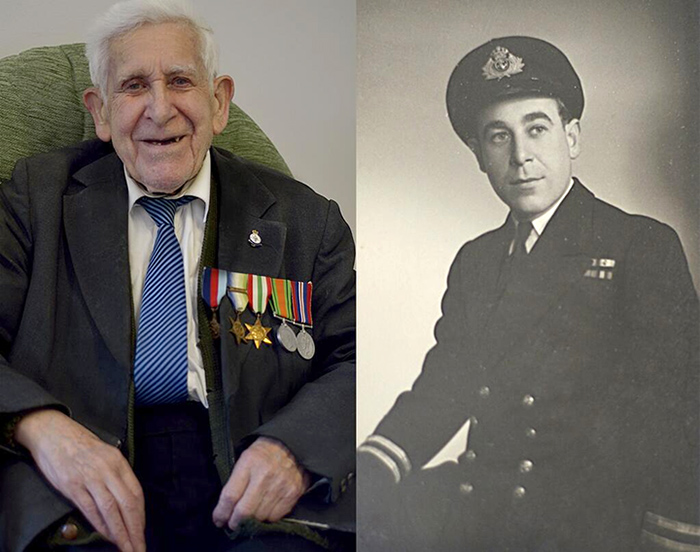 An 89-year-old World War II veteran reported missing Thursday evening actually fled his nursing home in England to attend the 70th anniversary of D-Day in Normandy on Friday.
The Pines care home in Hove, England, where Bernard Jordan has been living with his wife since January, telephoned police Thursday after realizing Jordan hadn’t returned from his morning walk, according to local media. Police said the veteran, who was also a former mayor of Hove, left wearing his war medals concealed beneath a gray jacket.
A younger veteran eventually telephoned Jordan’s nursing home to report Bernard was safe and they were staying together in a hotel in Ouistreham, Normandy. The two had met on a bus en route to the ceremonies in northern France.
A police spokesman told reporters: “We have spoken to the veteran who called the home today and are satisfied that the pensioner is fine and that his friends are going to ensure he gets back to Hove safely over the next couple of days after the D-Day celebrations finish.”
“Once the pensioner is home we will go and have a chat with him to check he is OK,” the spokesman said, according to the BBC.
Earlier reports said the veteran was banned from traveling to Normandy to attend the ceremonies, but a representative for the nursing home said that was “definitely not the case,” according the Press Association.
An 89-year-old World War II veteran reported missing Thursday evening actually fled his nursing home in England to attend the 70th anniversary of D-Day in Normandy on Friday.
The Pines care home in Hove, England, where Bernard Jordan has been living with his wife since January, telephoned police Thursday after realizing Jordan hadn’t returned from his morning walk, according to local media. Police said the veteran, who was also a former mayor of Hove, left wearing his war medals concealed beneath a gray jacket.
A younger veteran eventually telephoned Jordan’s nursing home to report Bernard was safe and they were staying together in a hotel in Ouistreham, Normandy. The two had met on a bus en route to the ceremonies in northern France.
A police spokesman told reporters: “We have spoken to the veteran who called the home today and are satisfied that the pensioner is fine and that his friends are going to ensure he gets back to Hove safely over the next couple of days after the D-Day celebrations finish.”
“Once the pensioner is home we will go and have a chat with him to check he is OK,” the spokesman said, according to the BBC.
Earlier reports said the veteran was banned from traveling to Normandy to attend the ceremonies, but a representative for the nursing home said that was “definitely not the case,” according the Press Association.
________
Blockade Running Available for Kindle
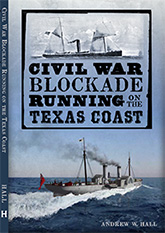
Civil War Blockade Running on the Texas Coast won’t be officially released for a few more days, but Amazon now has it available for order on Kindle, as well. Even more gooder, you can download a free sample immediately or use the “look inside” feature and read the e-edition of the first chapter and part of the second.
Too bad they cut off Chapter 2 just before the part where Seward makes an ugly, sloshy scene at the British ambassador’s dinner party. That was fun to write.
____________
Texas Navy Day, Surfside, Texas, September 19-20, 2014
 I’ve been asked to participate in the annual Texas Navy Day celebration at Surfside, Texas (just down the coast from Galveston) on Friday/Saturday, September 19-20. There will be a dinner at Stahlman Park on Friday evening, where I will tell the story of “The Steamboat Laura and the Coming of the Texas Revolution.” The venue is approximately perfect, given that those events happened at the mouth of the Brazos River, spittin’ distance from Surfside. There will be door prizes, live entertainment, and live and silent auctions. Proceeds go to the Fort Velasco Restoration Project. For tickets and information, call 979-233-7330 or e-mail dortha-at-fortvelasco-dot-org.
The main celebration takes place on Saturday, September 20, between 10 a.m. and 5 p.m. There will be costumed interpreters, heritage groups, vendors, period artillery and (maybe) things that go boom! Great fun will be had by all, and if you don’t have a good time, there’s probably something wrong with you.
__________
Image: Coffee mug by Zazzle user esmaxwell.
Frederick Douglass on Decoration Day, 1871
On Decoration Day, 1871, Frederick Douglass gave the following address at the monument to the Unknown Dead of the Civil War at Arlington National Cemetery. It is a short speech, but one of the best of its type I’ve ever encountered. I’ve posted it before, but it think it’s something worth re-reading and contemplating every Memorial Day.
The Unknown Loyal Dead
Arlington National Cemetery, Virginia, on Decoration Day, May 30, 1871Friends and Fellow Citizens:
Tarry here for a moment. My words shall be few and simple. The solemn rites of this hour and place call for no lengthened speech. There is, in the very air of this resting-ground of the unknown dead a silent, subtle and all-pervading eloquence, far more touching, impressive, and thrilling than living lips have ever uttered. Into the measureless depths of every loyal soul it is now whispering lessons of all that is precious, priceless, holiest, and most enduring in human existence.
Dark and sad will be the hour to this nation when it forgets to pay grateful homage to its greatest benefactors. The offering we bring to-day is due alike to the patriot soldiers dead and their noble comrades who still live; for, whether living or dead, whether in time or eternity, the loyal soldiers who imperiled all for country and freedom are one and inseparable.
Those unknown heroes whose whitened bones have been piously gathered here, and whose green graves we now strew with sweet and beautiful flowers, choice emblems alike of pure hearts and brave spirits, reached, in their glorious career that last highest point of nobleness beyond which human power cannot go. They died for their country.
No loftier tribute can be paid to the most illustrious of all the benefactors of mankind than we pay to these unrecognized soldiers when we write above their graves this shining epitaph.
When the dark and vengeful spirit of slavery, always ambitious, preferring to rule in hell than to serve in heaven, fired the Southern heart and stirred all the malign elements of discord, when our great Republic, the hope of freedom and self-government throughout the world, had reached the point of supreme peril, when the Union of these states was torn and rent asunder at the center, and the armies of a gigantic rebellion came forth with broad blades and bloody hands to destroy the very foundations of American society, the unknown braves who flung themselves into the yawning chasm, where cannon roared and bullets whistled, fought and fell. They died for their country.
We are sometimes asked, in the name of patriotism, to forget the merits of this fearful struggle, and to remember with equal admiration those who struck at the nation’s life and those who struck to save it, those who fought for slavery and those who fought for liberty and justice.
I am no minister of malice. I would not strike the fallen. I would not repel the repentant; but may my “right hand forget her cunning and my tongue cleave to the roof of my mouth,” if I forget the difference between the parties to hat terrible, protracted, and bloody conflict.
If we ought to forget a war which has filled our land with widows and orphans; which has made stumps of men of the very flower of our youth; which has sent them on the journey of life armless, legless, maimed and mutilated; which has piled up a debt heavier than a mountain of gold, swept uncounted thousands of men into bloody graves and planted agony at a million hearthstones — I say, if this war is to be forgotten, I ask, in the name of all things sacred, what shall men remember?
The essence and significance of our devotions here to-day are not to be found in the fact that the men whose remains fill these graves were brave in battle. If we met simply to show our sense of bravery, we should find enough on both sides to kindle admiration. In the raging storm of fire and blood, in the fierce torrent of shot and shell, of sword and bayonet, whether on foot or on horse, unflinching courage marked the rebel not less than the loyal soldier.
But we are not here to applaud manly courage, save as it has been displayed in a noble cause. We must never forget that victory to the rebellion meant death to the republic. We must never forget that the loyal soldiers who rest beneath this sod flung themselves between the nation and the nation’s destroyers. If today we have a country not boiling in an agony of blood, like France, if now we have a united country, no longer cursed by the hell-black system of human bondage, if the American name is no longer a by-word and a hissing to a mocking earth, if the star-spangled banner floats only over free American citizens in every quarter of the land, and our country has before it a long and glorious career of justice, liberty, and civilization, we are indebted to the unselfish devotion of the noble army who rest in these honored graves all around us.
______________
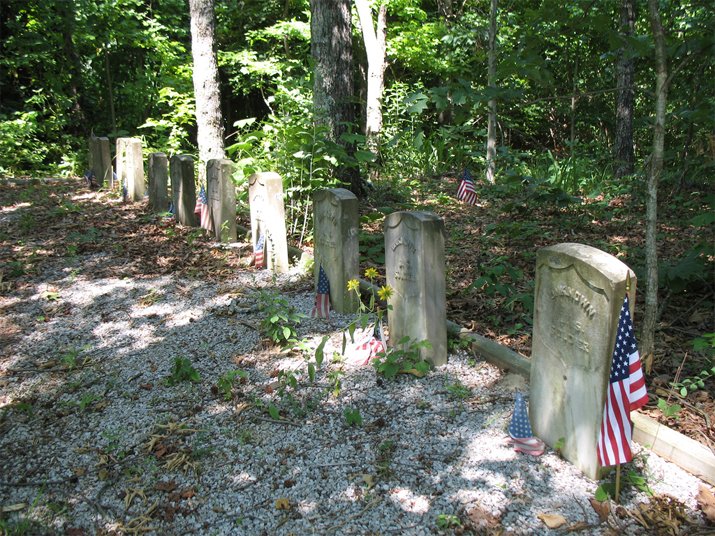
Image: Graves of nine unknown Federal soldiers in Pontotoc County, Mississippi. Photo by Flickr user NatalieMaynor, used under Creative Commons license. Text of Douglass speech from Philip S. Foner and Yuval Taylor, Frederick Douglass: Selected Speeches and Writings.

Decoration Day at Arlington, 1871
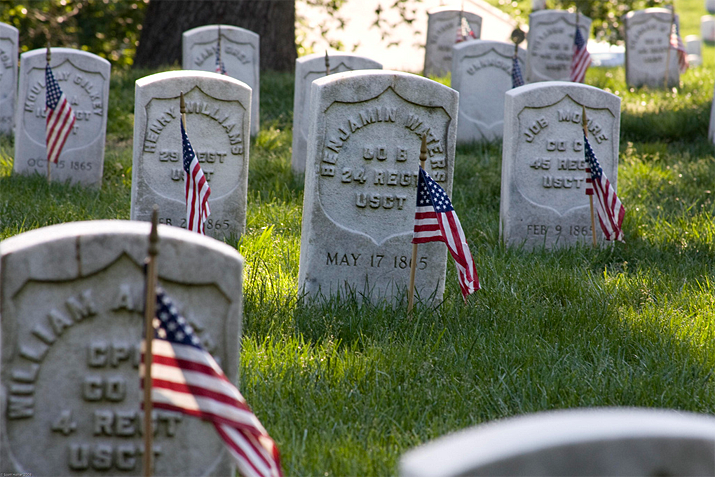
As many readers will know, the practice of setting aside a specific day to honor fallen soldiers sprung up spontaneously across the country, North and South, in the years following the Civil War. Over the years, “Decoration Day” events gradually coalesced around late May, particularly after 1868, when General John A. Logan, commander-in-chief of the Grand Army of the Republic, called for a day of remembrance on May 30 of that year. It was a date chosen specifically not to coincide with the anniversary of any major action of the war, to be an occasion in its own right. While Memorial Day is now observed nationwide, parallel observances throughout the South honor the Confederate dead, and still hold official or semi-official recognition by the former states of the Confederacy.
Recently while researching the life of a particular Union soldier, I came across a story from a black newspaper, the New Orleans Semi-Weekly Louisianan dated June 15, 1871. It describes an event that occurred at the then-newly-established Arlington National Cemetery. Like the U.S. Colored Troops who’d been denied a place in the grand victory parade in Washington in May 1865, the black veterans discovered that segregation and exclusion within the military continued even after death:
 The black soldiers’ graves were never moved; rather, the boundaries of Arlington were gradually expanded to encompass them, in what is now known as Section 27. Most of the graves, originally marked with simple wooden boards, were subsequently marked with proper headstones, though many are listed as “unknown.” In addition to the black Union soldiers interred there, roughly 3,800 civilians, mostly freedmen, lie there as well, many under stones with the simple, but profoundly important, designation of “citizen.” The remains of Confederate prisoners buried there were removed in the early 1900s to a new plot on the western edge of the cemetery complex, where the Confederate Monument would be dedicated in 1914.
Unfortunately, the more things change, the more. . . well, you know. In part because that segment of the cemetery began as a burial ground for blacks, prisoners and others of lesser status, the records for Section 27 are fragmentary. Further, Section 27 has — whether by design or happenstance — suffered an alarming amount of negligence and lack of attention over the years. The Army has promised, and continues to promise, that these problems will be corrected.
As Americans, North and South, we should all expect nothing less.
____________________________________
Images of Section 27, Arlington National Cemetery, © Scott Holter, all rights reserved. Used with permission. Thanks to Coatesian commenter KewHall (no relation) for the research tip. This post originally appeared here in December 2010.

Friday Night Concert: “The Brooklyn, Sloop-of-War”
One of the reasons I enjoy this album is because four of the thirteen songs on it are explicitly about events that happened in the Gulf of Mexico. The four songs are “The Fight of the Hatteras and Alabama,” “Farragut’s Ball,” “The Florida‘s Cruise,” and this one, “The Brooklyn, Sloop-of-War.” Four out of thirteen may not seem like a lot, but it’s more attention than the Gulf gets most of the time when talking about the naval side of the Civil War.
This particular song deals with Farragut’s passage of the forts below New Orleans in April 1862, but Brooklyn gave long service with the West Gulf Blockading Squadron during the war. She was the division flagship stationed off Galveston for a time, and in August 1864 led the Federal fleet when Farragut forced the entrance to Mobile Bay, ending Mobile’s time as a blockade-running port.
__________
2014 “Galveston Firsts” Menard Summer Lecture Series
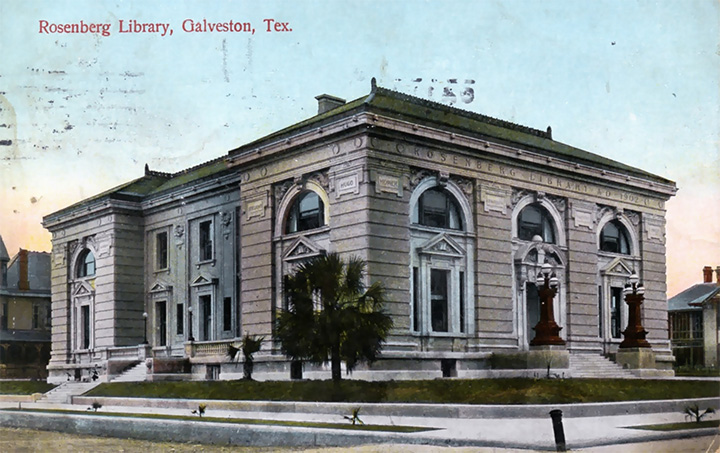
From my colleagues at the Galveston Historical Foundation:
___________
Juneteenth Marker to Be Unveiled
Next month, the Texas Historical Commission will unveil a state historical marker commemorating Juneteenth. It’s been a long time coming:
Thierry‘s point about placing the marker at the “most accurate, documented, historically significant venue” is well made. the location at 22nd Street and Strand is the former site of the Ostermann Building, which served as Granger’s headquarters. Backgrounder on the competing traditions on Juneteenth in Galveston here.
__________





 Dead Confederates, A Civil War Era Blog
1 comment