Scotland Votes

Russell Cheyne/Reuters

Cuckoo’s Bakery in Edinburgh has been tracking support for Scots independence based on sales of cupcakes emblazoned with Scots and Union flags (above). As of today, the “no” vote is running about four points ahead of the “yes,” a figure that seems to be reflected in actual polling. By this time tomorrow, we’ll know how accurate both the bakery and the polls are.
Regardless of the outcome, it’s important to note that the Scots have not gone about achieving independence by laying siege to the Royal Navy base at Faslane.
Having most of my own lineage come from every part of Great Britain, I have no great stake in this fight, or notion as to whether an independent Scotland is a good thing or not. But if independence encourages sartorial atrocities such as this, it’s just not worth it. No one needs that.
______________

Freedmen’s Patrol Goes Looking for a “Good” Slaveholder
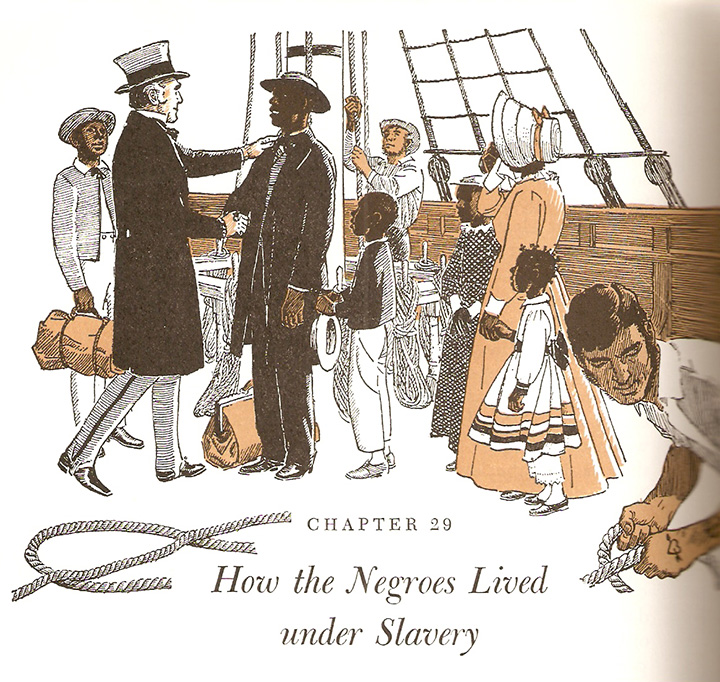
Building off a post by Kevin Levin, one of the best (and least-heralded) CW blogs out there thoroughly dismantles the notion of a “good” slaveholder, making it clear that even masters who saw themselves as benevolent patriarchs relied on the threat of intimidation and violence to maintain their authority — and did not hesitate to use it when they needed to. (You know, benevolent patriarchs like Bobby Lee.)
___________

Finding Franklin

Big news in the nautical archaeology world — last week a team from Parks Canada discovered one of the ships of the famous Franklin Expedition of 1845-48. The expedition, that originally set out to find the fabled Northwest Passage across the top of the North American continent, vanished without a trace and became one of the enduring mysteries of maritime history.
Good stuff. Nothing happens in a vacuum, of course, and the reality is that Parks Canada, the arm of the Canadian federal government that does historical archaeology work (similar to NPS or NOAA here in the U.S.), has gone through multiple rounds of deep budget cuts:
Many of Parks Canada’s remaining resources re-directed toward finding evidence of the Franklin Expedition — a worthy goal, for sure, but debatable given the severely-limited resources needed elsewhere. Harper’s reference to “Canada’s Arctic sovereignty” is very intentional, because his government is pushing hard for territorial claims in the Arctic for drilling. The discovery of one of Franklin’s ships, one that is older than the creation of Canada itself, provides a nice historical exclamation point for the prime minister’s scramble for Arctic oil and gas.
Still, it’s an amazing find, and kudos to the Parks Canada team that pulled it off.
_____________
Update: Here’s a Slate story from May that provides background on Harper’s specific interest in finding remains of the Franklin Expedition.
“There’s a girl from Tennessee, she’s long and she’s tall. . . .”
Many years ago, Alan Lomax recorded the legend of the Wabash Cannonball, a sort of Flying Dutchman of American railroading:
This particular video is a wonderful bit of stagecraft, opening with a 1940 clip of Roy Acuff performing the song in the film Grand Old Opry, which transitions into a video clip from the Opry in 1973, which then transitions into a live performance, led by Ketch Secor and Old Crow Medicine Show. Grand Ole Opry members joining them on stage include Bobby Osborne, Marty Stuart and Connie Smith, Clint Black, Ricky Skaggs, and Riders in the Sky, among many others.
Lotta talent on that stage, right there.
__________
Friday Night Concert: “Orange Blossom Special” with Annie Staninec
Denbigh Arrives at Galveston

August 25, 2014 makes the 150th anniversary of the blockade runner Denbigh‘s first arrival at Galveston. The little British paddle steamer had made five runs into Mobile before that post was closed off by the Union fleet at the Battle of Mobile Bay on August 5; she would go on to make a total of six successful runs in and out of Galveston during the remaining few months of the war.
____________
An Unlikely Blockade Runner, cont.
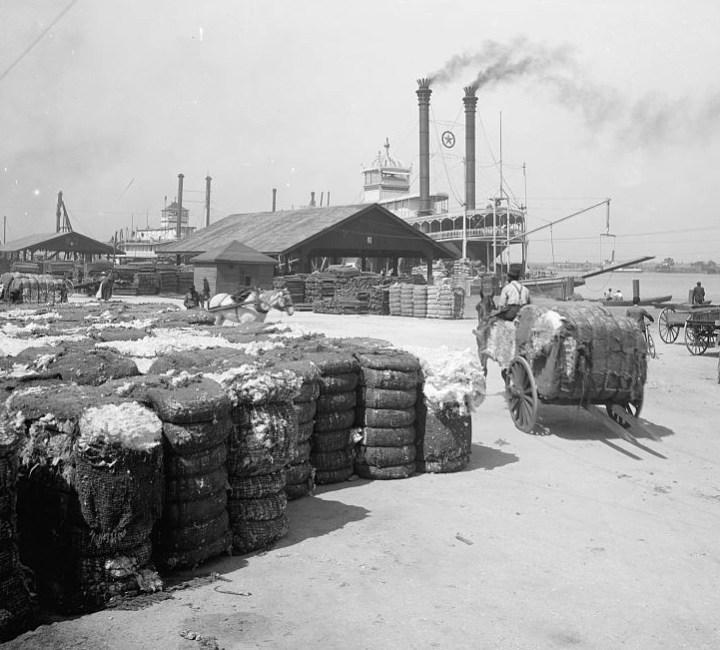
Riverboats at the cotton docks at Mobile, c. 1900. The scene in 1863 would not have been much different, when boats like these were pressed into service as blockade runners. LoC image.
In the comments on my recent post about the river steamboat William Bagaley attempting to run the blockade, a regular reader asks:
That’s a great question, and it underscores that in the last post I neglected to explain very well why Bagaley would be considered an unlikely candidate for a runner in the first place. Let me see if I can do that now.
Riverboats like William Bagaley were, by the 1850s, a very distinct and specialized type of vessel, optimized for work on the Western Rivers (i.e., the Mississippi, Ohio, Missouri and their tributaries). In the arrangement of their machinery, and particularly their hull construction, they were very ill-suited to make long passages on open water. They were generally of very shallow draft, and their hulls were of light construction, braced with wooden trusses and iron rods. The main deck of a fully-loaded riverboat was often barely above the level of the water. Western Rivers boats were generally built without external keels and, having lots of superstructure, would be prone to drift off to leeward in a strong wind. They could manage well enough on a calm day with a flat sea, but anything more unsettled than that could be a serious problem.
Not that riverboats didn’t ever make a passage in the open Gulf of Mexico; many of them did make relatively short runs along the coast. The large majority of the 200+ steamboats that operated in Texas on the Sabine, Neches, Trinity, Brazos and Rio Grande had been built on the Ohio or Mississippi, and made the transit to Texas from the mouth of the Mississippi through the Gulf of Mexico. But those were relatively short runs, and generally in sight of land. It’s a whole different thing, in my view, to set out on a three- or four-day passage across the Gulf from Mobile to Havana or another port in Cuba.
Fuel is another problem. Riverboats in the Deep South generally burned cordwood, which is enormously bulky. Boats generally stopped to wood at least daily, if not more frequently. Boats sometimes towed wood barges along behind them, or lashed alongside, but that would severely limit their speed, and doesn’t seem to have been done in this case. Carrying four days’ fuel would have taken up a LOT of space that otherwise might have been used for an outbound cargo. And it had to be enough fuel for the whole trip, since (unlike more conventional, seagoing steamers), these riverboats didn’t carry a rudimentary sail plan that could be used to help them get by when the wood started running low.
So, yeah, it’s just a little bit nuts to try something like this with a riverboat. But the fact that there was a fairly large-scale, coordinated effort to use riverboats in this way speaks both to the urgency of Confederate government officials in wanting to establish a viable blockade-running system out of Mobile, and a willingness on the part of boat owners, whose vessels had been largely idled by the war and the near-elimination of maritime trade in the Gulf of Mexico, to try just about anything to turn their fortunes around.
Here’s how Stephen Wise describes this effort in Lifeline of the Confederacy (170-72):
or captured, with the fast Union steamer De Soto accounting for five of the losses.
We know what became of Wiliam Bagaley and James Battle; they were captured on their first run out of Mobile for Havana. What about the others?
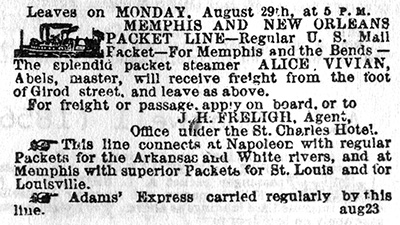 Alice Vivian was a 175-foot-long Alabama River sidewheel packet, built at New Albany, Indiana in 1856. In 1859 she was running a regular mail packet service between New Orleans and Memphis (right). She ran out of Mobile the first time around June 12, 1863, and returned safely from Havana around July 15. She was captured on her second run out of Mobile on August 16, 1863, by U.S.S De Soto and sold at Key West for $237,300.83 — almost all of which must have been for her cargo. Three attempts at the blockade, two successful.
 Crescent was a 146-foot sidewheel steamer renamed Nita for the purposes of blockade-running. She made two successful runs out of Mobile to Havana, in April and June 1863, but was captured by De Soto on August 17, 1863 while on her second return voyage to Mobile. Four attempts at the blockade, three successful.
Kate Dale was a large sidewheel riverboat, 193 feet long and 428 tons burthen, built at New Albany, Indiana in 1855. She ran out of Mobile in July 1863 and was captured by the U.S.S. R. R. Cuyler on July 14 near the Tortugas. She was subsequently sold at auction to private buyers, who then sold or leased her to the U.S. Quartermaster Department. She burned on Mobile Bay in May 1865. One attempt, captured.
Planter — not to be confused with the steamboat Planter stolen by pilot Robert Smalls at Charleston in 1862 — was a 156-foot sidewheeler built at Wheeling, (West) Virginia in 1860. She ran out of Mobile in mid-July 1863, and was captured on July 15 by U.S.S. Lackawana. She was sold by the prize court to the U.S. Quartermaster Department, and sold again to civilian interests in 1866.One attempt, captured.
Warrior was a 130-foor-long sidewheeler built at Mobile in 1857. She was captured by U.S.S. Gertrude on her first attempt to run out of Mobile, on August 17, 1863.One attempt, captured.
Crescent was a 146-foot sidewheel steamer renamed Nita for the purposes of blockade-running. She made two successful runs out of Mobile to Havana, in April and June 1863, but was captured by De Soto on August 17, 1863 while on her second return voyage to Mobile. Four attempts at the blockade, three successful.
Kate Dale was a large sidewheel riverboat, 193 feet long and 428 tons burthen, built at New Albany, Indiana in 1855. She ran out of Mobile in July 1863 and was captured by the U.S.S. R. R. Cuyler on July 14 near the Tortugas. She was subsequently sold at auction to private buyers, who then sold or leased her to the U.S. Quartermaster Department. She burned on Mobile Bay in May 1865. One attempt, captured.
Planter — not to be confused with the steamboat Planter stolen by pilot Robert Smalls at Charleston in 1862 — was a 156-foot sidewheeler built at Wheeling, (West) Virginia in 1860. She ran out of Mobile in mid-July 1863, and was captured on July 15 by U.S.S. Lackawana. She was sold by the prize court to the U.S. Quartermaster Department, and sold again to civilian interests in 1866.One attempt, captured.
Warrior was a 130-foor-long sidewheeler built at Mobile in 1857. She was captured by U.S.S. Gertrude on her first attempt to run out of Mobile, on August 17, 1863.One attempt, captured.
So out of these seven vessels (including Wiliam Bagaley and James Battle), only two — Alice Vivian and Crescent — successfully made a complete, round voyage (one each), Mobile-Havana-Mobile. Five were captured on their first run out. It’s a terrible record, particularly for that period of the war. The seven ships together made twelve one-way attempts to pass through the Yankee blockade, only five of which were successful (about 42%). Marcus Price, the historian who tallied up attempts by blockade runners throughout the war, calculated that during 1863 in the Gulf of Mexico, steamers made 99 attempts at the blockade, of which 73 were successful. On any given run, three out of four typically got through. In fact, the actual odds were probably better than that for the others, given that Price’s totals include these sad-sack cases out of Mobile.
The lesson, I suppose, is that riverboats make terrible blockade runners. Make a note.
___________
New in the Civil War Monitor for Fall 2014
The Fall 2014 issue of the Civil War Monitor is available online now, and should be appearing on newsstands and in subscribers’ mailboxes soon. As always, Editor-in-Chief Terry Johnston and his crew have taken a little different angle on the conflict and its participants. This issue includes sesqui-stories on the Battle of Nashville, and a visitor’s guide to touring Franklin. An article by Craig Warren on the famous rebel yell is notable not only for its discussion of the yell on the battlefields of the Civil War, but its use and reputation after — during Reconstruction, at San Juan Hill during the Spanish American War, and later. Warren reminds us that, like that other iconic symbol, the Confederate Battle Flag, the rebel yell’s use and meaning didn’t end with the echoes of the last guns at Appomattox.
The article that’s really going to raise hackles, though, is the cover story by Glenn W. LaFantasie on Robert E. Lee, “Broken Promise.” LaFantasie cuts right to the core of Lee’s character, depicting him as a man fundamentally out of place in mid-nineteenth century America, “a rambunctious nation of go-getters and scramblers who sought to make their way in the world by whatever means might come along.” Lee, the FFV tidewater patrician, very consciously modeled his own demeanor on that of George Washington, an approach that served him well until the secession crisis of 1860-61. It was then that Lee, up to that point so unrelenting in his desire to emulate Washington and (to a much lesser degree) his own father, broke from their example and resigned his commission in the Old Army. LaFantasie goes on to detail how, after the war, Lee went to considerable effort to contort the well-known political philosophies of Washington and Light-Horse Harry — both men being strong Federalists by word and deed in their own lifetimes — into somehow justifying his own renunciation of the United States and taking up arms against it:
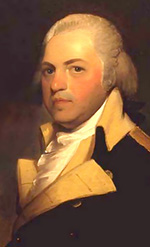 It is, in fact, open to question whether Light-Horse Harry [right] was as die-hard as his son claimed in his loyalty to state over nation. The elder Lee had been a fierce nationalist during and after the War for Independence. If, after the ratification of the Constitution and Washington’s two terms as president, he had decided that his state was more important than the Union, it is a wonder that he did not shift his political allegiance to the Jeffersonian Republicans, the party that became the beneficiary of the Anti-Federalist legacy. Instead, Light-Horse Harry spoke passionately against the Virginia and Kentucky Resolutions of1798 (in which James Madison and Thomas Jefferson introduced the idea of state nullification of federal laws), denounced Jefferson and his presidency, and, like other Federalists, distrusted the public and feared the growing excesses of “wicked citizens. . . incapable of quiet.” If states could override federal laws such as the Alien and Sedition Acts, he predicted, insurrection and disunion would be the result. “If we love the Union,” wrote Light-Horse Harry, “if we wish peace at home, and safety abroad; let us guard our own bosoms from a flame which threatens to consume all reason, temper and reflection.” He did not condone disunionism in his own time, so it was unlikely he would have approved the creation of the Confederate States of America or his son’s prominent involvement in fighting a bloody war for the southern nation. . . . These were the very things his father had warned his countrymen to avoid at all costs.
In short, Lee’s decision to take up arms against the United States went against the very things that Washington and his own father stood for. I told ya, it’s gonna raise some hackles.
LaFantasie’s manuscript will not be the last word on Lee, of course, but it does poke a sharp stick in 150 years of far-too-generous evaluations of Lee, the man. The Civil War Monitor was founded to be a new sort of CW magazine, one that challenges traditional ideas about the events and personalities of the war. It’s not the magazine you want to be reading if you’re looking for reassurance that what you always believed is The Truth. “Broken Promise” forwards those colors. Do yourself a favor and subscribe today.
______________
Friday Night Concert: “Rock Island Line”
Here’s a gem — Pete Seeger, Sonny Terry and Brownie McGhee performing “Rock Island Line” on Seeger’s Rainbow Quest television show, c. 1966. There were only 39 episodes of the show, which was broadcast locally in New York City by a (mostly) Spanish language UHF station. Very few people actually saw these episodes when they originally broadcast, even though they featured well-known performers like Johnny Cash, June Carter, Mississippi John Hurt, Doc Watson, the Stanley Brothers, and Judy Collins. Elizabeth Cotten, who was “discovered” by the Seegers in her middle age, performed on the show as well.
“Rock Island Line” was originally recorded by musical anthropologist John Lomax in 1934 in Arkansas, during a “collecting” trip across the South. He recorded a chorus of African American prisoners, with lead singer Kelly Pace. Lomax’s second recording had a strong gospel component. Five years later Lomax returned and recorded another version at the Cummins unit.
Many artists have recorded “Rock Island Line” since then, from Lead Belly (who accompanied Lomax on his first recording trip) to John Lennon and Paul McCartney and George Harrison and Paul Simon. But my favorite may be Little Richard:
“I may be right and I may be wrong, but you’re gonna miss me when I’m gone!”
_____________
Talking Blockade Runners (and Other Stuff)
I don’t know if I’m objectively busier than usual with the history thing right now, but some days it sure does feel like it. I sat down last night an worked out my speaking schedule for the next few months:
Friday, September 19, 2014 at 7 p.m.
Texas Navy Days
Stahlman Park, Brazoria County
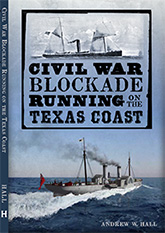
For tickets and information, call 979-233-7330 or e-mail dortha-at-fortvelasco-dot-org. Civil War Blockade Running on the Texas Coast (presentation and signing)
Friday, October 10, 2014 at 7 p.m.
University of Texas at Arlington Library Arlington, Texas The Blockade Runner Will o’ the Wisp: Lost and Found, and Found Again (presentation)
Saturday, October 25 (tentative)
Texas Archeological Society Annual Meeting
Embassy Suites in San Marcos, Texas Registration info here. Captain Dave Whups the Yankees (presentation) 10:30 a.m., Saturday, November 8, 2014 Friends of the Clayton Genealogical Library Meeting 5300 Caroline Houston, Texas Civil War Blockade Running on the Texas Coast (presentation and signing)
Saturday, November 8, 2014 Houston History Book Fair Julia Ideson Library, Houston Public Library
550 McKinney
Houston, Texas Inseparable Enemies: Galveston and Houston in the Nineteenth Century (presentation and signing)
Tuesday, November 11, 2014 at 6 p.m.
Galveston College Fall Lecture Series Abe and Annie Siebel Wing, Cheney Student Center Galveston College 39th Street and Avenue Q Galveston, Texas Captain Dave Whups the Yankees Monday, December 1, 2014 at 10 a.m. Terry’s Texas Rangers Chapter, United Daughters of the Confederacy George Memorial Library Richmond, Texas
You can always get an updated schedule of speaking engagements here. Hope to see y’all there!
____________




 Dead Confederates, A Civil War Era Blog
5 comments