More Corroboration for the Richard Kirkland Story


The story of Richard Kirkland, the Confederate soldier who reportedly went across the wall after the battle of Marye’s Heights at Fredericksburg to bring water to wounded Union soldiers, is well known. It has also been often questioned, because it relied on secondhand testimony that was not recorded until many years after the battle. Then a few years ago, a researcher named Mac Wyckoff published a series of blog posts at the Mysteries and Conundrums blog, that fleshed out substantial evidence that corroborates the basic elements of the story. For me personally, Wyckoff’s posts moved the Richard Kirkland story from the “possible” column into the “probable” column. You can read the first of those posts here, with links to the second and third installments.
Earlier today, Mysteries and Conundrums posted an update by Wyckoff, that includes additional corroboration of the story, including the identification of a second Confederate soldier, Isaac Rentz, who assisted Kirkland in bringing water to the wounded Federals who lay on the field in front of Confederate lines.
A recently discovered article in The Bamberg Herald, a South Carolina newspaper, includes the story of a soldier who assisted Kirkland in giving water. The story is told by Confederate veteran J.B. Hunter, a childhood friend of Isaac Washington Rentz, of the 2nd South Carolina.
Hunter summarizes the basic story and then adds additional details. After Kirkland received permission to carry water to wounded Union soldiers and went to administer the liquid, Hunter states, “Just then, Isaac Rentz, seeing it, filled several canteens and carried water to Kirkland and they gave water to every crying man and was not hurt.”
Go read the whole thing.
_____
Image: “I Was Thirsty,” by Nathan Greene

Liberty and Pelícano: A Story of the Texian Navy
 On Tuesday I had the privilege of speaking to the Lone Star Chapter No. 58 of the Sons of the Republic of Texas in Conroe, on “Liberty and Pelícano: A Story of the Texian Navy.” It’s an amazing story, how the fledgling Texas Navy pulled off the capture of a Mexican schooner anchored in a small port on the Yucatán coast, hundreds of miles from Texas. And the story of what became of Pelícano‘s cargo later is even more remarkable.
The attack gets underway:
The first boat, under the command of First Lieutenant Hartwell Walker, was about 100 yards off Pelícano’s starboard side when it was spotted by the soldiers on board the schooner. They rushed to the rail, and let off a volley of musket fire at Walker’s boat. All the shots missed, and the crewmen bent to the oars to get alongside as quickly as they could. Hartwell and his crew scrambled up over the rail before the Mexican soldiers could reload and get off another volley, and began hacking and slashing their way across the deck. Just at that moment, the second boat, commanded by Sailing Master Oliver Mayo, thumped against the port side of the schooner.
It’s a great story, like something out of Forester or O’Brian.
________

Friday Night Concert: “Stay All Night,” Hill Country Cosmopolitans

The Hill Country Comspolitans are out of Hillsborough, North Carolina. That’s Jerry Renshaw at center on guitar and vocals, Glenn Jones at right on bass and vocals, and Robert Striegler at left on guitar and vocals. From their Facebook page:
Bringing a touch of Texas to Carolina, they decided to call themselves the Hill Country Cosmopolitans…and expanded their repertoire to include a little bit of country and honky tonk and even jazz as well. Danceable, catchy and infectious, Western Swing has a universal charm that people find irresistible…and the Hill Country Cosmopolitans want to share that fun with you at the next barn dance, beer joint, skull orchard, hoedown, shiv-a-ree, wedding, funeral, wake, bar mitzvah, cut ‘n shoot, pig pickin, BBQ, supermarket grand opening, car show, turkey shoot, party or family reunion near you.
Y’all have a great weekend. Gonna rain like hell here, which kinda sucks for the Dickens on the Strand festival.
________

Houston CWRT: “Blood on the Bayou,” December 8
Blood on the Bayou:
Vicksburg, Port Hudson, and the Trans-Mississippi
“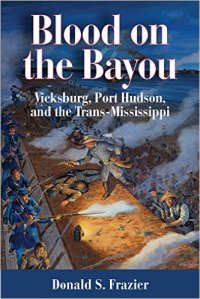 See what a lot of land these fellows hold, of which Vicksburg is the key!” wrote Abraham Lincoln. “The war can never be brought to a close until that key is in our pocket. We can take all the northern ports of the Confederacy, and they can defy us from Vicksburg.” Many Civil War historians assume that the physical occupation of the Confederacy was what Lincoln had in mind. However, by looking at operations on the west bank of the Mississippi, observers may see another picture emerge.
Vicksburg was a key, to be sure, but Port Hudson may have actually been more important. In addition, the occupation of Confederate territory may have been important, but the control of the Confederacy’s population — in particular its enslaved population — may have been even more critical. Dr. Don Frazier examines the role of the Trans-Mississippi in the great Mississippi Valley Campaign and takes a fresh look at the role the immense population of African-Americans in the region may have played in forming Union strategy.
Dr. Donald S. Frazier is professor of history at McMurry University in Abilene, Texas. A graduate of the University of Texas at Arlington and Texas Christian University, Frazier is also the award-winning author of four books on the Civil War including Blood and Treasure, Cottonclads!, Fire in the Cane Field, and Thunder Across the Swamp. He released his latest book, Blood on the Bayou, in spring, 2015. His other work includes serving as co-author of Frontier Texas, Historic Abilene, and The Texas You Expect, as well as general editor of The U.S. and Mexico at War and a collection of letters published as Love and War: The Civil War Letter and Medicinal Book of Augustus V. Ball. In addition to his teaching duties, Frazier has been very involved in work on Civil War and frontier heritage trails in Texas, New Mexico, and Louisiana, and work on historical projects in Europe and Mexico. He is the writer and director for the video Our Home, Our Rights: Texas and Texans in the Civil War, a winner of the Mitchell Wilder Award for Excellence in Publications and Media Design from the Texas Association of Museums. Dr. Frazier is an elected member of the prestigious Philosophical Society of Texas, the oldest learned organization in the state, a Fellow of the Texas State Historical Association, and a board member of the Texas Historical Foundation.
Reservations required for both dinner ($30) and lecture only ($10)E-Mail Reservation is Preferred; Email Don Zuckero at drzuckero-at-sbcglobal.net, or call (281) 479-1232 by 6 p.m. Monday, December 5th, 2016.
_______
Maurice Bessinger is Still Causing Mischief
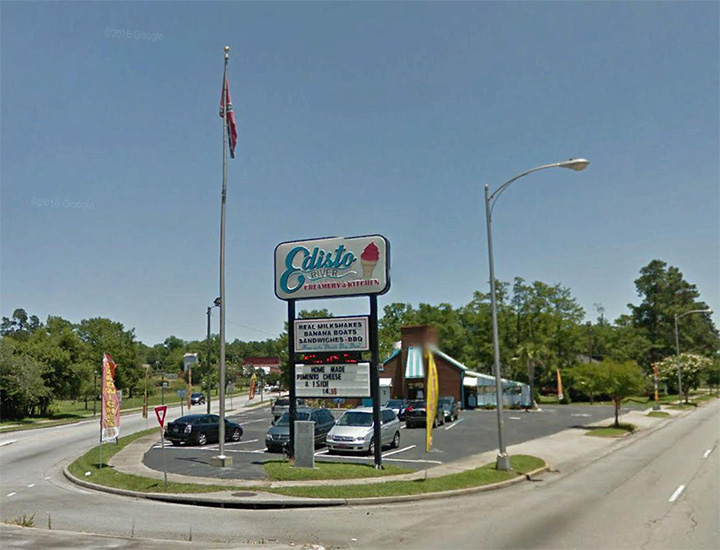
Maurice Bessinger (1930-2014) was a well-known South Carolina restaurateur, equally famous for his mustard-based barbecue sauce and infamous for his life-long defense of chattel bondage as having been ordained by God. (“God gave slaves to whites.”) He was an unrepentant segregationist who, even after being forced to open his restaurants to African Americans by the federal courts in the late 1960s, continued to distribute pamphlets defending slavery and generally making black folks as uncomfortable as possible about stopping there. And of course, he put up a big ol’ Confederate Battle Flag outside each restaurant, just to make sure folks got the message. One of the first things his grown children did when they took over the business in the early 2010s was to quickly and quietly remove those flags.
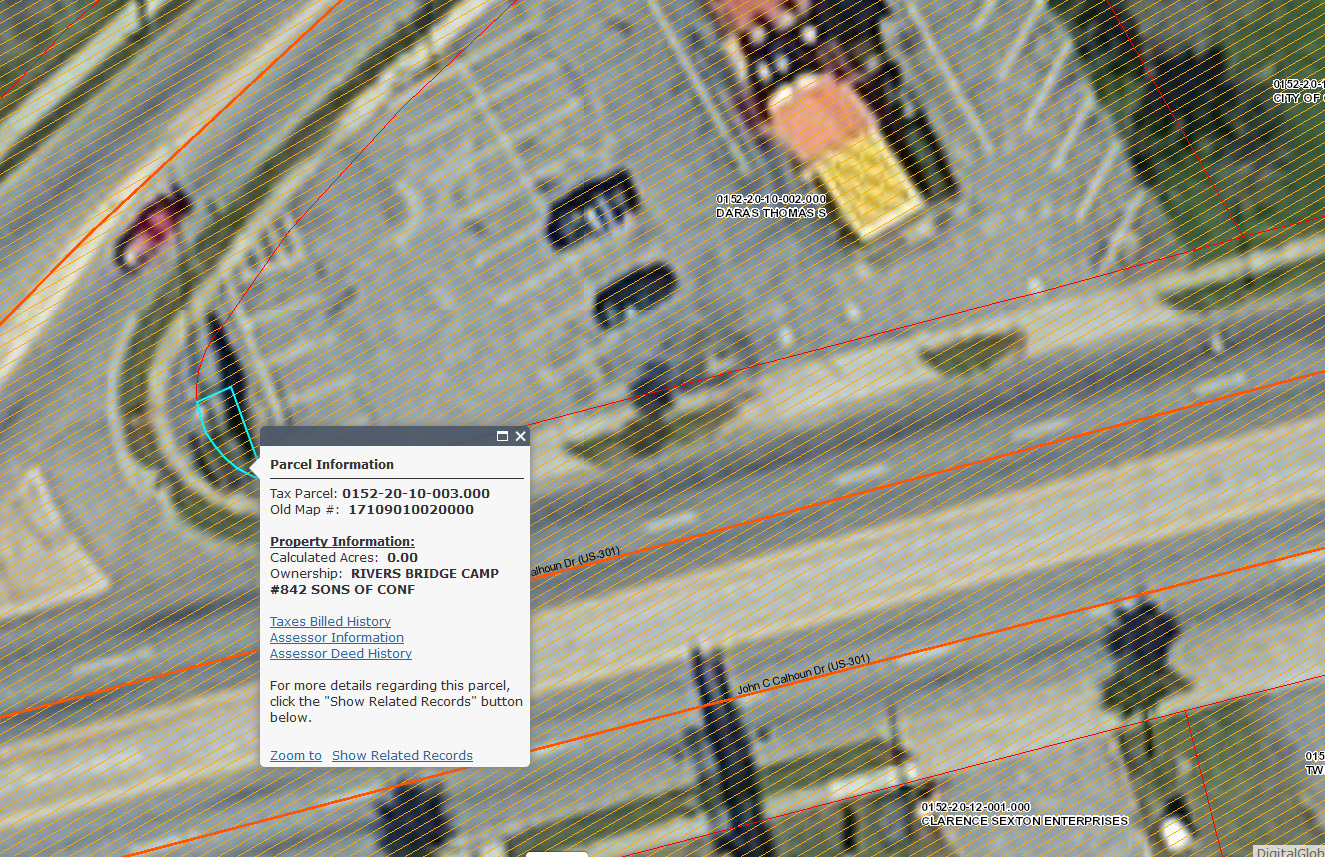
But Bessinger had a few tricks left. In at least a couple of cases, he deeded over to local Confederate Heritage™ groups tiny, tiny plots of land adjacent to his restaurants on which they could put up a marker and flagpole. One of these was in Orangeburg, where the SCV’s Rivers Bridge Camp #842 flies a Battle Flag outside of what had once been one of Bessinger’s restaurants, but is now home to the Edisto River Creamery. (See it on the Orangeburg County tax map here.) The business owner, Tommy Daras, bought the property in 2014 and ever since has been getting complaints about the flag. On Wednesday, there was a confrontation between Daras and members of the Rivers Bridge Camp, who prevented Daras from hauling down the flag himself:
After about an hour stand-off, SCV members left the restaurant and the flag remained up.
Restaurant owner Tommy Daras said he would most likely contact his lawyer and find out how to proceed.
“I want to do the civil thing,” he said. “I don’t want any violence.”
Daras said he and his wife have been receiving complaints and threats about the flag since they purchased the restaurant in 2014. . . .
Daras says after conducting some more research, he realized that he in fact has the title to the deed to the property, not the Sons of Confederate Veterans.
“I am clean on doing something,” Daras said.
Buzz Braxton of Rivers Bridge Camp #842 SCV and flag keeper at the site said the site belongs to the SCV. He says tax records prove it. He said the matter will be taken to court.
“This is our property,” Braxton said.
We’ll see what happens, but a quick skim of Orangeburg County tax records suggests that Braxton is correct — the Rivers Bridge Camp has been paying taxes on that tiny plot of land for years, between $10 and $11 annually. While I don’t know what Daras’ deed says, it’s going to be hard for him to argue that he owns property that someone else has been paying the taxes on for at least a decade.
What a mess. Somewhere, I’m sure, Maurice Bessinger is laughing — when he’s not busy looking for some ice water.
________
The (Self-) Righteous Entitlement of Confederate Heritage
Some of you will have heard about the latest kerfuffle in Lexington concerning the observance of Lee-Jackson Day next January. It seems that a local community group, CARE Rockbridge, pulled a cheeky maneuver and obtained a parade permit months ago for the date and route that had been previously used by local Confederate Heritage™ folks to march through town carrying Confederate flags. CARE Rockbridge was able to do this because they applied for a permit, which is issued by the City of Lexington on a first-come, first-served basis.
Naturally the heritage folks are a little bent out of shape about this — which was sort of the point, duh! — but they haven’t done themselves any favors with their rhetoric in complaining about it. Local SCV leader Brandon Dorsey, who is always good for an inflammatory quote, hinted at litigation over it:
The Lexington City Council is asking to be sued. First, the city deliberately granted a permit for another organization to usurp the usual time and place of the Lee-Jackson Day parade.
Then his Confederate confederate, “Doc” Wilmore, whinged that CARE Rockbridge was “underhanded” in, you know, filing paperwork with the city:
An anti-racism group has obtained a parade permit for Jan. 14 — taking the date and route that traditionally has been claimed by a local Sons of Confederate Veterans chapter. . . .
“I think it was kind of underhanded the way they slipped it in like that,” said W.B. “Doc” Wilmore, a Sons of Confederate Veterans member who usually handles bookings for the group’s Lee-Jackson Day events.
I get it that Dorsey and Wilmore think CARE Rockbridge stole a march on them, because they did exactly that. What’s more interesting is the (barely) unspoken assumption that the City of Lexington should have shown the SCV special consideration by holding that date open for them to apply for at their leisure, in preference to another group that actually got off the couch and applied for the permit. That belief — that the local city government should give special consideration to their private organization over another — is just ludicrous.
And while there’s been plenty of vitriol directed against CARE Rockbridge by the heritage folks, I haven’t seen even the slightest hint of criticism of Dorsey, Wilmore, or the other local organizers of this event who let this one slip by them.
So now the SCV will be marching of January 21 in Lexington which, as it happens, is actually Jackson’s birthday. My suggestion to them is to quit carping about those ol’ meanies at CARE Rockbridge, get on with it, and start planning (and preparing parade permit requests) for Lee-Jackson Day 2018. I don’t recall Lee spending a lot of time complaining about how “underhanded” the Yankees were when they turned him back at Sharpsburg or Gettysburg; Dorsey and Wilmore should take a lesson from the men they purport to honor.
______
The Secret Life of Bacon Tait
Update, March 4, 2017: I learned Saturday evening that Hank has passed away. He had been candid with those he knew about his illness, and its grim prognosis. He knew back in November that his time remaining was short, and I think he took comfort in seeing The Secret Life of Bacon Tait off to press.
_________
 Hank Trent is a researcher specializing in the antebellum period that I’ve come to know through his contributions at Civil War Talk. (He posts there under a different name.) Hank’s posts and comments are invariably deeply-informed and articulate, and he both makes and understands subtle, nuanced interpretations of historical subjects. He gets it, that what we call “history” is made up collectively by people, and people are complicated, conflicted, noble and hypocritical, sometimes all at once. There are many smart and knowledgeable folks who post over at CWT, but I make it a point to read all of Hank’s posts and comments because I know he will have something useful to say. He always does.
So I was happy to see him announce the pending publication of his new book,The Secret Life of Bacon Tait, a White Slave Trader Married to a Free Woman of Color by LSU Press, due out in March 2017. It’s available for pre-order now. If the title is provocative, so is the story:
Historians have long discussed the interracial families of prominent slave dealers in Richmond, Virginia, and elsewhere, yet, until now, the story of slave trader Bacon Tait remained untold. Among the most prominent and wealthy citizens of Richmond, Bacon Tait embarked upon a striking and unexpected double life: that of a white slave trader married to a free black woman. In The Secret Life of Bacon Tait, Hank Trent tells Tait’s complete story for the first time, reconstructing the hidden aspects of his strange and often paradoxical life through meticulous research in lawsuits, newspapers, deeds, and other original records.
Active and ambitious in a career notorious even among slave owners for its viciousness, Bacon Tait nevertheless married a free woman of color, Courtney Fountain, whose extended family were involved in the abolitionist movement and the Underground Railroad. As Trent reveals, Bacon Tait maintained his domestic sphere as a loving husband and father in a mixed-race family in the North while running a successful and ruthless slave-trading business in the South. Though he possessed legal control over thousands of other black women at different times, Trent argues that Tait remained loyal to his wife, avoiding the predatory sexual practices of many slave traders. No less remarkably, Courtney Tait and their four children received the benefits of Tait’s wealth while remaining close to her family of origin, many of whom spoke out against the practice of slavery and even fought in the Civil War on the side of the Union.
In a fascinating display of historical detective work, Trent illuminates the worlds Bacon Tait and his family inhabited, from the complex partnerships and rivalries among slave traders to the anxieties surrounding free black populations in Courtney and Bacon Tait’s adopted city of Salem, Massachusetts. Tait’s double life illuminates the complex interplay of control, manipulation, love, hate, denigration, and respect among interracial families, all within the larger context of a society that revolved around the enslavement of black Americans by white traders.
Typically, Hank worried that the title may not precisely reflect the complexity of Bacon Tait’s relationship with Courtney Fountain:
I discussed [with the editor] whether “married” was correct for the title, because even though the Taits signed legal papers as Mr. and Mrs. or wife, and presented themselves as married to neighbors and the census taker, they legally weren’t married, and there wasn’t even a common law marriage provision in Massachusetts at the time.
The editor said he thought that was enough, but I still worry…
Be at ease, Hank. I expect this book to be on many, many bookshelves for years to come.
__________
Schooner Yacht America Photos


Following up on last week’s post about the visit of the schooner yacht America, I was able to get some photos of her under sail this weekend. (There’s a lot of other shipping in there, too; it was, as they say, a “target-rich environment.”) Nothing spectacular, but there are a few decent ones in the mix. You can view them here and here.
_______
Go Vote, Y’all! You’ll Feel Better When It’s Over.
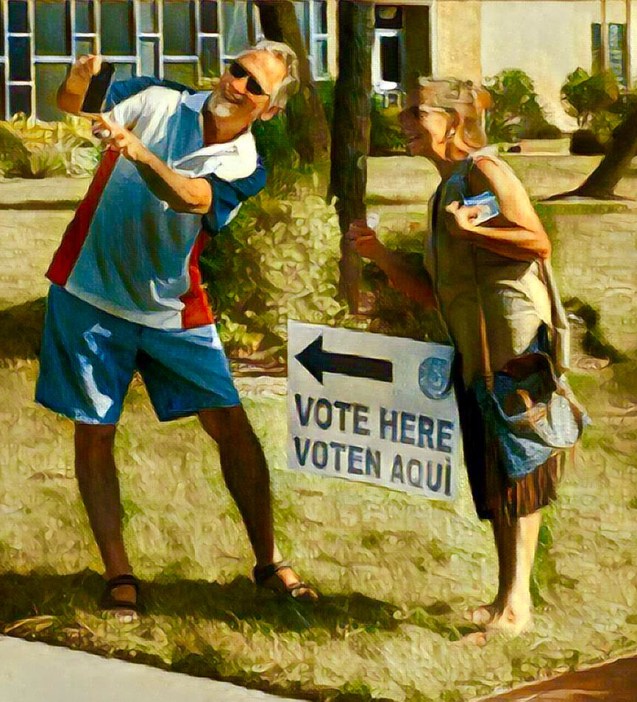
After this past year, is it surprising that people are taking selfies to celebrate after they vote?
______
Schooner Yacht America at Galveston, October 27-30
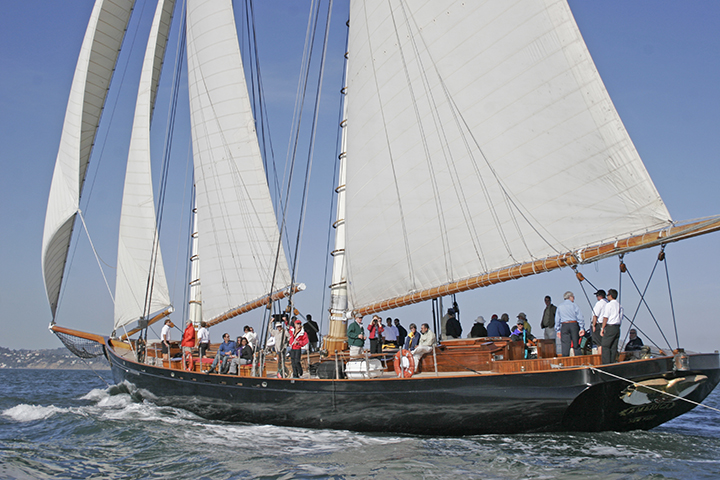
Sorry for the short notice on this one, folks, but tomorrow through Sunday, October 27-30, a sailing replica of the famous schooner yacht America will be visiting the Texas Seaport Museum here for both tours and short sailing excursions. As some of you will likely know, America was used briefly as a blockade runner during the first months of the Civil War, but was scuttled, raised and put into service with the U.S. Navy with the South Atlantic Blockading Squadron, and later was used as a training ship for the U.S. Naval Academy. At one point, she was even owned and raced by Ben Butler (yes, that one), who reportedly maintained her in good shaped and sailing trim. Not all of her owners did, though, and she was eventually broken up and burned in the 1940s.
From the Galveston Historical Foundation website:
GHF’s Texas Seaport Museum will play host to another legendary ship in October as the Schooner AMERICA makes a stop in Galveston from Thursday, October 27 through Sunday, October 30 from 10am – 5pm daily (last ticket is sold at 4 pm). During their stay, the public is invited to tour the ship each morning and even take a rare journey onboard during special afternoon sail-aways. Viewing tickets are $18 per person, available at Texas Seaport Museum, and allow access to both AMERICA and the 1877 Tall Ship ELISSA and are available at the Texas Seaport Museum. Sail-away tickets are $85 per person for adults and $42.50 for children 17 and under.
AMERICA will be available for tours on:
Thursday, October 27 : 10 am – 1:30 pm
Friday, October 28 : 9 am – 12 pm
Saturday, October 29 : 9 am – 11:30 am
Sunday, October 30 : 9 am – 11:30 am
AMERICA will be available for sail aways on:
Thursday, October 27 : 2:30 & 5 pm
Friday, October 28 : 1 & 3:30 pm
Saturday, October 29 : 12:30 & 3 pm
Sunday, October 30 : 12:30 & 3 pm
ABOUT THE SCHOONER AMERICA
Additionally, GHF will host a special happy hour, complete with sunset cannon fire, for the ship featuring seasonal craft beers from Saint Arnold Brewing Company. Held on Friday, October 28 from 6-8 p.m., tickets are $30 per person and include complimentary beer.
The original AMERICA put yachting on the map and, without exaggerating, is the world’s most famous racing yacht. In 1851, a boat named ‘AMERICA’ won the ‘Royal Yacht Squadrons’ 100 Guinea Cup given to the winner of a race around the Isle of Wight. It is said that the margin was so great that watching AMERICA sail past the royal yacht, Queen Victoria famously asked “Who came second?” “Your majesty, there is no second” was the reply. The winners, members of the New York Yacht Club, donated the trophy to the Club, to be held as a ‘challenge’ trophy. Thus was born the America’s Cup, named after the boat, not the country.
Her later career was equally as colorful. Conveyor of secret agents, Confederate blockade runner, Union warship, Naval Academy training vessel, and pride and joy of a famous Civil War general and politician. By her end in 1945, she was one of the most honored vessels in the United States. While the original was destroyed during World War II, this AMERICA is a near perfect replica built in 1995 at a cost of more than $6 million. Now, AMERICA has been selected as the ambassador for the America’s Cup Tour, visiting sites along the west coast, Mexico, U.S. gulf and east coast, and the Caribbean.
Should be fun. Maybe I’ll see y’all down there.
________
Image: Chesapeake Bay Maritime Museum.




 Dead Confederates, A Civil War Era Blog
4 comments