
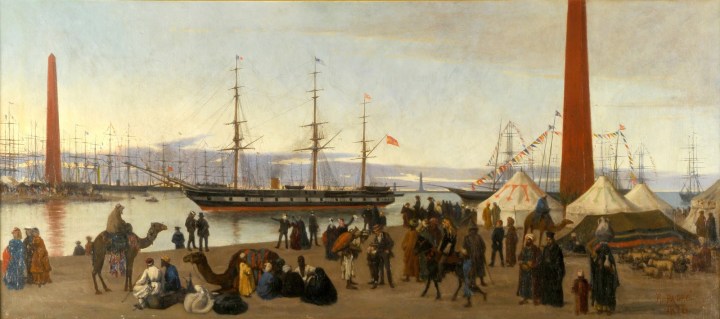
A few years later, Berenguela was said to be the first large vessel to transit the newly-completed Suez Canal.
_________
h/t Chubacus.

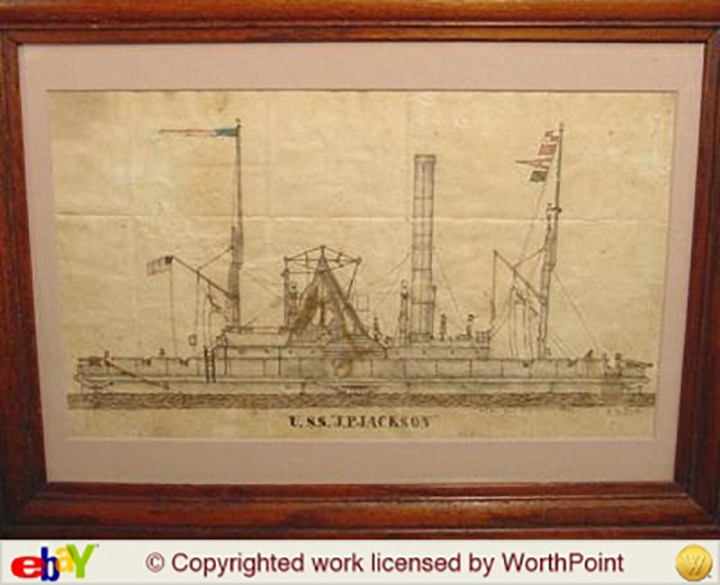
A friend and colleague doing in-depth historical/technical research on converted ferries is seeking the owner of this image of U.S.S. John P. Jackson (sometimes given as J. P. Jackson), that sold in an online auction in 2011. Unfortunately neither the seller nor the appraiser retained records that identify the buyer. He’s trying to obtain a high-resolution copy of the image. If you know who might have it, please let me know, or have that person let me know. Assistance would be tremendously appreciated.
The other day in my post about the monument protests in New Orleans, I mentioned the “Confederate heritage folks, Three Percenter milita types, Oath Keepers, ‘Antifa’ anarcho-communists, and God only knows who else, all jostling and trying to provoke one another and get themselves on the teevee.” Now we can add to that listing (on the anti-monument side) an enormous street parade with a marching band, and on the pro-monument side, the white nationalist League of the South, Nazis and assorted klansmen. There was also some dude wearing replica Roman armor. I don’t know who he was repping.
What a nasty, nasty clown show. I wouldn’t be surprised if, after witnessing the last few days, Davis took a header off that monument on his own.
_____
More images at NOLA.com.

The situation in New Orleans, prompted by the city’s removal of the Battle of Liberty Place monument and planned dismantling of three more dedicated to Confederate leaders Jefferson Davis, Robert E. Lee, and P. G. T. Beauregard, continues. It’s a tinderbox, with Confederate heritage folks, Three Percenter milita types, Oath Keepers, “Antifa” anarcho-communists, and God only knows who else, all jostling and trying to provoke one another and get themselves on the teevee. As best I can tell, not many of these folks are actually from New Orleans. There has been sporadic violence, and threats made against public officials. It’s ugly, and we should all hope that whatever becomes of the monuments, no one else gets hurt.
I did find this piece interesting, from the website/blog The Hayride, that challenges the central tactic of “heritage defense,” namely “flagging.”
Neither side is particularly angelic, either with respect to the monument fight or the Sterling matter. [Alton Sterlng was an African American man killed by police in Baton Rouge in July 2016; the monument protests in New Orleans and Baton Rouge coincided with protests in the latter city over the the announcement that the U.S. Department of Justice would not file charges against the officers involved.] Last night the preservationists who could easily have found themselves at an Alamo-style disadvantage didn’t do themselves too many favors; while they weren’t the aggressors in the hostilities that took place at the Jefferson Davis monument, brandishing a bunch of confederate [sic.] flags to go with Mississippi and Alabama accents as they did was stupid. The persuasive case for preserving the statues to Davis, P.G.T. Beauregard and Robert E. Lee isn’t made with a confederate flag, as those three figures offered more than just four years of rebellion against the Lincoln administration. Davis, Beauregard and Lee are figures of American history, and as such the people resisting the bowdlerization of their statues ought to have been flying American flags.
Lee and Beauregard, after all, signed loyalty oaths to the union after the war in 1865 – though Davis never did. Beauregard’s was especially eloquent…
“In taking up arms during the late struggle (after my native state, Louisiana, had seceded) I believed, in good faith, that I was defending the constitutional rights of the South against the encroachments of the North. Having appealed to the arbitration of the Sword, which has gone against us, I accept the decision as settling finally the question of secession & slavery – & I offer now my allegiance to the Government of the United States, which I promise, truly and faithfully, to serve & uphold hereafter, against all external or internal foes.”
One of the stupid things said by New Orleans mayor Mitch Landrieu during this controversy was that the monuments he’s trying to take down are an “aberration” or a “denial” of history, since the Confederacy only lasted for four years. But Davis had been a U.S. Senator before the secession in 1861. Lee and Beauregard were heroes in the Mexican-American War. Lee’s efforts at bringing the South back into the union were lauded on both sides of the Mason-Dixon line following the war, which was the reason Lee Circle was so celebrated when it was constructed in 1878 (and the statue was crafted in New York, of all places). Beauregard played a substantial role in the post-war history of New Orleans, not the least of which was his having designed what ultimately became the city’s streetcars. Their influence on the culture of New Orleans and the South greatly transcends the four years between 1861 and 1865. But the people waving confederate flags around are poisoning the case that those historical monuments represent more than mere slavery.
And what we do not need is a bunch of confederate flag-waving out-of-towners coming up to Baton Rouge and goading the Alton Sterling protest crowd into a rumble.
This piece really underscores something that I’ve long had a sense of, but often had difficulty articulating — when people are (rightly or wrongly) put off by Confederate iconography, you’re not going to win them over by flashing more and bigger Confederate flags in their faces. When heritage groups do that (“pepper Danville with flags,” etc.) they’re essentially conceding defeat on the issue they’re supposedly trying to reverse. It’s defiance, sure, but it also almost always results in the targeted organization or institution — the VMFA, Lexington, Danville, and now New Orleans — digging in its own heels. Why on Earth do heritage folks assume that they’re the only ones who can display resolve and intransigence in the face of adversity?
What’s most interesting to me about this argument is that it’s coming from the right of the political spectrum, not the left — The Hayride is VERY conservative, a sort cayenne pepper-flavored local alternative to Breitbart. When you lose those guys, seems to me, it’s really time to re-think your tactics.
___________
h/t RBLee
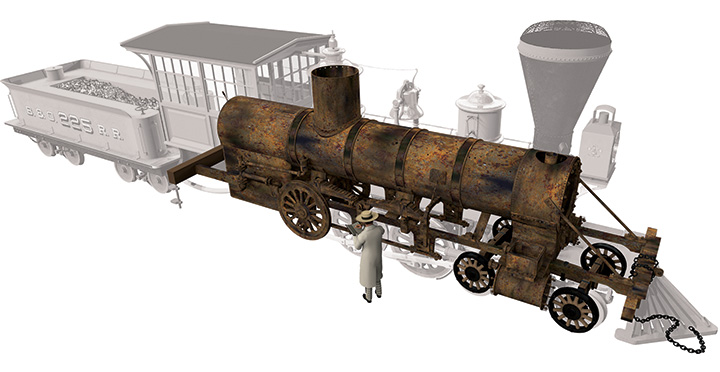
Over at Civil War Books and Authors, Andrew Wagenhoffer gives a solid review to Dave Bright’s Locomotives Up the Turnpike:

About half the narrative is devoted to Bright’s meticulously reconstructed account of the Haul. In addition to being both a testament to still heavily discounted Confederate engineering prowess and the literature’s first truly comprehensive and primary source based history of the event, the book very effectively counters the many naysayers past and present. Contrary to common belief, abundant evidence that the event truly happened exists in the archives, and Bright was able to compile hundreds of these primary source documents as the backbone of his study. The mental image of teams of men and horses dragging enormously heavy locomotives down primitive roads probably dominates the thinking of the doubters, but the truth of the matter is that much of the engine and rolling stock was either wholly or partially burned prior to the removal operation, and the locomotives were significantly dismantled (as an example, wooden engine trucks were often substituted for the metal trucks to lower the weight) before being moved. The processing, organization, and routes of these equipment convoys are detailed in the text. . .
The book is abundantly illustrated with photographs, original maps, and color artwork. For the benefit of the reader, a vast number of tables organize data of all kinds. In the appendix section, one can find among other things an effective summary rebuttal of the Haul’s detractors, full ‘biographies’ of the locomotives saved through the Haul, and rosters of the hundreds of men (and a few women) employed by Sharp during his various postings and operations in Virginia and the Carolinas.
On several levels, Locomotives Up the Turnpike is a significant contribution to the railroad history of the Confederacy. Its unique and exhaustive documentation of the famous Haul means that other authors finally have a proper source to refer to in their own work, and the question of whether the event actually occurred or not seems more than convincingly answered. Bright’s study also extends proper recognition to the architect of the Haul, while in the process bringing to light Captain Sharp’s other equally important services to the Confederate war effort. Finally, the book offers useful accounts of how some of the many logistical challenges of the Confederacy’s Atlantic railroad network were addressed by military, state, and Richmond authorities. Recommended.
_______

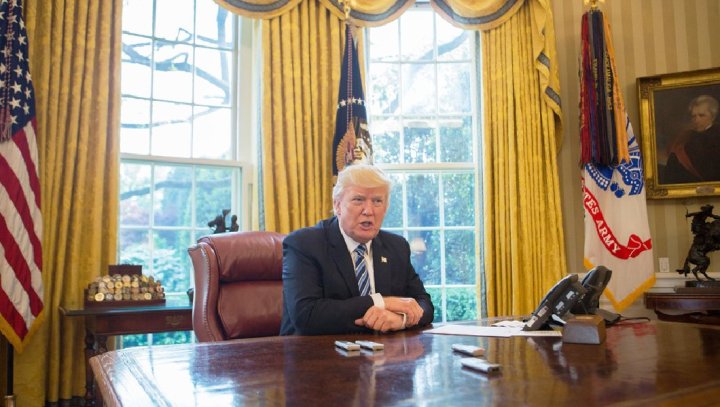
I’m sure you’ve heard about the comments that the president made recently about Andrew Jackson, and how he might have prevented the Civil War from happening. A reporter at Vice, Eve Peyser, called several historians in different specialties the other day and asked what they thought about the president’s comments. One of them was David Blight, the Yale professor who, as much as anyone, has shaped Civil War historiography over the past couple of decades. Blight apparently hadn’t heard about the president’s comments before the Peyser contacted him. He replied, somewhat incredulously:
He really said this about Jackson and the Civil War? All I can say to you is that from day one I have believed that Donald Trump’s greatest threat to our society and to our democracy is not necessarily his authoritarianism, but his essential ignorance—of history, of policy, of political process, of the Constitution. Saying that if Jackson had been around we might not have had the Civil War is like saying that one strong, aggressive leader can shape, prevent, move history however they wish. This is simply a fifth-grade understanding of history or worse. And this comes from the president of the United States! Under normal circumstances if a real estate tycoon weighed in on the nature of American history from such ignorance and twisted understanding we would simply ignore or laugh at him. But since this man lives in the historic White House and wields the constitutional powers of the presidency and the commander in chief we have to pay attention. Trump’s “learning” of American history must have stopped even before the fifth grade. I wish I could say this is funny and not deeply disturbing. My profession should petition the President to take a one- or two-month leave of absence, VP Pence steps in for that interim, and Trump goes on a retreat in one of his resorts for forced reeducation. It could be a new tradition called the presidential education leave. Or perhaps in New Deal tradition, an ‘ignorance relief’ period. This alone might gain the United States again some confidence and respect around the world. God help us.
The only thing I can add is that, if you have any doubt about Trump’s ignorance of the most basic knowledge of Old Hickory — who’s represented in the Oval Office by both a sculpture and a portrait in places of prominence — know that in his own telling of the story, Trump had to ask, “when was Andrew Jackson?
_________
Several weeks back my colleague Pat Young posted a summary table from the 1860 U.S. Census to the Civil War Talk forum, that showed migration patterns within the United States. Pat has a deep interest in the story of immigration to the United States, but that extends to movement patterns within the country, as well. The United States has always been a mobile society, but where people move from- and to isn’t random; it’s driven by larger larger forces, in particular where people perceive the greatest opportunity for themselves.
For each of the states that existed in 1860, Pat’s table listed the leading four other states or territories where native-born citizens were likely to end up. I wondered what that information would look like on a map, so here it is — native states are shown in dark blue, and the states where those people ended up by 1860 is shown in light blue:
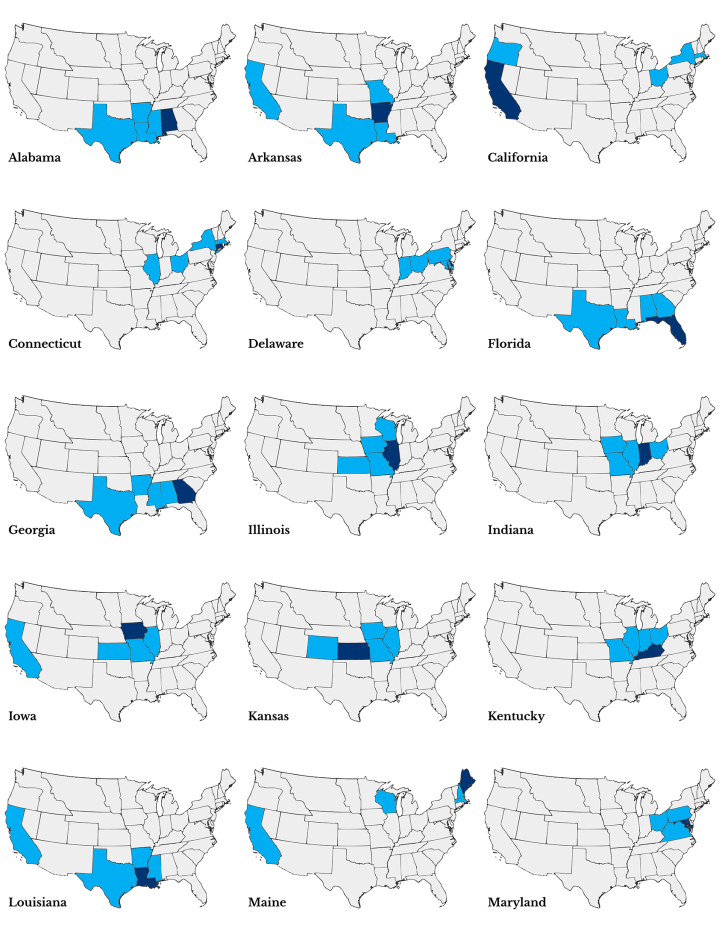


It’s clear that internal migration up to 1860 was overwhelmingly from free states to free states, and from slaveholding states to slaveholding states. One outlier in that trend is Missouri, which was a slaveholding state but less so than others, and drew migrants from all over the country.
And of course, California — everybody was going to California. Same as it ever was, y’all.
________
One of the conceits of the Confederate Heritage™ crowd is that their Confederate ancestors — and they themselves, by extension — fought for the true values and principles of the U.S. Constitution, against the wicked and evil tyranny of Lincoln and the North. So what to make of this petition at Change-dot-org?
I urge President Trump, Vice President Mike Pence and the U.S. Supreme Court to sign a bill into law protecting these monuments, all military monuments from removal.
Uh, wut?
Ignore for a moment the odd spectacle of people who fetishize “states’ rights” and argue that it’s a governing principle worth fighting a war over, now wanting the federal government — you know, the oppressive, tyrannical one their forefathers took up arms against — to step in and tell states and local governments how to run their affairs. What, exactly, do the organizers and thousands of people who signed this petition think the Vice President’s or the Supreme Court’s role is in “signing” a law in the first place?
Should (say) the Congress play a role in creating such a law? How do new laws even get made? Is there a role for the Legislative Branch in preparing legislation? It is a puzzlement.
I get it that folks are unhappy about the removal or relocation of Confederate iconography and want their voices heard. But sheesh, make a little effort to understand how to get what you want accomplished. You might even want to take notes:
________
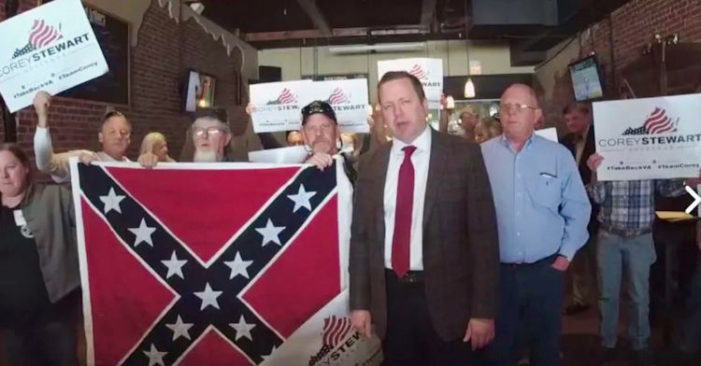
Virginia GOP candidate and Corey Stewart unveils his own “repeal and replace” for the Commonwealth:
HARRISONBURG, Va. — During a rally in downtown Harrisonburg yesterday, Republican gubernatorial candidate Corey Stewart unveiled his new, state-sponsored plan for health care, calling for the reintroduction of and reliance on medicinal leeches and kitchen cutlery.
Stewart, who recently proclaimed his admiration for the Confederacy at a rally in Roanoke, said the new plan, which has been dubbed “Antebellum Healthcare,” will be an answer to “the disastrous, tax-hungry plan of Obamacare,” and will save citizens money by utilizing medicinal ideas that were regularly used before the Civil War.
“Our proposed Medicaid plan will offer Virginia citizens health care that was successfully used by our stalwart forefathers,” Stewart explained, citing the use of such practices during the mid-19th century as a measure of its benefits. “It will also come at a lower cost with minimal premiums.”
Yes, it’s satire. Probably.
Y’all have a great weekend.
______
h/t Brooks Simpson
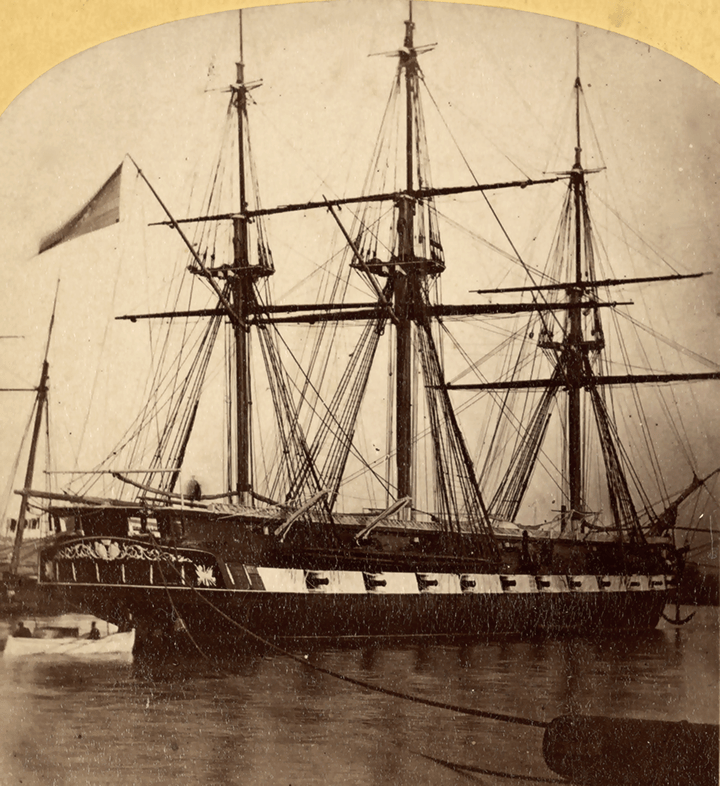
This past week, the Texas Seaport Museum here hosted a visit by El Galéon, a replica of a Spanish sailing ship from the 16th century. A hundred-and-fifty-odd years ago, New York was the port of call for a contemporary Spanish warship, the frigate Berenguela, part of that country’s naval forces assigned to its colonies in the Caribbean. New York Times, November 16, 1860:
The Spanish Navy; ARRIVAL OF THE FRIGATE BERENGUELA SPANISH VESSELS IN THE GULF OF MEXICO.
The Spanish frigate Berenguela, whose arrival at this port was briefly noticed in our issue of yesterday, is now lying off the Battery, and attracts considerable numbers of the curious, who go around her in row boats. She comes here to have her machinery overhauled at the Brooklyn Navy-yard, to enable her to do which the steam-frigate Wabash, now in the drydock, will be floated into the stream.
Our Naval Reporter visited the frigate yesterday, and was courteously furnished with the information he sought by the officers. The Berenguela is about 1,200 tons burden, and carries a fine armament of 37 guns, medium size, thirty-two and sixty-eights, manufactured at the naval depot of Turvia, in Spain. Fifteen of these guns are on the spar, and twenty-fire on the gun deck. Forward, on the former, is a neat brass 12-pounder howitzer, of Boston origin, a personal present to the commander of the fleet. A novel idea has been carried out in arranging the small arms beside the cannon of the ship, thus obviating the necessity of keeping them in a separate room. A spare propeller is stowed, to be used in case of need. The decks are kept exceedingly neat. The sailors are smart, intelligent-looking men generally; and the marines, of whom 64 are on board, present a soldier-like appearance. The day guard is regularly in uniform from “flag-up” to sundown. The lower decks contain the officers’ sleeping apartments and the middies’ mess-rooms. The Commander’s chamber is tastefully decorated with portraits of the Royal family of Spain, and a crucifix hangs over his bed. There are no men undergoing punishment at present on board. Her officers say that very little is ever necessary with them.
The squadron, of which the Berenguela is one, consists of no less than twenty men-of-war, of which, eleven are steamers. As it is well to know how the Spanish navy is represented in the Gulf, we append a list of the entire fleet:
STEAM FRIGATES — Berenguela, Blancha, Petrioula.
STEAM CORVETTES — Francis de Ais, Isabel de Cattolica, Velasco, Blaico de Garay, Rezana, Baran, Hernan Cortes, Neptune, Venandila, General Lero, Guadalquiver.
SAILING VESSELS — Alcido, Isabel II., Pelago, Herbannero, Christina, Janitor.
The officers of the Berenguela are as follows:
Capt. Jose Ignacio Rodriques, Commander Francis de Pa Margon, Lieuts. Dernetris de Coster Montenega, Thomas de Sartoa, Soloa der Caweza Francis Vila, Assistant-Surgeon Juan Acosta, Chaplain Valentine Acosta and Seraph Galendo; other officers, J.M. Twazello, Louis Garcea Corlenell, G. Lobi, M. Paria, R. Freye, D.E. Lurate, D.J. Beriter, and others.
Subjoined is a statement of the present strength of the Spanish Navy. There are in serviceable condition 82 vessels, carrying in all 887 guns. Of these 2 are ships-of-the-line, rating 86 guns each; 4 are frigates, rating from 32 to 42; 4 are corvettes of from 16 to 20; 9 are brigs of from 10 to 20; and 16 are smaller vessels and 10 transports. There are three steam frigates, of which the Berenguela is 1; and 5 schooners, all fitted with the screw, besides 3 paddle-wheel frigates of 500 horse-power, and 16 guns each; 8 brigs of 380 horse-power, and 6 guns; and 18 schooners of from 100 to 300 tons, and 2 to 5 in active service, independent of 6 battallions of marines numbering 100 men each. There are, however, nearly 100,000 registered fishermen and others, who could be drafted into the service. Their officers number 1,150 of all grades. The Coast-Guard of Spain is maintained by 24 feluccas, and 87 estamperia.
The Berenguela will be put in regular “ship-shape” before a week, and persons having proper passes may visit her. She would well pay a tour of inspection.
A few years later, Berenguela was said to be the first large vessel to transit the newly-completed Suez Canal.
_________
h/t Chubacus.
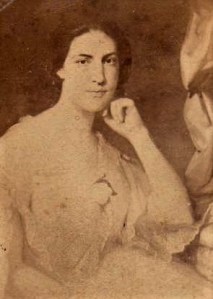 Over at Civil War Talk, John Hartwell tells us of Marguerite Caroline Deslonde Beauregard (right), wife of the Confederate general, Pierre Gustave Toutant-Beauregard. Marguerite and G. T. (as he styled himself as an adult) married in 1860. Beauregard had been a widower for ten years at that point, and by all accounts the newlyweds were completely devoted to each other.
When the war came, Beauregard almost immediately found himself at the center of military operations, serving as one of the principal Confederate commanders at First Manassas, the first major battle of the conflict. Marguerite went to live at the estate of her brother-in-law, John Slidell, the Confederate minister to France. In 1862 Marguerite became seriously ill, and her friends petitioned the Federal commander in occupied New Orleans, Benjamin Butler, for permission to travel outside Union lines to South Carolina, to take the news to Beauregard, now commanding the defenses at Charleston. Butler sent them on to Beauregard not only with a pass through the lines, but granting permission for Beauregard himself to return to be at his wife’s side:
Headquarters, Dept. of the Gulf, New Orleans, December 5th 1862General G. Beauregard
General: this note will be handed you by your relatives, Mr. and Mrs. Proctor, who go to meet you under a pass from me. They will inform you of the dangerous and, it is feared, soon to be fatal illness of your wife. You have every sympathy with your affliction.
If you wish to visit Mrs. Beauregard, this will be a safeguard, pass, and protection to come to New Orleans and return. All officers and soldiers of the United States will respect this pass. I have the honor to be
Your obt. Servant
Benj. F. Butler, Maj Gen Commdg
The Proctors traveled to South Carolina with the news, but also brought with them a note from Marguerite, in which she told him not to come if his duty required him to stay: “the country comes before.” The general did not come, remaining to handle the defenses of Charleston, which was by that time perhaps behind only Richmond and Vicksburg in its strategic importance to the Confederacy. Marguerite lingered for more than a year, and died in New Orleans in March 1864. It was said that 6,000 people attended her funeral. She and G. T. were never reunited.
It’s a sad story, one that was probably repeated thousands of times, North and South, during the conflict. After her death, Union Major General Nathaniel P. Banks, who had succeeded Butler, arranged for a steamer and a military escort to return her remains to her native St. John the Baptist Parish, where she was interred in the St. John Catholic Cemetery in Edgard. Later a marble slab (now lost) was reportedly placed over her grave with the epitaph, “the country comes before.”
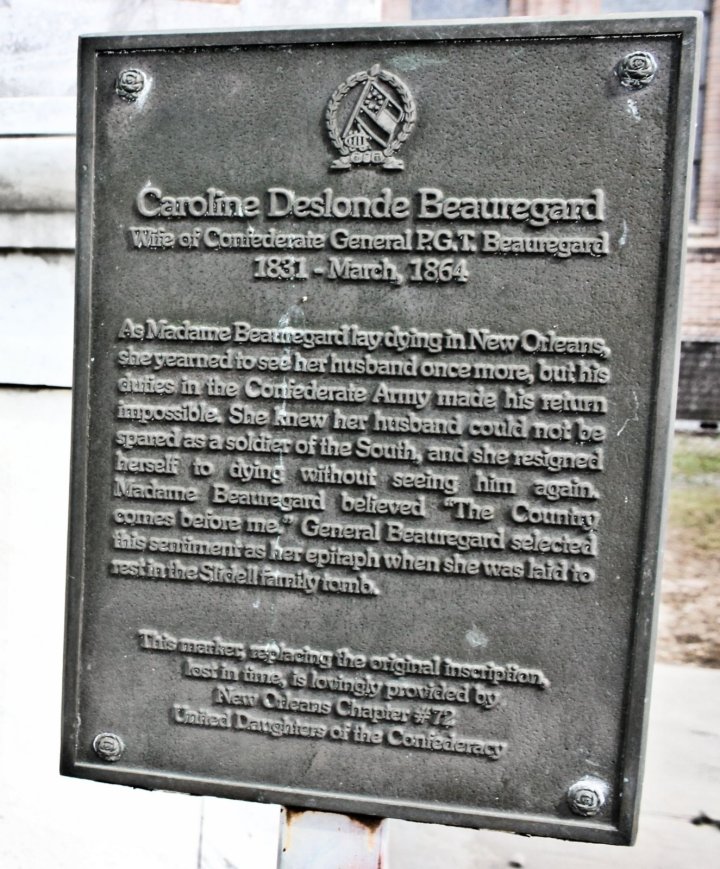
There is a marker there at the cemetery, sponsored by the United Daughters of the Confederacy, that tells Marguerite’s story. It omits both Butler’s invitation for Beauregard to pass through Federal lines to be at Marguerite’s side, and Bank’s provision of military transport and escort to her interment.
Why these particular anecdotes are left out of her story, I cannot say — perhaps the UDC researchers didn’t know about them, or left them off for the sake of space. Neither “Beast” Butler nor General Banks were terribly popular figures in Louisiana, and it’s by no means certain that they were left off the marker by simple happenstance. But whether the omission was deliberate or not, this is a great example of how markers and monuments aren’t, themselves, “history” — they represent a particular point of view, and reflect decisions made by those who created them, about what to include and what not to, to present the story they want to tell about the subject. In short, they don’t reflect historical events so much as they reflect historical events as the monument’s sponsor wants them to be remembered.
That’s worth keeping in mind, next time you hear some nonsense about removing Confederate iconography as “erasing” history, or some such foolishness. The history remains, and quite possibly wasn’t being told fully to start with.
___________
Images via Find-a-Grave.



 | Craig L. on Three Veterans |
 | Andy Hall on Lee, Pickett, and Mosby |
 | ExileDawg on Lee, Pickett, and Mosby |
| Andy Hall on Lee, Pickett, and Mosby |
 Dead Confederates, A Civil War Era Blog


leave a comment