The Attack on U.S.S. New Ironsides
 Virginia native William Thornton Glassell (right, 1831-1879) was a Lieutenant aboard U.S.S. Hartford in Chinese waters when the Civil War broke out. When the ship returned to Philadelphia on December 2, 1861, Glassell refused to take the oath to the United States. He was formally dismissed from the U.S. Navy on December 6, and so was arrested and imprisoned at Fort Warren. In time he was issued a commission by the Confederate government and, now being considered a prisoner of war, Glassell was eventually exchanged. Once in Confederate service, Lieutenant Glassell, C.S.N. assigned to the ironclad Chicora at Charleston.
Chafing for the opportunity to strike more directly at the Federal blockading fleet offshore, Glassell volunteered for duty in one of the more unconventional programs then being organized at Charleston, and took command of the little steam torpedo launch David. These cigar-shaped torpedo boats — the name of the first boat was an allusion to the biblical story of David and Goliath — had ballast tanks that allowed them to run almost completely submerged. They were fitted with a fixed torpedo on the end of a long spar, that could be rammed into the side of an enemy ship. It was a dangerous tactic, as much for the attacker as for the target, but the Confederates at Charleston were increasingly anxious to strike a real blow at the Union Navy. On the evening of October 5, 1863, Lieutenant Glassell and his three-man crew set out to attack the most prominent of the blockading ships offshore, U.S.S. New Ironsides.

 U.S.S. New Ironsides (center) on blockade duty.
The admiral s ship, “New Ironsides,” (the most powerful vessel in the world), lay in the midst of the fleet, her starboard side presented to my view. I determined to pay her the highest compliment. I had been informed, through prisoners lately captured from the fleet, that they were expecting an attack from torpedo boats, and were prepared for it. I could, therefore, hardly expect to accomplish my object without encountering some danger from riflemen, and perhaps a discharge of grape or canister from the howitzers. My guns were loaded with buckshot. I knew that if the officer of the deck could be disabled to begin with, it would cause them some confusion and increase our chance for escape, so I determined that if the occasion offered, I would commence by firing the first shot. Accordingly, having on a full head of steam, I took charge of the helm, it being so arranged that I could sit on deck and work the wheel with my feet. Then directing the engineer and firemen to keep below and give me all the speed possible, I gave a double barrel gun to the pilot, with instructions not to fire until I should do so, and steered directly for the monitor. I intended to strike her just under the gangway, but the tide still running out, carried us to a point nearer the quarter. Thus we rapidly approached the enemy. When within about 300 yards of her a sentinel hailed us: Boat ahoy! boat ahoy! repeating the hail several times very rapidly. We were coming towards them with all speed, and I made no answer, but cocked both barrels of my gun. The officer of the deck next made his appearance, and loudly demanded, “What boat is that?” Being now within forty yards of the ship, and plenty of headway to carry us on, I thought it about time the fight should commence, and fired my gun. The officer of the deck fell back mortally wounded (poor fellow), and I ordered the engine stopped. The next moment the torpedo struck the vessel and exploded. What amount of direct damage the enemy received I will not attempt to say. My little boat plunged violently, and a large body of water which had been thrown up descended upon her deck, and down the smokestack and hatchway.
U.S.S. New Ironsides (center) on blockade duty.
The admiral s ship, “New Ironsides,” (the most powerful vessel in the world), lay in the midst of the fleet, her starboard side presented to my view. I determined to pay her the highest compliment. I had been informed, through prisoners lately captured from the fleet, that they were expecting an attack from torpedo boats, and were prepared for it. I could, therefore, hardly expect to accomplish my object without encountering some danger from riflemen, and perhaps a discharge of grape or canister from the howitzers. My guns were loaded with buckshot. I knew that if the officer of the deck could be disabled to begin with, it would cause them some confusion and increase our chance for escape, so I determined that if the occasion offered, I would commence by firing the first shot. Accordingly, having on a full head of steam, I took charge of the helm, it being so arranged that I could sit on deck and work the wheel with my feet. Then directing the engineer and firemen to keep below and give me all the speed possible, I gave a double barrel gun to the pilot, with instructions not to fire until I should do so, and steered directly for the monitor. I intended to strike her just under the gangway, but the tide still running out, carried us to a point nearer the quarter. Thus we rapidly approached the enemy. When within about 300 yards of her a sentinel hailed us: Boat ahoy! boat ahoy! repeating the hail several times very rapidly. We were coming towards them with all speed, and I made no answer, but cocked both barrels of my gun. The officer of the deck next made his appearance, and loudly demanded, “What boat is that?” Being now within forty yards of the ship, and plenty of headway to carry us on, I thought it about time the fight should commence, and fired my gun. The officer of the deck fell back mortally wounded (poor fellow), and I ordered the engine stopped. The next moment the torpedo struck the vessel and exploded. What amount of direct damage the enemy received I will not attempt to say. My little boat plunged violently, and a large body of water which had been thrown up descended upon her deck, and down the smokestack and hatchway.

The torpedo goes off. I immediately gave orders to reverse the engine and back off. Mr. Toombs informed me then that the fires were put out, and something had become jammed in the machinery so that it would not move. What could be done in this situation? In the mean time, the enemy recovering from the shock, beat to quarters, and general alarm spread through the fleet. I told my men I thought our only chance to escape was by swimming, and I think I told Mr. Toombs to cut the water pipes and let the boat sink. Then taking one of the cork floats, I got into the water and swam off as fast as I could. The enemy, in no amiable mood, poured down upon the bubbling water a hailstorm of rifle and pistol shots from the deck of the Ironsides, and from the nearest monitor. Sometimes they struck very close to my head, but swimming for life, I soon disappeared from their sight, and found myself all alone in the water. I hoped that, with the assistance of flood tide, I might be able to reach Fort Sumter, but a north wind was against me, and after I had been in the water more than an hour, I became numb with cold, and was nearly exhausted. Just then the boat of a transport schooner picked me up, and found, to their surprise, that they had captured a rebel.

Fireman James Sullivan and Engineer Toombs dived overboard with Glassell, as well. Pilot J. Walker Cannon remained with the boat because, some sources say, he could not swim — a remarkable fact, if true, given the semi-submerged nature of his craft, even in the best conditions. Glassell and Sullivan were picked up by Federal picket boats; Toombs scrambled back aboard David and, with Cannon guiding him, managed to return safely to Charleston. In his follow-up report to Confederate authorities, Toombs recounted that “the conduct of Lieutenant Glassell was as cool and collected as if he had been on an excursion of pleasure, and the hope of all is that he may yet be in safety.” Toombs reserrved his highest praise for Cannon, though, who in the engineer’s’ view “has won for himself a reputation that time cannot efface, and deserves well of his country, as, without his valuable aid, I could not have reached the city.” Engineer Toombs succeeded to command of the torpedo boat David.
U.S. Navy Acting Ensign Charles W. Howard, the officer of the deck of U.S.S. New Ironsides who was shot by Glassell, died of his wound on October 10. After Howard’s injury, Admiral Dahlgren had recommended him for promotion to Acting Master, which was formally granted on October 16, 1863, in recognition of his “gallant conduct in face of enemy.” Howard’s remains were subsequently buried in Beaufort National Cemetery. A Wickes Class destroyer, DD-179, was later named for him.
Glassell remained in Union hands until the last few months of the war, when he was again exchanged. This time he was assigned to the naval defenses of Richmond, commanding the ironclad Fredericksburg in the James River Squadron.
After the war, Glassell traveled to California, where his brother Andrew was active in land speculation. The Glassell brothers surveyed much of central and southern California, and Andrew Glassell helped establish the city of Orange, California. William Thornton Glassell died in Los Angeles in January 1879, leaving neither a wife nor children. He is buried in Angelus Rosedale Cemetery in Los Angeles.

Fun fact: William Thornton Glassell’s younger sister, Sarah Thornton Glassell, married George Smith Patton, a Confederate officer killed at the Third Battle of Winchester. The Confederate naval officer who very nearly sank U.S.S. New Ironsides was the grand-uncle of the famous World War II General, George S. Patton, Jr.
_____________

Texas Navy to Recognize Lieutenant Munse Hitchcock, October 21
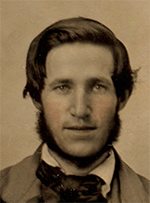 The Texas Navy Association will hold a medallion ceremony for Lent Munson Hitchcock, Jr. (right), on Saturday, October 21, at 10 a.m. at Old Episcopal Cemetery in Galveston.
Hitchcock served as a midshipman and lieutenant in the Republic of Texas Navy in 1836-37. The city of Hitchcock in mainland Galveston County is named in his honor.
“Munse” Hitchcock came from a seafaring family in Connecticut, and joined the Texas Navy as a midshipman aboard the schooner Independence at New Orleans in 1836. He was later commissioned as a lieutenant and served aboard the schooner Brutus.
After resigning his commission in 1837, Hitchcock became a pilot guiding vessels in and out of the harbor at Galveston. He became the first harbor master when Galveston was incorporated as a city in 1838, and went on to serve in multiple public offices.
Hitchcock died in 1869. Several years later his widow, Emily, donated land on the mainland to the Santa Fe Railroad for use as a right-of-way, on condition that they name the station there after her husband. That station stop later grew into the town of Hitchcock.
The Texas Navy Association is a private, 501(c)(3) organization, dedicated to preserving and promoting the historical legacy of the naval forces of the Republic of Texas, 1835-45. Membership in the Texas Navy Association is open to all persons age 16 and over who have an interest in Texas history and want to help support the goals of the organization.


Crowdfunding History: What Did 17th-Century Sailors Really Eat?
There’s a group of students at Texas A&M working on a project to recreate shipboard food from the 17th century, and they’re doing it here in Galveston aboard the 1877 Tall Ship ELISSA. They need only a modest amount of additional funding to complete the project, one that strikes me as both valuable in the sense of generating new knowledge, and simply a lot of fun, as well. I hope you will join me in making a contribution to this project. From their crowdfunding page:

About This Project
Were sailors actually ship-shape–or were they truly a sickly bunch? Find out with us! We are replicating shipboard food using the exact ingredients and methods from the 17th century. Then, a transatlantic voyage is simulated by storing the food in casks and keeping them on Elissa, the 19th century tallship. The nutritional and microbiological data from this project will offer a glimpse into the unique food situation, health, and daily life of past sailors.What is the context of this research?
“[Unsalted food] is rotten and stinking [so] it is necessary to lose your senses of taste and smell and sight just to [consume] it and not sense it,” wrote Eugenio de Salazar, a Spanish explorer to the New World, in 1573. Before canning technologies or refrigeration were invented, food was fermented, salted, or dried to prevent spoilage. Unfortunately, these methods of preservation also decrease the nutritional value of food on lengthy voyages. Previous attempts to gauge the nutritional value of shipboard diets were based on historical documentation or existing USDA nutrition charts that only reflect nutritional values from modern foods, not historical ones.What is the significance of this project?
This project hopes to understand the effects of shipboard diet on the health of sailors by determining the nutritional and microbial intake of seamen on 17th-century English ships by replicating the food items as close to possible as they were in the past.This project will give us great insight into humankind’s shared maritime history and answer some longstanding questions in archaeology and history. We hope to understand how this unique subset of society ate and how this impacted their health, as prior to airplanes, all immigrants who made the transatlantic voyage to the United States came here via ship. Yet, there is little knowledge on the precise conditions of the food 17th-century sailors consumed.
What are the goals of the project?
In this project, shipboard food will be replicated using the exact ingredients and methods of preparation from the 17th century, including non-GMO ingredients, the exact species of plant or animal, and the same butchery methods and cuts of meat. Archaeological and historical data will be used to replicate the salted pork and beef, ship biscuit, wine and beer, and other provisions aboard Warwick, an English race-built galleon that sank in 1619. We will also simulate a trans-Atlantic voyage by storing the food in casks and keeping these in a ship’s hull for three months. Representative samples of food will be sent for nutritional and microbial analysis, including species of microbes, their quantities, and toxins, to understand changes that the food undergoes.
The Experiment.com crowdfunding page is here. As of Saturday morning, they’re about $3,500 short of their goal. This is do-able, y’all!
__________
“That is how slave revolts work.”
Over at Talking Points Memo, Josh Marshall considers a proposal in Richmond, Virginia, to include Nat Turner in an anti-slavery monument:
Virginia had seen Gabriel’s rebellion in 1800 and Charleston, South Carolina had been rocked by the Denmark Vesey uprising in 1822. But critically, neither of these planned insurrections ever happened. The plots were uncovered before they could begin. Most of what we know about all these events either comes from whites or from the testimonies of free or enslaved blacks communicated through whites. They are often ‘confessions’ or under confinement, testimonies from people either facing death or trying to escape it. Most of what we know about Turner, his ambitions, goals, life history comes from a jailhouse interview conducted after he was captured by a lawyer named Thomas Ruffin Gray. Because of this, it is difficult to know how far along these plots were or, possibly, whether some of them were products of panics or paranoia among white slaveholders. But Turner’s rebellion was real and bloody. The write-up in the Richmond Times-Dispatch says Turner is “seen as a freedom fighter by many and a mass murderer by others.” The simple truth is that he was unquestionably both. That is how slave revolts work. . . .
Memorializing Turner or other slave rebels has simply been a step too far in the US, at least until now. In a sense, this is hardly surprising. The South is covered with monuments to men who fought a war to preserve slavery. They are only now starting to come down. Most still stand.
The state of Virginia executed Turner. The state must still consider him a criminal. He hasn’t been pardoned or exonerated. Now it’s memorializing him. That is a sea change and I suspect still a highly controversial one. There are many forms of slave resistance. Most are incremental and small – what the political scientist James C. Scott called the ‘weapons of the weak.’ The most tangible. The ones we know most about is running away.
But slave revolts are inherently violent and uncompromisingly brutal. That is hard for this country, which still honors a legal continuity with a long history of slavery, to grapple with. Because coming to the terms with the brutality of slave revolts brings the brutality and violence of slavery itself to the fore in a way America has seldom publicly faced. It’s like a tight and uncompromising algebraic equation. Honoring Turner means that his actions were laudatory and merit public memorialization. But his actions involved killing families and small children in their beds. If such actions, which are normally among the worst we can imagine, merit praise and public honor, the system they were meant to fight and destroy must have been barbaric and unconscionably violent beyond imagining. Very few of us would contest this description of slavery. But bringing Turner into the discussion of public commemoration will air these issues in a new (I think very positive) and jarring way.
I struggle with this, like Marshall does, like any thinking person does. It’s not easy to square this circle, and I suspect it’s not really possible anyway. What’s important is to have this discussion, which up to now mostly hasn’t happened. It’s high time it does.
_______
Houston Civil War Round Table’s 2017-18 Campaign
The Houston Civil War Round Table’s 2017-18 Campaign kicks off on Thursday, September 21, with a presentation by Brian Matthew Jordan, author of the finalist for the 2016 Pulitzer Prize in History, Marching Home: Union Veterans and Their Unending Civil War. It should be a fine program, but it’s just getting things started for this year. In October, Gary Gallagher will discuss “Another Look at the Generalship of Robert E. Lee,” and in November Eric J. Wittenberg will present “John Buford at Gettysburg.” It’s one helluva roster, y’all:
Sept 21, 2017, Brian Matthew Jordan, Marching Home: Union Veterans and Their Unending Civil War (2017 Vandiver Award Recipient)
Oct 19, 2017, Gary W. Gallagher, Another Look at the Generalship of Robert E. Lee
Nov 16, 2017, Eric J. Wittenberg, John Buford at Gettysburg
Dec 14, 2017, Dennis Trainor, VMI Cadets at New Market
Jan 18, 2018, Edwin C. Bearss, Brice’s Crossroads and Tupelo
Feb 15, 2018, Mark Christ, All Cut to Pieces and Gone to Hell’: Atrocities During the Camden Expedition
Mar 15, 2018, Scott C. Patchan, Second Manassas: Longstreet’s Attack and the Struggle for Chinn Ridge
Apr 19, 2018, Lesley J. Gordon. The 2nd Texas at Shiloh
May 17, 2018, To Be Determined, Holding for 2018 Vandiver Award recipient
I hope many of you will be able to brave the Galleria-area traffic and attend. The Round Table meets for dinner the third Thursday of each month from September to May (except December when the meeting is usually the second Thursday in December) at the Hess Club to hear renowned speakers from across the United States. The Round Table welcomes members and guests alike to any meeting, but it is always necessary to make reservations by 6:00 pm the Monday before a meeting for Dinner or Lecture Only.
6:00 – 6:45 PM: Social Hour with Cash Bar
6:45 – 7:30 PM: Dinner ($32.00)
7:30 – 7:45 PM: Meeting / Quiz / Raffle
7:45 – 8:45 PM: Guest Speaker
Lecture Only – Chairs are available for a small charge to persons who wish to attend the meeting without eating dinner. ($10.00)
The Hess Club’s address is 5430 Westheimer. The club is situated on the corner of Westheimer Way and Westheimer Court. Free, convenient, and handicap-accessible parking is across the street. Valet parking is also available.
The Hess Club
5430 Westheimer
Houston, Texas 77056
Phone: (713) 627-2283
Call Don Zuckero at (TwoEightOne) 479-OneTwoThreeTwo or email him at Reservations at HoustonCivilWar dot com by 6:00 PM the Monday preceding the Thursday meeting.
_______
Texian Navy Days Postponed
From TNA President Jerry Patterson:
Admirals and Friends of the Texas Navy Association:
In light of the effects of Hurricane Harvey, the leadership team of the Texas Navy Association and the hosting Hawkins Squadron in Galveston have decided to cancel the Texian Navy Days events scheduled for September 15-17, 2017, to be rescheduled at a later date to be announced. As of Friday, September 1, evacuations are still underway in flooded areas in East Texas and Louisiana, and we’ve received reports of TNA members with significant damage to their homes and businesses. One critical vendor to the event had to cancel as a result of the storm, and we have not been able to follow up with others. A number of TNA members who had reserved a place at the event have been forced by the situation to cancel their plans.
Although we’re disappointed to have to make this decision, it’s the correct and necessary one. In addition to the logistical challenges brought about by Harvey, the storm has inevitably caused all of us to realign our priorities respond to our own needs, those of our friends and families, and those of our neighbors.
We will be making arrangements to refund those monies already paid to the TNA for registration, and will provide details on that soon. Reservations for lodging at Moody Gardens or other locations must be cancelled by each of you separately; the TNA has no control over that part of the process.
I would like to thank everyone who’s been involved in organizing this event across the TNA. Although we won’t be gathering as planned in two weeks, we believe that we’ve developed a blueprint for a successful event, and look forward to having it on the calendar again soon.
In the meantime, we appreciate your ongoing support, and look forward to corresponding with you again soon. We all face difficult days and weeks ahead but, just as our for-bearers in the Texian Navy did 180 years ago, with diligence and determination we will not only persevere, but thrive.
Sincerely,
Jerry Patterson,
President, Texas Navy Association
_______
CW Naval Paper Models Available
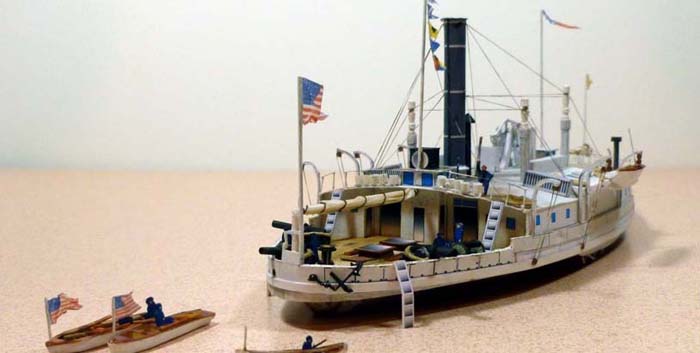
While looking for something else today, I happened on a collection of paper models by the late Magnus Mörck that are available for download as PDF files.
http://modelsnmoore.com/mmork.php
http://modelsnmoore.com/mymodels.php
Individual models:
USS Cairo
USS Carondelet
USS Essex
USS Mendota
Blockade runner Teazer
US Perry (above)
USS Coeur de Lion
Transport Maple Leaf
USS Lehigh
CSS Albemarle
Not all of the links work. I haven’t printed out and assembled any of these, so I can’t speak to their quality, but looks interesting.
_____
Duke Researchers: Hunley’s Crew Killed by Blast Wave

Four and a half years ago, the archaeologists announced that they had confirmed that when the Confederate submersible H. L. Hunley sank USS Housatonic in February 1864, the torpedo they used was still attached to a sixteen-foot iron pole attached to the bow of the boat. They were also able to corroborate that the remains of that copper torpedo match a contemporary drawing of a device claimed to be the same weapon, filled with 135 lbs of black powder. It was a landmark discovery in the process of investigating the wreck itself.
Now, armed with that knowledge, researchers at Duke University believe they’ve determined what actually sank the boat and killed its crew:
Speculation about the crew’s deaths has included suffocation and drowning, but a new study claims that a shockwave created by their own weapon was to blame.
Researchers from Duke University in North Carolina set blasts near a scale model of the vessel to calculate their impact.
They also shot authentic weapons at historically accurate iron plates.
They used this data to work out the mathematics behind human respiration and the transmission of blast energy.
Ms Rachel Lance, one of the researchers on the study, says the crew died instantly from the force of the explosion travelling through the soft tissues of their bodies, especially their lungs and brains.
Ms Lance calculates the likelihood of immediately fatal lung trauma to be at least 85 per cent for each member of the Hunley crew.
She believes the crippled sub then drifted out on a falling tide and slowly took on water before sinking.
‘This is the characteristic trauma of blast victims, they call it “blast lung”, said Ms Lance.
‘You have an instant fatality that leaves no marks on the skeletal remains.
‘Unfortunately, the soft tissues that would show us what happened have decomposed in the past hundred years.’
While I don’t have the scientific background to assess the Duke researchers’ methodology, this seems right to me, and I’ve long thought that whatever died happen must surely have killed or incapacitated the crew almost instantly.
____
Update, Wednesday evening: Here’s a paper from last year arguing that the crew of Hunley did NOT suffocate due to lack of oxygen. So that rules out one of the other major theories.
____
Update, slightly later Wednesday evening: The U.S. Navy History and Heritage Command isn’t so sure:
Navy researchers helping with the official examination of the Hunley have studied the blast wave theory and have their doubts, Naval History and Heritage Command spokesman Paul Taylor said.
“The Navy has already examined the concussive wave theory. We found it highly unlikely to have injured the crew, let alone caused their deaths,” said Taylor, who added the team had not had time to review Lance’s research. . . .
The official scientists working to preserve the submarine in a North Charleston, South Carolina, laboratory, had no comment on Lance’s research, said Kellen Correia, executive director of the Friends of the Hunley. Correia pointed out Lance had no access to the primary evidence from the current research into the sub.
Those official researchers continue their work on several ways the men could have died, including the notion that the submarine had a leak and could not surface, or that the crew ran out of oxygen while underwater.
So maybe something, maybe not. The “fish boat” has fooled people before.
____
h/t Bobby Hughes of the Ships and the Sea Museum in Savannah, Georgia.
Now Houston.
And now this:
A Houston man has been charged with trying to plant explosives at the statue of Confederate officer Richard Dowling in Hermann Park, federal officials said Monday.
Andrew Schneck, 25, who was released from probation early last year after being convicted in 2015 of storing explosives, was charged in a criminal complaint filed in federal court, Acting U.S. Attorney Abe Martinez said in a statement Monday.
Schneck was arrested Saturday night after a Houston park ranger spotted him kneeling in bushes in front of the Dowling monument in the park, Martinez said.
When confronted Saturday night in the park, he tried to drink some of the liquid explosives but spit it out, officials said.
The ranger then asked if he planned to harm the statue, and he said he did because he did not “like that guy,” according to a sworn statement submitted in federal court by an FBI agent investigating the case.
I and others have long argued that each community — whether it’s Houston, Charlottesville, Lexington, Danville, or any other — needs to find its own resolution to publicly-owned displays of Confederate iconography. I still believe that.
But as the saying goes, “life is what happens while you’re busy making plans.” The measured, deliberate, and rational approach has been completely overtaken by events of the last few months, most particularly in Charlottesville. The real question at this point seems to be not whether or not monuments like this should stay, but what can be done with them when they, or at least a great many of them, end up being dismantled or relocated. It’s not longer a question of preserving these monuments in place; it’s a question of whether they can be preserved at all.
You can read my earlier posts about this monument here:
Dick Dowling, Kirby Smith, and the Future of Confederate Monuments
Dick Dowling and the Immigrant’s Call to Arms
_______
Be Careful What You Ask For. . . .
Earlier this evening, a crowd pulled down a Confederate monument in North Carolina. Two thoughts:
First, the people who did this should be prosecuted.
Second, the folks who pushed hard in North Carolina (and other states) for legislation that prevents local governments from moving or altering Confederate monuments on their own property need to acknowledge that in doing so, they’ve made incidents like this MORE likely now, not less. Had Durham County been able to deal with this issue directly, this monument might well have been moved rather than destroyed.
These laws to “protect” monuments by preventing local communities from making their own decisions about them are a bit like tying down the safety valve on a steam boiler — it works great for a while, but it only lasts so long until the whole damned thing blows up.
Boom.
_____




 Dead Confederates, A Civil War Era Blog
4 comments