The Irresistible Appeal of Black Confederates

Photo by JimmyWayne, via Creative Commons License.
Over at Civil War Memory, Kevin highlights photos by Robert Pomerenk of an exhibit on “Blacks Who Wore Gray” at the Old Court House Museum in Vicksburg. The display features an original document, the 1914 pension application for former slave Ephram Roberson — the document explicitly asks for “the number of the regiment. . . in which your owner served” — but is otherwise composed of nothing but printouts of various quotes and well-known photographs of African American men in the field with Confederate troops, or (decades later) participating in reunion activities. At least one of the latter photos is credited to the neoconfederate publication Southern Partisan. The “Chandler Boys” are included, of course, though no one else whose image is displayed in the exhibit is fully identified by name and unit. One old African American man is listed only as “Uncle Lewis,” and others are not identified at all.
In terms of presenting or explaining history, the exhibit is a hopeless mess. Its organization — there actually is no organization or structure to it — is exactly the same as many Black Confederate websites, which amount to nothing more than a hodgepodge of quotes and images, unconnected either to each other or to any larger context, that make reference to African Americans in connection with Confederate troops. Like the typical Black Confederate website, there’s no distinction at all made between men who went to war as slaves and those who might have been free; one wonders if those who compile and present this material before the public have any real sense of the most basic elements of the “peculiar institution.” Several of the men shown in the Old Court House exhibit are explicitly identified as servants; there is no recognition — or at least public acknowledgment — that these men were almost certainly slaves, and had no say in whether they went off to war with their masters or not. There’s virtually no information offered about these men that would allow the visitor to get any sort of understanding of these men’s lives, either in the 1860s or in the early 20th century, as old men. There’s no attempt to flesh out their stories, to understand the details of their experiences either during the war, or after; instead, one is left with random quotes from Nathan Bedford Forrest and paeans “to the faithful slaves, who loyal to a sacred trust, toiled for the support of the Army, with matchless devotion and sterling fidelity guarded our defenseless homes, women and children, during the struggle for the principles of our Confederate States of America.” These men were soldiers, we’re asked to believe, volunteering and fighting for their homes and way of life, but they are never allowed to speak for themselves — the only ones allowed to speak on their behalf are white, and even then only to praise their loyalty and fidelity to the Confederacy.
This effort does nothing to honor these men as men. It is simply an extension of the time-honored “faithful slave” narrative, updated to make it more palatable to a modern audience. The Old Court House Museum differs from other efforts to push the case for Black Confederates only in that they actually go so far as to describe them explicitly as “faithful slaves.”
This exhibit would do far more to further the case for Black Confederates as a group if it proved the case of even a single man — Ephram Roberson, perhaps — and really provided in-depth coverage and explication of his life and role during the war and after, and proved his case as a soldier. Show us his service records, if such exist. Show us his listing in the census. Show us his property records, if there are any, or his obituary. If he was a slave, did he talk to the WPA in the 1930s? Are there contemporaneous letters or diaries from his fellow soldiers that describe his service? Track down his descendants living today and interview them. That is how history is done, through dogged research and building a case from the ground up.
But none of that is present at the Old Court House. There is no discussion of these mens’ supposed military service in the larger context of the war, no discussion of the actions they each fought in, and — most significantly — no firsthand accounts by white soldiers within those same units of their African American comrades’ service. What the Old Court House exhibit (and a hundred others on the web and in print) does is just the opposite; it takes a dozen or fifty or a hundred different, unconnected and disparate snapshots and claims that they form a larger, coherent picture. They don’t. They’re like items pulled from a dozen different families’ albums, scattered and mixed into a single pile on the floor; they do not, can not, tell anything approaching a single, cohesive story, no matter how many times they’re rearranged, e-mailed or Xeroxed.
I want to give the Old Court House Museum a pass on this exhibit, which contributes nothing at all to the making the case for Black Confederates. I began my professional career in small, local history museums not unlike this one. I spent six years, starting as an undergrad and continuing after graduation, part- and full-time, researching, writing, designing and setting up exhibits on local history. After that, I spent two years in grad school getting a masters in the field. I’m trained as a museum professional, though I haven’t worked in one for years. So I don’t walk into any museum as a purely blank slate. I even visited the Old Court House Museum once, years ago, although at the time I paid more attention to the steamboat material on display. And while I don’t know much about the specific resources available to the Old Court House — their administration and staff page is blank — I’ve got a good idea of what their situation is like, and it ain’t pretty. Small history museums like the Old Court House often get little or no direct support from local government, apart from in-kind provision of space and utilities; they have minimal paid staff, and cannot afford to hire people with significant experience or training in the field; they get by hand-to-mouth, year after year, trying to squeak by on a few thousand visitors paying a couple of bucks for admission. They are eager to give space to almost any group or person with a new or provocative idea for an exhibit, particularly if it fits well with the museum’s own preferred image of itself and the community it documents. And, as an organization dependent on the good will of the local business community — think of the chamber of commerce crowd — they’re heavily and inevitably influenced by the wishes of a small number of local patrons who may not know the first thing about history, but have very strong ideas about what they do and do not want showcased in their local museum. You’re welcome to make your own speculation who those folks are in Vicksburg.
Vicksburg looms large in the memory of the Civil War; it has been argued that the Vicksburg campaign, which cemented effective Union control of the Mississippi, was the true turning point of the war. But among the moonlight-and-magnolias image the community likes to present to tourists, it’s easy to forget that Vicksburg remains a small, poor town in a small, poor state. Fewer than 25,000 people live there; they are, on the whole, older and less-educated than the rest of the country. The median household income in Vicksburg is a little over half that of the rest of the United States; one in four families live below the poverty level, compared to one in ten nationally. Three-fifths of Vicksburg’s population is African American, a proportion that is exactly the reverse of Mississippi as a whole. Like many cities in the South, it has an ugly postwar history of racial violence and intimidation.
One might assume that the presence of the Vicksburg National Military Park would reinforce the efforts of local museums like the Old Court House; in fact, I think presence of a major Civil War site in town actually (and inadvertently) undermines the efforts of the local museum in developing a strong historical interpretive program of its own, in two ways. First, the national military park is the heavy hitter in terms of history; those in the area who have the educational background or experience are naturally drawn to the park, whether to work as administrators, guides or volunteers. Second, with the National Park Service providing a solid, but conventional, interpretation of the city’s role in the Civil War, the Old Court House Museum would naturally be drawn into serving as an “alternative” museum, presenting material and ideas that, for whatever reason, the NPS won’t touch. That’s where Black Confederates come in.
The idea of Black Confederates has a ready-made appeal. The contribution of African Americans to military service in this country has often been overlooked by both historians and popular culture. On its face, demanding recognition for African American soldiers who fought for the Confederacy sounds not unlike recognizing the achievements of the Tuskegee Airmen of World War II or the 54th Massachusetts Volunteer Infantry — both groups of African American soldiers who had to fight bigotry and doubt even to win the chance to prove themselves against the enemy. The notion of the existence of Black Confederates, while seeming contradict everything most people remember from school about the South, the war and the institution of slavery, also carries with it a certain conspiratorial appeal as well — this is the secret that Northern history books don’t want you to know. Who wouldn’t want to get let in on something like that? Recognizing African Americans serving in butternut uniforms seems like the right and just thing to do; conversely, those who express skepticism (or reject the notion outright) are easily portrayed as being motivated by elitism, prejudice or other ulterior motives to keep these mens’ service quiet, as has supposedly been done these last hundred and fifty years. They want to deny African Americans in the South their heritage. The Black Confederate narrative has a strong element of conspiracy about it, attributed to those who reject it, and like all good conspiracy theories this one is self-affirming: of course they deny these men’s existence, just like they always have. But we know better, don’t we?
I don’t know how many subscribers to the narrative of African Americans in the Confederate ranks are genuinely sincere but ill-informed and unable to recognize an historiographical con game when it’s foisted on them, and how many are willfully, cynically, spinning a line of “evidence” that they know to be composed of smoke and mirrors. As I said before, I want to give the Old Court House Museum a pass on this exhibit, because I know (or think I do) how vulnerable they are to the whims of a few well-heeled patrons, and how poorly-positioned they are to push back. But it’s hard to give them that pass. They may not know better, but they damn surely ought to.
“I’m a Son of Confederate Veterans as well as a son of slavery.”
Cary Clack, a columnist for San Antonio Life and a descendant of both a Confederate cavalry officer and a slave, attends an SCV meeting and finds it to be an odd, but not-entirely-unpleasant experience:
I’d written a column sarcastically dismissive of Virginia Gov. Bob McDonnell and Texas Gov. Rick Perry. While proclaiming my pride in being a child of the South and Southwest, I took issue with McDonnell’s initial declaration of Confederate History Month — on behalf of the Sons of Confederate Veterans — which ignored slavery, and with Perry’s earlier suggestion of secession.
The Heritage of Honor page on the SCV website didn’t mention the word “slavery” either, but I saw that membership is open to “all male descendants of any veteran who served honorably in the Confederate armed services” and that I qualified.
I wrote, “I’m a Son of Confederate Veterans as well as a son of slavery” and expected an application.
I got one, as well as an invitation to attend the May meeting, from Russ Lane, the affable head of Alamo Camp #1325. I never doubted I’d go, just as I never doubted I would be treated kindly.
Including wives, there were about 30 people in the meeting that began with “the Pledge of Allegiance” to “the United States of America,” which heartened me to know I wasn’t in the presence of secessionists.
Mr. Clack’s take on the encounter is interesting, and doesn’t easily fit into preconceived notions. It’s complicated, that’s for sure, and I hope he continues to write on this particular journey of his. It’s challenging enough thinking about one’s Confederate ancestors, who marched and fought and sometimes died in the uniform of a nation established to preserve and expand the institution of slavery; I can’t even imagine how to begin approaching the knowledge that one of your ancestors considered another to be his personal property.
Juneteenth, Historicity and Tradition
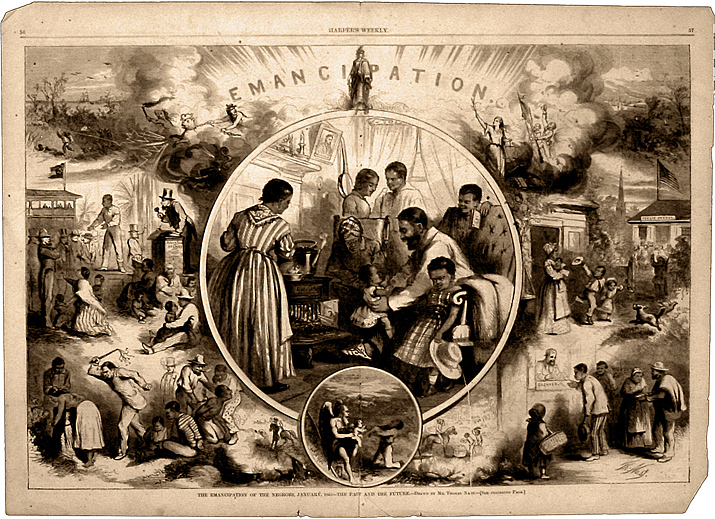
“Emancipation” by Thomas Nast. Ohio State University.
Juneteenth has come again, and (quite rightly) the Galveston County Daily News, the paper that first published General Granger’s order that forms the basis for the holiday, has again called for the day to be recognized as a national holiday:
Those who are lobbying for a national holiday are not asking for a paid day off. They are asking for a commemorative day, like Flag Day on June 14 or Patriot Day on Sept. 11. All that would take is a presidential proclamation. Both the U.S. House and Senate have endorsed the idea.
Why is a national celebration for an event that occurred in Galveston and originally affected only those in a single state such a good idea?
Because Juneteenth has become a symbol of the end of slavery. No matter how much we may regret the tragedy of slavery and wish it weren’t a part of this nation’s story, it is. Denying the truth about the past is always unwise.
For those who don’t know, Juneteenth started in Galveston. On Jan. 1, 1863, the Emancipation Proclamation was issued. But the order was meaningless until it could be enforced. It wasn’t until June 19, 1865 — after the Confederacy had been defeated and Union troops landed in Galveston — that the slaves in Texas were told they were free.
People all across the country get this story. That’s why Juneteenth celebrations have been growing all across the country. The celebration started in Galveston. But its significance has come to be understood far, far beyond the island, and far beyond Texas.
This is exactly right. Juneteenth is not just of relevance to African Americans or Texans, but for all who ascribe to the values of liberty and civic participation in this country. A victory for civil rights for any group is a victory for us all, and there is none bigger in this nation’s history than that transformation represented by Juneteenth.
But as widespread as Juneteenth celebrations have become — I was pleased and surprised, some years ago, to see Juneteenth celebration flyers pasted up in Minnesota — there’s an awful lot of confusion and misinformation about the specific events here, in Galveston, in June 1865 that gave birth to the holiday. The best published account of the period appears in Edward T. Cotham’s Battle on the Bay: The Civil War Struggle for Galveston, from which much of what follows is abstracted.
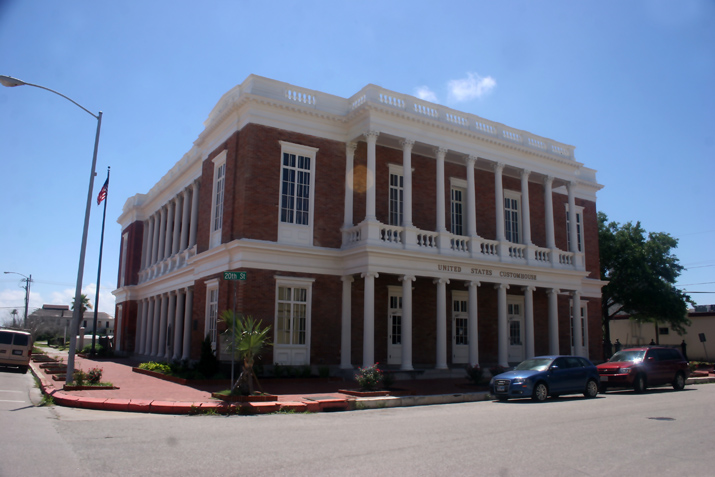
The United States Customs House, Galveston.
On June 5, Captain B. F. Sands entered Galveston harbor with the Union naval vessels Cornubia and Preston. Sands went ashore with a detachment and raised the United States flag over the federal customs house for about half an hour. Sands made a few comments to the largely silent crowd, saying that he saw this event as the closing chapter of the rebellion, and assuring the local citizens that he had only worn a sidearm that day as a gesture of respect for the mayor of the city.

Site of General Granger’s headquarters, southwest corner of 22nd Street and Strand.
A large number of Federal troops came ashore over the next two weeks, including detachments of the 76th Illinois Infantry. Union General Gordon Granger, newly-appointed as military governor for Texas, arrived on June 18, and established his headquarters in Osterman Building (now gone) on the southwest corner of 22nd and Strand. The provost marshal, which acted largely as a military police force, set up in the Customs House. The next day, June 19, a Monday, Granger issued five general orders, establishing his authority over the rest of Texas and laying out the initial priorities of his administration. General Orders Nos. 1 and 2 asserted Granger’s authority over all Federal forces in Texas, and named the key department heads in his administration of the state for various responsibilities. General Order No. 4 voided all actions of the Texas government during the rebellion, and asserted Federal control over all public assets within the state. General Order No. 5 established the Army’s Quartermaster Department as sole authorized buyer for cotton, until such time as Treasury agents could arrive and take over those responsibilities.
It is General Order No. 3, however, that is remembered today. It was short and direct:
Headquarters, District of Texas
Galveston, Texas, June 19, 1865General Orders, No. 3
The people are informed that, in accordance with a proclamation from the Executive of the United States, all slaves are free. This involves an absolute equality of personal rights and rights of property, between former masters and slaves, and the connection heretofore existing between them, becomes that between employer and hired labor. The Freedmen are advised to remain at their present homes, and work for wages. They are informed that they will not be allowed to collect at military posts; and that they will not be supported in idleness either there ro elsewhere.
By order of
Major-General Granger
F. W. Emery, Maj. & A. . G.
What’s less clear is how this order was disseminated. It’s likely that printed copies were put up in public places. It was published on June 21 in the Galveston Daily News, but otherwise it is not known if it was ever given a formal, public and ceremonial reading. Although the symbolic significance of General Order No. 3 cannot be overstated, its main legal purpose was to reaffirm what was well-established and widely known throughout the South, that with the occupation of Federal forces came the emancipation of all slaves within the region now coming under Union control.
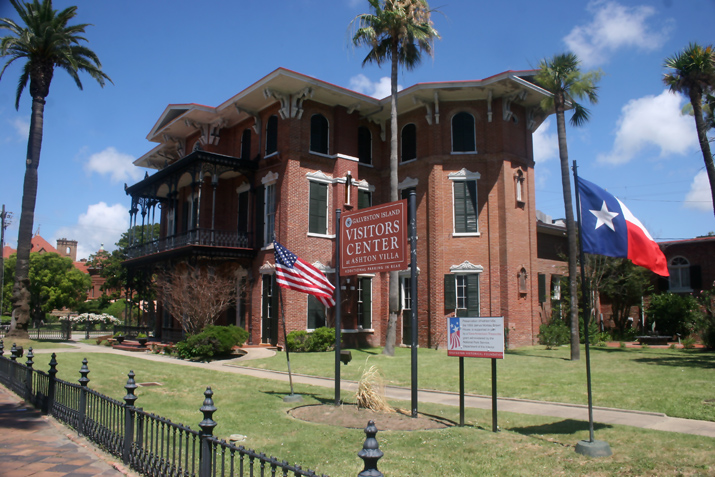
The James Moreau Brown residence, now known as Ashton Villa, at 24th & Broadway in Galveston. This site is well-established in local tradition as the site of the original Juneteenth proclamation, although direct evidence is lacking.
Local tradition has long held that General Granger took over James Moreau Brown’s home on Broadway, Ashton Villa, as a residence for himself and his staff. To my knowledge, there is no direct evidence for this. Along with this comes the tradition that the Ashton Villa was also the site where the Emancipation Proclamation was formally read out to the citizenry of Galveston. This belief has prevailed for many years, and is annually reinforced with events commemorating Juneteenth both at the site, and also citing the site. In years past, community groups have even staged “reenactments” of the reading of the Emancipation Proclamation from the second-floor balcony, something which must surely strain the limits of reasonable historical conjecture. As far as I know, the property’s operators, the Galveston Historical Foundation, have never taken an official stand on the interpretation that Juneteenth had its actual origins on the site. Although I myself have serious doubts about Ashton Villa having having any direct role in the original Juneteenth, I also appreciate that, as with the band playing “Nearer, My God, to Thee” as Titanic sank beneath the waves, arguing against this particular cherished belief is undoubtedly a losing battle.
Assuming that either the Emancipation Proclamation (or alternately, Granger’s brief General Order No. 3) was formally, ceremonially read out to the populace, where did it happen? Charles Waldo Hayes, writing several years after the war, says General Order No. 3 was “issued from [Granger’s] headquarters,” but that sounds like a figurative description rather than a literal one. My bet would not be Ashton Villa, but one of two other sites downtown already mentioned: the Osterman Building, where Granger’s headquarters was located and where the official business of the Federal occupation was done initially, or at the United States Customs House, which was the symbol of Federal property both in Galveston and the state as a whole, and (more important still) was the headquarters of Granger’s provost marshal, Lieutenant Colonel Rankin G. Laughlin of the 94th Illinois Infantry. It’s easy to imagine Lt. Col. Laughlin dragging a crate out onto the sidewalk in front of the Customs House and barking out a brief, and somewhat perfunctory, read-through of all five of the general’s orders in quick succession. No flags, no bands, and probably not much of a crowd to witness the event. My personal suspicion is that, were we to travel back to June 1865 and witness the origin of this most remarkable and uniquely-American holiday, we’d find ourselves very disappointed in how the actual events played out at the time.
Maybe the Ashton Villa tradition is preferable, after all.




 Dead Confederates, A Civil War Era Blog
7 comments