Do Not Read This Post!
Over at SHPG, Administrator John Stones has an earnest warning for the True Southrons™:

The purpose of this post is to encourage each of you to stay away fom [sic.] the blogs of our opposition. By going there you are actually funding their endevours because their advertisers pay them a percentage according to the amount of traffic they have. Their lies are infuriating, I know, but leaving them to their own devices will let them know that they are not affecting our goal of telling the truth of history and our ancestors. You cannot debate with a brainwashed idiot and you cannot seek to convert a fool. Let us focus on those who are interested in the truth that we can have an impact upon. God bless each of you for your desire to stand for truth and may we never waiver from that stand! Deo Vindice!
I’m sure it’s a coincidence that this warning comes so soon after I called out that group’s founder and self-styled CEO for plagiarism. Again.
For the record, there’s no paid advertising on this blog, and never has been. It generates no income, and I bear all the costs out of my own pocket. The advertising banners in the upper right-hand column are uncompensated and unrequested — I put them up on my own because I want to support those products or events.
So SHPG members, feel free to browse here at your leisure — at least until John Stones thinks up some other reason why you shouldn’t.
______________

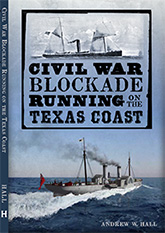
Talkin’ Blockade Runners
 Next Sunday, July 15 at 2 p.m., I’ll be giving a talk, “For-Profit Patriots: Blockade Runners of the Texas Coast.” There will be particular emphasis on two vessels wrecked here in 1865, Will o’ the Wisp and Denbigh. The official blurb:
In the closing months of the Civil War, long, low blockade runners slipped in and out of Texas ports, racing both to keep the Confederacy supplied, and to generate dramatic profits for their owners. It was a risky, high-stakes gamble that was the foundation for many fortunes on both sides of the Atlantic. Almost 150 years later, archaeologists and historians have begun to uncover the stories of these remarkable vessels. The discovery of the paddle steamer Denbigh in 1997, and of a wreck believed to be the famous Will o’ the Wisp in the aftermath of Hurricane Ike, open the door to a long-overlooked story of patriotism, avarice and daring during those last desperate months of the conflict.
Tickets are $10 for Galveston Historical Foundation members and $12 for non-members. The presentation will be at Menard Hall, 33rd Street and Avenue O in Galveston. Reservations may be made with Jami Durham at GHF at 409-765-3409. Hope top see y’all there!
_______
Update, July 16: The talk went well, lots of follow-up Q&A. Seventy folks in attendance, which I understand is a strong turnout for that venue and subject matter. (Especially on a rainy Sunday afternoon.) I was especially glad to see two of my former teachers, Jim Clyburn and Alex Pratt, in the audience. Thanks, y’all!
_____________Image: Hand-colored portrait of an unidentified Confederate blockade runner shown with large Confederate naval flag, Matanzas, Cuba, c. 1865. Southern Methodist University, Central University Libraries, DeGolyer Library.

Celebrating Independence Day in Vicksburg, 1877
[This post originally appeared here on July 4, 2011.]
It’s a common trope that the citizenry of Vicksburg, Mississippi, did not celebrate the Fourth of July until well into the 20th century. While it’s certainly true that the anniversary of the fall of that city to Grant in 1863 continued to resonate with Vicksburg residents down through the years, in fact the date was observed by plenty of local residents, white and black, even if the celebration was unofficial and somewhat more muted there than elsewhere. And they were celebrating it even when the war itself was a recent memory. From the Vicksburg Daily Commercial, July 3, 1877:

To-morrow being the anniversary of our Nations independence, all patriotic citizens of this great Republic are expected to observe it as a holiday. We desire to be reckoned among this class of patriotic citizens, consequently no paper will be issued from this office to-morrow. The glorious Fourth happens to come in hot weather this year, and we are glad to be able to observe it ‘neath the shade of country forests.
And a follow-up, on July 5:
The people of Vicksburg came nearer celebrating the glorious Fourth yesterday than they have done for several years. True, there was no general suspension of business, as indicated by closed doors, but so far as the profits of trade were concerned doors might as well have been closed, for the salesrooms were deserted almost entirely. Everybody was out of town, apparently, enjoying the holiday in some way. Several hundred people attended the Hibernian picnic at Newman’s Grove, and not withstanding the extreme heat, all seemed to enjoy the festivities of the day. The colored population turned out in large force, fully one thousand men of them going down the river on excursion boats to picnic-grounds, yet there were enough of them left in the city to form a very respectable procession of colored Masons, and a very large audience to listen to the oration of Judge J. S. Morris, and to assist in laying the corner-stone of King Solomon’s Church. There was no prolific display of fire-works on the streets, but occasional reports from fire-crackers and large torpedoes could be heard, accompanied now and then by a patriotic cry, “rah for the Fourth of July!” We do not wonder at the lack of patriotic enthusiasm displayed on our streets. No amount of patriotism could have induced any sane man to exert himself very considerably on such a day when the thermometer registered very nearly 100° Farenheit [sic.] in the shade. However, the observance of Independence Day yesterday, slight as some may have thought it, was yet sufficient to indicate the prevalence of a broader National sentiment and a determination to at least partially forget the past which renders the Fourth of July especially distasteful to Vicksburgers, and make it in future “The Day We Celebrate” as much as any other National holiday.
To be sure, the Fourth of July remained a bitter date for many Vicksburg citizens, for a long time. Undoubtedly there are some who still reject the date as one for celebration. But in this, as in so much else about the legacy of the war, the reality is more complex than the mythmakers would have one believe.
_____________

So Long, Ange

Andy Griffith died earlier today, and it’s a little sad. Everyone knows him, of course, for the two iconic teevee roles he created, those of Sheriff Andy Taylor (1960-68), and the seersucker-clad, avuncular defense attorney Ben Matlock (1986-95).
Those roles brought him fame and considerable financial success, but he was a fine actor outside those likeable characters, as well. His first major film role, in 1957, was as Larry “Lonesome” Rhodes in Elia Kazan’s A Face in the Crowd, about a manipulative, alcoholic drifter who becomes a media sensation, a demagogue caught up in a spiral of self-aggrandizement, fame and insecurity. It’s an ugly, if compelling, character.
For pure evil, though, it’s hard to beat Griffith’s portrayal of John Wallace in the 1983 television adaptation of Margaret Anne Barnes’ Murder in Coweta County. The Wallace case is notable for two primary reasons. First, because Wallace was one of the wealthiest men ever sent to the death chamber, and second, because he was reportedly the first white man in Georgia sent there on the testimony of African Americans. It was a landmark case.
It’s an interesting story for me, as well, because I’m related to some folks named Potts from that same part of Georgia, and the family genealogist believes we’re some sort of distant cousin to Coweta County Sheriff Lamar Potts (1901-1971), the man who sent John Wallace to death row. I don’t know if that’s true or not, but I wouldn’t mind a bit if it were.
Anyway, so long, Ange. We’ll miss you.
__________

Test Excavations at Camp Douglas
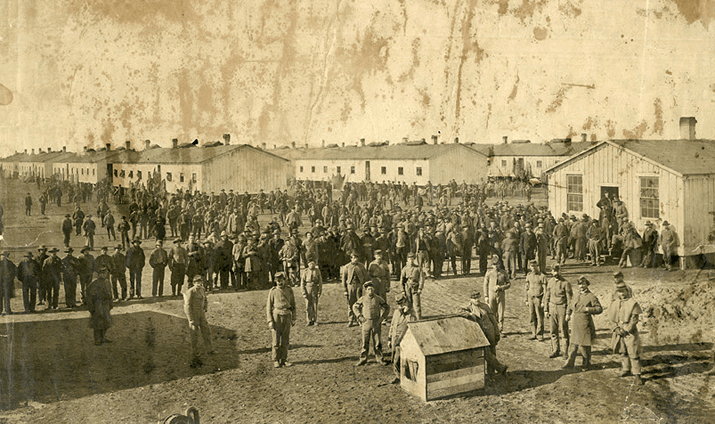
Via Michael Lynch at Past in the Present, archaeologists in Illinois believe they’ve uncovered remnants of Camp Douglas, the infamous Civil War prison camp in Chicago.
Under 150 years worth of accumulated dirt, Demel and his team of mostly volunteer diggers uncovered limestone that likely made up the foundation of Camp Douglas, the most important legacy of Chicago’s role in the War between the States. “It’s exciting,” said Demel, a Northern Michigan University archaeologist, as he stared at a piece of Camp Douglas poking through the dirt for the first time in more than a century. . . . Named after U.S. Sen. Stephen A. Douglas, who owned the 60-acre site where the camp’s 200 buildings stood, Camp Douglas was initially a training site for about 25,000 Union soldiers, many of them black. In 1862 it was adapted as a prison camp. In 1864, anti-war activists staged the “Camp Douglas Conspiracy,” a failed attempt to free prisoners in hopes of disrupting that year’s presidential election, according to the Encyclopedia of Chicago. By the end of the war, more than 4,000 rebel soldiers had died there — and the final resting place for many of them was Oak Woods Cemetery, where such famed black Americans as Harold Washington, Jesse Owens and Ida B. Wells are buried. Camp Douglas was demolished after the Civil War, the wooden posts and limestone structures that remained eventually sinking into the Near South Side earth. Now a small but enthusiastic group of academics and volunteers is trying to bring Camp Douglas back into the city’s consciousness. “This is probably the most significant Civil War site in Chicago,” said historian Robert Girardi, who was at the dig site early Friday morning.
The full story, along with video, is available here (free registration required).
Camp Douglas was located just back from the Lake Michigan shore on the south side of Chicago, not far from present-day White Sox home at Cellular Field.

This image shows the approximate boundaries of Camp Douglas overlaid in Google Earth. The gold star shows the approximate location of the excavation.
_______________

Plagiarism is the Sincerest Form of Flattery
 A couple of years ago, I worked up a long comment over at Kevin’s place about the prevalence of slave-holding in the Confederate states. I later took that initial comment and expanded it into a longer piece that was published both on this blog and as a guest post on Ta-Nehisi Coates’ blog at The Atlantic.
Gary Adams (right), self-styled “Chief Executive Officer” of the SHPG, has repeatedly lifted large segments of my posts on that subject and posted them, without attribution, to that Facebook group. (I know Gary saw my original comment of at Kevin’s, because he posted his own long comment in the same thread.) He’s done this at least twice previously. Today, he’s put up a nearly 800-word Facebook posting that’s lifted verbatim from this blog.
There’s not a single original word in it. About half of it is a long excerpt from Joe Glatthaar’s magnificent General Lee’s Army: From Victory to Collapse, but neither of us is credited as the original authors. Indeed, Gary actually appended his own name at the bottom of the piece.
I realize that, in the grand scheme of the universe, this doesn’t matter for much of anything. And I’m glad Gary thinks enough of my work (and Glatthaar’s) to appropriate it and claim it as his own. But still, it grates, coming from someone who claims the role of “Chief Executive Officer” of a group that wraps itself in self-righteousness and uses words like “honor” and “truth” and “integrity” as cudgels against those with whom they disagree.
So what’s the correct response here, y’all?

Update, July 3: Gary responds with a heaping helping of word salad here. This is, if anything, even less comprehensible than his attempt at refuting Kevin’s published research on Silas Chandler. The main takeaways here seem to be that (1) neither Gary nor his friends are willing to acknowledge the original complaint, and (2) they really, really hate Corey Meyer.
Same as it ever was.
______________
Image: “Me admiring Grant’s Bust” from Gary Adams’ Facebook page.

No Room for Abolitionist Talk in a “Free” Country
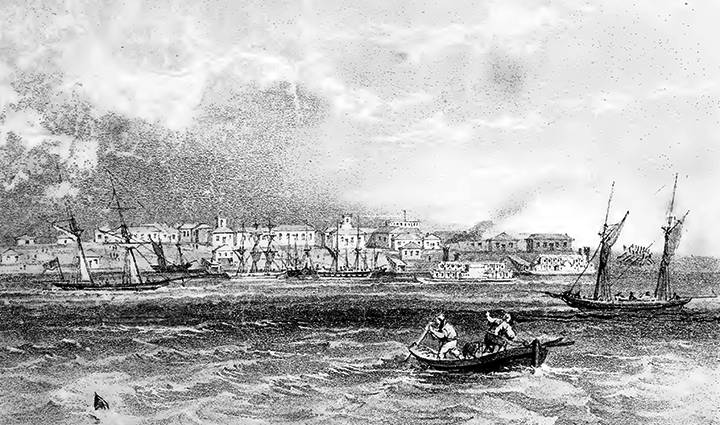
While working on something else, I came across this passage in Matilda Charlotte Houstoun’s Texas and the Gulf of Mexico, or Yachting in the New World, Vol. II (London: John Murray, 1844). Mrs. Houstoun (as she styled herself) was an Englishwoman in her late 20s, who visited Galveston twice during the winter of 1842-43 with her husband, Captain M. C. Houstoun, as they toured the Republic of Texas and other nations around the Gulf of Mexico. Mrs. Houstoun (1815-1892) would go on to a successful career as a novelist, but at this point she was an aspiring author, making notes on her travels:

As on board the steamer, we found the slave question the principal topic of conversation among the good citizens of Galveston. Many of the latter maintained, that individuals have no right to interfere with their lawful property, and were so indignant with the abolitionists, that they banished the principal philanthropist from the city. The person in question was conveyed in a boat to the mainland, and there turned adrift to preach to the inhabitants of the woods and prairies. Another, a black man, and by trade I believe a barber, had likewise incited the displeasure of the inhabitants of Galveston, by advocating the cause of his race in the market-place. He declared his life was in danger, and pretending to be a British subject, claimed the protection of the British minister. One of their own most respected townsmen did not escape their wrath. This person having declared himself opposed to the abolition of slavery, but still inclined to hear the arguments pro and con, was ordered to be silent on the subject. He replied, that his was a free country, where everyone had a right to express his opinions. This right apparently was not acknowledged, for he was put into a boat and sent to the mainland: strange occurrences in a country calling itself free.
Imagine that — Texians responding with anger, threats and even violence against those expressing abolitionist leanings. Why, it’s hard even to imagine such a thing. Oh, wait.
_____________
Image: Galveston harbor in the early 1840s, from Houstoun’s book.

Buh-Bye, Barry.
Barry Landau, the rare-documents dealer who was caught stealing materials from the Maryland Historical Society, will be sentenced later today in federal court in Baltimore. Landau entered a guilty plea last February, admitting that he and his assistant, Jason Savedoff, had an elaborate and extensive scheme for lifting materials — at least 4,000 of them, according to investigators:
Many of the stolen documents are more than 100 years old and some are worth more than $100,000. They include the copies of speeches President Franklin D. Roosevelt read from during his three inaugurations, a land grant signed by President Abraham Lincoln in 1861 and letters written by scientist Isaac Newton, novelist Charles Dickens and French Emperor Napoleon Bonaparte. In a plea agreement signed in February, Landau acknowledged that he and his now 25-year-old assistant Jason Savedoff would visit historical archives and often distract staff while stuffing documents into secret pockets in their clothing. The pair attempted to cover up the thefts by removing card catalog listings for the items and using sandpaper and other methods to remove museum markings, a process they called “performing surgery.”
There’s a good background piece on this case, and the implications for archivists and collections, at the Wall Street Journal. Their modus operandi went beyond secret compartments in their clothing, to just plain ol’ ingratiating themselves to the staff:
Lee Arnold, senior director of the library and collections at the Historical Society of Pennsylvania, recalls a duo with a voracious appetite for documents. He says the pair handled hundreds of boxes of items, visiting 21 times between December and May, and gave out Pepperidge Farm cookies to staff. At the Maryland Historical Society, where the indictment alleges the pair stole roughly 60 documents, a staffer says they tried to charm employees with cupcakes (including a “California Dreamin'” variety with orange citrus-flavored buttercream).
Landau and Savedoff reportedly face up to 15 years for their crimes, though federal sentencing guidelines typically call for much shorter sentences for first-time convictions, or defendants who cooperate with investigators to mitigate the harm they’ve done. I’m not a lock-em-up-and-throw-away-the-key kinda guy, generally, but I’m going to be hard pressed to be sympathetic if the court goes outside the sentencing guidelines and throws the book at these fools. Their actions are, in many ways, more damaging than those of the guy who systematically looted the Petersburg National Battlefield Park. As I said last year, I’ve been to too many collections, and asked to see too many documents listed in the catalog, only to find a note in the folder that reads, “Missing since [date].” The theft of materials from archives — with shrinking staff and often poor security — is a terrible problem. I’ve long believed that a not-insignificant proportion of the documents market is made up from material gone missing from archives, and especially so with autographs; whole letters can often be traced back to their source, but a signature excised from a larger document cannot.
___________
Update, Wednesday afternoon: Landau was sentenced to seven years in prison and $46,000 restitution. His accomplice, Jason Savedoff, pleaded guilty last fall and will be sentenced at a later date.
___________

Old Friends and Small Discoveries

I think my favorite Confederate memoirist must be Val Giles, whose (very) posthumously-published Rags and Hope (Mary Lasswell, ed.) oughter count as one of the great soldier’s accounts of the war. It was published in (as far as I can tell) only a single edition in 1961, and is consequently hard to find.
Apart from its wry observations, self-deprecating humor and mature perspective, Rags and Hope was valuable to me personally for two reasons. First, it served as a sort of surrogate for the experiences of a relative of mine, Lawrence Daffan, who served in the same regiment and went through many of the same battles and ordeals, including imprisonment at Rock Island for the last 18 months of the war. Second, he and Daffan were friends after the war, both being very active in Confederate Veteran activities. I don’t know if they were friends during the war itself, as they were from different parts of the state, and were assigned to different companies. But there were friends later, and Daffan’s daughter — Cou’n Katie in the family — made a grand gesture of placing a little Confederate flag in Giles’ casket at his funeral in 1915.
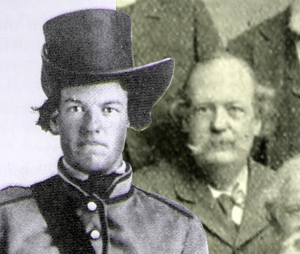 Anyway, I’d long been familiar with the image of Val Giles, as a teenaged recruit in the Tom Green Rifles, posing in the ridiculous top hat his father had insisted on buying him to complete his uniform upon his enlistment in 1861. What I hadn’t seen, until today, was Giles in his later years around the time he started compiling the notes and anecdotes that, decades after his own death, Mary Lasswell would compile into the volume Rags and Hope. Then I happened upon this photo (top) of veterans of the Tom Green Rifles (later Company B, 4th Texas Infantry) in the November 1897 issue of Confederate Veteran. According to the accompanying text, out of over 180 men who passed through that company during the conflict, “less than 20 now survive.”
The eyes haven’t changed in the intervening 36 years.
The man in the back row, far left, is “Uncle” John Price, an African American servant who brought the soldiers rations while under fire at the base of the Little Round Top. Garland Colvin (back row, second from right), the company’s First Sergeant, had been wounded in that same action. He would be wounded again at Chickamauga and taken prisoner in December 1863.
__________

Stonewall Jackson’s “Regiment of Free Negroes”
 Within the smoke-and-mirrors, ignore-that-man-behind-the-curtain game that constitutes advocacy for black Confederate soldiers, one often comes across the claim that Stonewall Jackson commanded two battalions of African American troops. It pops up all over the place, including (briefly) in grade school textbooks in the Old Dominion. Remarkably, with 27 bazillion books published to date on the Civil War, and a fair number of those specifically about Ol’ Blue Light himself, no one’s ever bothered to name those two battalions by their official designation, identify their officers, or point them out on the order of battle for a specific engagement.
I’m not sure where the claim about these battalions originated, but it may be at least in part based on this news item from the front page of the Philadelphia Inquirer of November 27, 1861:

FROM THE UPPER POTOMAC POSITION OF THE REBELS — A FREE NEGRO REGIMENT A letter from Darnestown, Md., dated to-day, says. . . . Gen. JACKSON, who, as Colonel, formerly commanded at Harper’s Ferry, is engaged at Winchester in organizing, arming, and equipping a regiment of free negroes [sic.], said to number fully a thousand. The negroes are reported to be very enthusiastic in their new position.

Rumors and second-hand accounts of African American troops in Confederate service appeared frequently in Northern newspapers, especially during the early part of the war. We’ve seen how a single mention of black troops — from a source that seems dubious to start with — got rewritten and embellished and recycled, over and over, for weeks after the Battle of First Manassas. That one took in a lot of people, including (it seems likely) Frederick Douglass.
So now we’ve got a date (November 1861) and a location (Winchester, Virginia), for at least one (anonymous, second-hand) account of Jackson’s black troops. Anyone who has further details on this regiment — its commanding officer, its official designation, the actions in which it fought, or citations to it in Confederate sources, please drop it in the comments.
I have Fold3 open and waiting.
___________





 Dead Confederates, A Civil War Era Blog
12 comments