Lee, Pickett, and Mosby
Over the last couple of days, this post has received an unusual number of hits. I suspect this is due to Fort Pickett being in the news as it’s renamed as Fort Barfoot, and folks are doing web searches for George Pickett.
In any event, this seems like a good excuse to revisit this post from 2019.


In 1870, not long before Robert E. Lee’s death, John Singleton Mosby visited him while both happened to be in Richmond. Mosby recalled accompanying George Pickett when the latter wanted to call on Lee, but didn’t want to do so alone:
_____________
I met General Lee a few times after the war, but the days of strife were never mentioned. I remember the last words he spoke to me about two months before his death at a reception that was given to him in Alexandria. When I bade him good-by, he said: “Colonel, I hope we shall have no more wars.”
In March 1870, I was walking across the bridge that connected the Ballard and Exchange Hotels in Richmond and, to my surprise, I met General Lee and his daughter. The general was pale and haggard, and did not look like the Apollo I had known in the army…
View original post 280 more words
“He has always voted with the Democrats.”
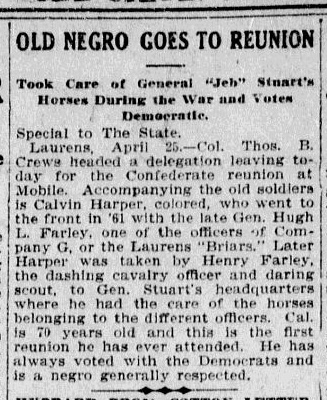
I’ve discussed in previous posts how, when one digs a little into the stories of old African American men who attended Confederate reunions, there’s often a subtext that tells as much about the how the men were perceived at the time of the reunion as it does about their role during the war. What does this item, from the Columbia, South Carolina State newspaper from April 26, 1910, tell readers about Mr. Harper’s wartime status? What distinctions does the paper draw (or imply) between Mr. Harper and the “old soldiers?” What does it say, that this is a news item in 1910? More important, what does it suggest about how he was viewed by white Confederate veterans in 1910?



 Dead Confederates, A Civil War Era Blog
leave a comment