Juneteenth, History and Tradition
[This post originally appeared here on June 19, 2010.]
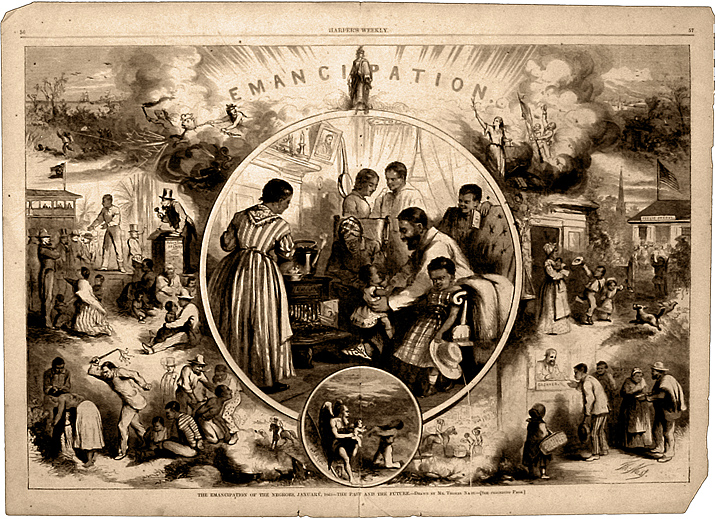
“Emancipation” by Thomas Nast. Ohio State University.

Juneteenth has come again, and (quite rightly) the Galveston County Daily News, the paper that first published General Granger’s order that forms the basis for the holiday, has again called for the day to be recognized as a national holiday:
Those who are lobbying for a national holiday are not asking for a paid day off. They are asking for a commemorative day, like Flag Day on June 14 or Patriot Day on Sept. 11. All that would take is a presidential proclamation. Both the U.S. House and Senate have endorsed the idea. Why is a national celebration for an event that occurred in Galveston and originally affected only those in a single state such a good idea? Because Juneteenth has become a symbol of the end of slavery. No matter how much we may regret the tragedy of slavery and wish it weren’t a part of this nation’s story, it is. Denying the truth about the past is always unwise. For those who don’t know, Juneteenth started in Galveston. On Jan. 1, 1863, the Emancipation Proclamation was issued. But the order was meaningless until it could be enforced. It wasn’t until June 19, 1865 — after the Confederacy had been defeated and Union troops landed in Galveston — that the slaves in Texas were told they were free. People all across the country get this story. That’s why Juneteenth celebrations have been growing all across the country. The celebration started in Galveston. But its significance has come to be understood far, far beyond the island, and far beyond Texas.
This is exactly right. Juneteenth is not just of relevance to African Americans or Texans, but for all who ascribe to the values of liberty and civic participation in this country. A victory for civil rights for any group is a victory for us all, and there is none bigger in this nation’s history than that transformation represented by Juneteenth.
But as widespread as Juneteenth celebrations have become — I was pleased and surprised, some years ago, to see Juneteenth celebration flyers pasted up in Minnesota — there’s an awful lot of confusion and misinformation about the specific events here, in Galveston, in June 1865 that gave birth to the holiday. The best published account of the period appears in Edward T. Cotham’s Battle on the Bay: The Civil War Struggle for Galveston, from which much of what follows is abstracted.
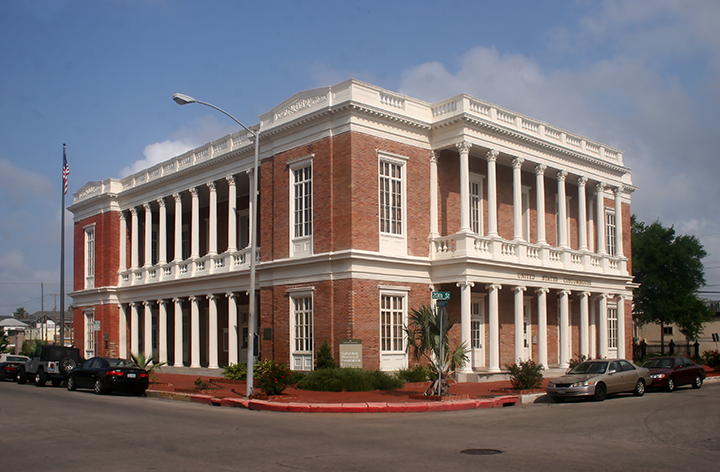
The United States Customs House, Galveston.
On June 5, Captain B. F. Sands entered Galveston harbor with the Union naval vessels Cornubia and Preston. Sands went ashore with a detachment and raised the United States flag over the federal customs house for about half an hour. Sands made a few comments to the largely silent crowd, saying that he saw this event as the closing chapter of the rebellion, and assuring the local citizens that he had only worn a sidearm that day as a gesture of respect for the mayor of the city.
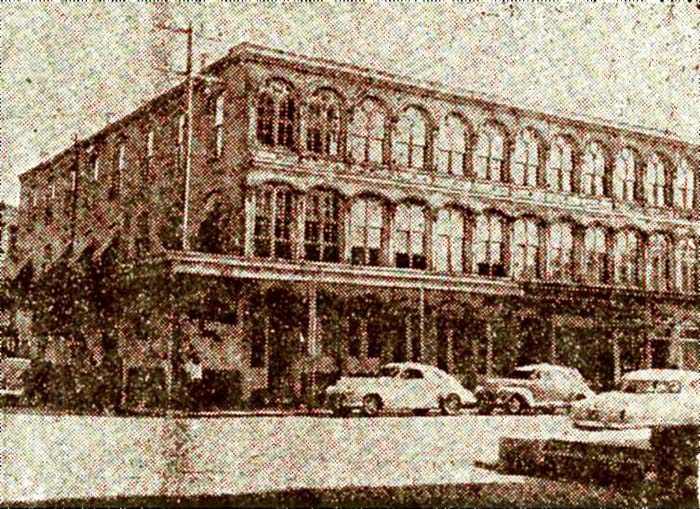
The 1857 Ostermann Building, site of General Granger’s headquarters, at the southwest corner of 22nd Street and Strand. Image via Galveston Historical Foundation.
A large number of Federal troops came ashore over the next two weeks, including detachments of the 76th Illinois Infantry. Union General Gordon Granger, newly-appointed as military governor for Texas, arrived on June 18, and established his headquarters in Ostermann Building (now gone) on the southwest corner of 22nd and Strand. The provost marshal, which acted largely as a military police force, set up in the Customs House. The next day, June 19, a Monday, Granger issued five general orders, establishing his authority over the rest of Texas and laying out the initial priorities of his administration. General Orders Nos. 1 and 2 asserted Granger’s authority over all Federal forces in Texas, and named the key department heads in his administration of the state for various responsibilities. General Order No. 4 voided all actions of the Texas government during the rebellion, and asserted Federal control over all public assets within the state. General Order No. 5 established the Army’s Quartermaster Department as sole authorized buyer for cotton, until such time as Treasury agents could arrive and take over those responsibilities.
It is General Order No. 3, however, that is remembered today. It was short and direct:
Headquarters, District of Texas
Galveston, Texas, June 19, 1865 General Orders, No. 3 The people are informed that, in accordance with a proclamation from the Executive of the United States, all slaves are free. This involves an absolute equality of personal rights and rights of property, between former masters and slaves, and the connection heretofore existing between them, becomes that between employer and hired labor. The Freedmen are advised to remain at their present homes, and work for wages. They are informed that they will not be allowed to collect at military posts; and that they will not be supported in idleness either there or elsewhere. By order of
Major-General Granger
F. W. Emery, Maj. & A.A.G.
What’s less clear is how this order was disseminated. It’s likely that printed copies were put up in public places. It was published on June 21 in the Galveston Daily News, but otherwise it is not known if it was ever given a formal, public and ceremonial reading. Although the symbolic significance of General Order No. 3 cannot be overstated, its main legal purpose was to reaffirm what was well-established and widely known throughout the South, that with the occupation of Federal forces came the emancipation of all slaves within the region now coming under Union control.
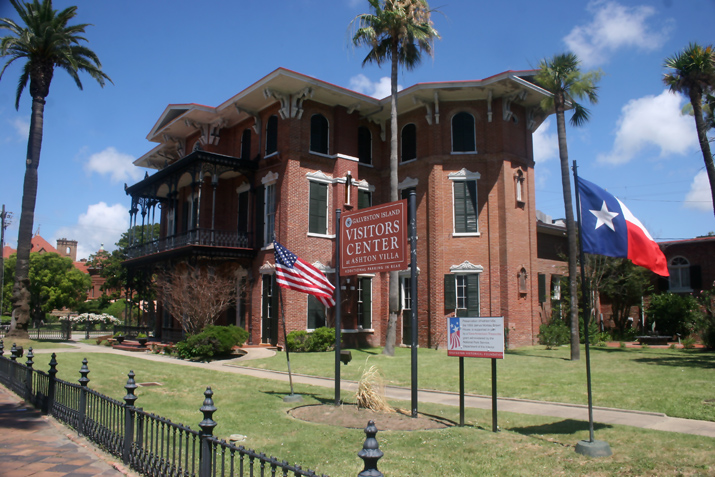
The James Moreau Brown residence, now known as Ashton Villa, at 24th & Broadway in Galveston. This site is well-established in recent local tradition as the site of the original Juneteenth proclamation, although direct evidence is lacking.
Local tradition has long held that General Granger took over James Moreau Brown’s home on Broadway, Ashton Villa, as a residence for himself and his staff. To my knowledge, there is no direct evidence for this. Along with this comes the tradition that the Ashton Villa was also the site where the Emancipation Proclamation was formally read out to the citizenry of Galveston. This belief has prevailed for many years, and is annually reinforced with events commemorating Juneteenth both at the site, and also citing the site. In years past, community groups have even staged “reenactments” of the reading of the Emancipation Proclamation from the second-floor balcony, something which must surely strain the limits of reasonable historical conjecture. As far as I know, the property’s operators, the Galveston Historical Foundation, have never taken an official stand on the interpretation that Juneteenth had its actual origins on the site. Although I myself have serious doubts about Ashton Villa having having any direct role in the original Juneteenth, I also appreciate that, as with the band playing “Nearer, My God, to Thee” as Titanic sank beneath the waves, arguing against this particular cherished belief is undoubtedly a losing battle.
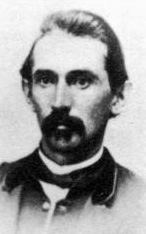 Assuming that either the Emancipation Proclamation (or alternately, Granger’s brief General Order No. 3) was formally, ceremonially read out to the populace, where did it happen? Charles Waldo Hayes, writing several years after the war, says General Order No. 3 was “issued from [Granger’s] headquarters,” but that sounds like a figurative description rather than a literal one. My bet would not be Ashton Villa, but one of two other sites downtown already mentioned: the Ostermann Building, where Granger’s headquarters was located and where the official business of the Federal occupation was done initially, or at the United States Customs House, which was the symbol of Federal property both in Galveston and the state as a whole, and (more important still) was the headquarters of Granger’s provost marshal, Lieutenant Colonel Rankin G. Laughlin (right, 1827-78) of the 94th Illinois Infantry. It’s easy to imagine Lt. Col. Laughlin dragging a crate out onto the sidewalk in front of the Customs House and barking out a brief, and somewhat perfunctory, read-through of all five of the general’s orders in quick succession. No flags, no bands, and probably not much of a crowd to witness the event. My personal suspicion is that, were we to travel back to June 1865 and witness the origin of this most remarkable and uniquely-American holiday, we’d find ourselves very disappointed in how the actual events played out at the time.
Maybe the Ashton Villa tradition is preferable, after all.

Update, June 19: Over at Our Special Artist, Michele Walfred takes a closer look at Nast’s illustration of emancipation.
Update 2, June 19: Via Keith Harris, it looks like retiring U.S. Senator Kay Bailey Hutchison supports a national Juneteenth holiday, too. Good for her.
Update 3, June 19, 2013: Freedmen’s Patrol nails the general public’s ambivalence about Juneteenth:
Exactly right.
______________

Hari Jones Drops the Hammer on National Observance of Juneteenth
[This post originally appeared in 2011.]
Update, June 24, 2018: Via Bryan Cheeseboro, Hari Jones passed away suddenly on Friday. While I differed with his view on Juneteenth as a holiday, he was a powerful and respected contributor in the Civil War history community. He leaves a space that will be impossible to completely fill.

Hari Jones, Curator of the African American Civil War Museum, drops the hammer on the movement to make Juneteenth a national holiday, and the organization behind it, the National Juneteenth Observance Foundation (NJoF). He argues that the narrative used to justify the propose holiday does little to credit African Americans with taking up their own struggle, and instead presents them as passive players in emancipation, waiting on the beneficence of the Union army to do it for them. Further, he presses, the standard Juneteenth narrative carries forward a long-standing, intentional effort to suppress the story of how African Americans, in ways large and small, worked to emancipate themselves, particularly by taking up arms for the Union. He wraps up a stem-winder:
Certainly, informed and knowledgeable people should not celebrate the suppression of their own history. Juneteenth day is a de facto celebration of such suppression. Americans, especially Americans of African descent, should not celebrate when the enslaved were freed by someone else, because that’s not the accurate story. They should celebrate when the enslaved freed themselves, by saving the Union. Such freedmen were heroes, not spectators, and their story is currently being suppressed by the advocates of the Juneteenth national holiday. The Emancipation Proclamation did not free the slaves; it made it legal for this disenfranchised, enslaved population to free themselves, while maintaining the supremacy of the Constitution, and preserving the Union. They became the heroes of the Republic. It is as Lincoln said: without the military help of the black freedman, the war against the South could not have been won.
That’s worth celebrating. That’s worth telling. The story of how Americans of African descent helped save the Union, and freed themselves. Let’s celebrate the truth, a glorious history, a story of a glorious march to Liberty.
One gets the idea that Jones’ beef with the NJoF and its director, Dr. Ronald Myers, is about something more personal than mere historical narrative.
Jones makes a powerful argument, with solid points. But I think he misses something crucial, which is that in Texas, where Juneteenth originated, it’s been a regular celebration since 1866. It is not a modern holiday, established retroactively to commemorate an event in the long past; the celebration of Juneteenth is as old as emancipation itself. It was created and carried on by the freedmen and -women themselves:
Some of the early emancipation festivities were relegated by city authorities to a town’s outskirts; in time, however, black groups collected funds to purchase tracts of land for their celebrations, including Juneteenth. A common name for these sites was Emancipation Park. In Houston, for instance, a deed for a ten-acre site was signed in 1872, and in Austin the Travis County Emancipation Celebration Association acquired land for its Emancipation Park in the early 1900s; the Juneteenth event was later moved to Rosewood Park. In Limestone County the Nineteenth of June Association acquired thirty acres, which has since been reduced to twenty acres by the rising of Lake Mexia.
Particular celebrations of Juneteenth have had unique beginnings or aspects. In the state capital Juneteenth was first celebrated in 1867 under the direction of the Freedmen’s Bureau and became part of the calendar of public events by 1872. Juneteenth in Limestone County has gathered “thousands” to be with families and friends. At one time 30,000 blacks gathered at Booker T. Washington Park, known more popularly as Comanche Crossing, for the event. One of the most important parts of the Limestone celebration is the recollection of family history, both under slavery and since. Another of the state’s memorable celebrations of Juneteenth occurred in Brenham, where large, racially mixed crowds witness the annual promenade through town. In Beeville, black, white, and brown residents have also joined together to commemorate the day with barbecue, picnics, and other festivities.

It’s one thing to argue with another historian or community leader about the the historical narrative represented by a public celebration (think Columbus Day), but it’s entirely another to — in effect — dismiss the understanding of the day as originally celebrated by the people who actually lived those events, and experienced them at first hand.
What do you think?
_____________
h/t Kevin. Image: Juneteenth celebration in Austin, June 19, 1900. PICA 05476, Austin History Center, Austin Public Library.

Dallas Monument Bidder Identified


A Dallas-based law firm placed the winning $1.435 million bid for a statue of Confederate Gen. Robert E. Lee that the city put in an online auction almost two years after removing it from a state park [sic., city park].
Holmes Firm PC made the top offer for the bronze sculpture, according to documents from the Dallas City Council. It was among several Lee monuments around the U.S. that were removed from public view amid the fallout over racial violence in Charlottesville, Virginia, in 2017.
The firm, owned by Ronald L. Holmes, has not said what it plans to do with the statue or whether it is representing someone else who wanted the artwork depicting Lee and another soldier on horses.
Holmes’ firm, which was identified in the auction as “LawDude,” did not immediately respond to requests for comment on Wednesday.
Dallas Assistant City Manager Joey Zapata said the city does not have any plans to auction other Confederate symbols and the money for sculpture would go back into its contingency fund.
The assistant city manager said a task force that reviewed the sculpture along with other monuments and places in Dallas named for Confederate leaders recommended finding a local museum or educational institution to take them.
“So, we’ve tried to find interested institutions and tried and tried and no one was interested,” Zapata said.
It will be interesting to see whether Holmes intends to keep and display the monument, or was actually a straw bidder for someone else.
_________
Image via Fox4, Dallas.

Cannister!

It’s been a while since the last update, so here are a few quick stories that might be worth your attention.
- Nautical archaeologists in Alabama have confirmed a find first tentatively reported last year, the wreck of Clotilda, the last slave ship known to have landed its cargo in the United States.
- Cooper Wingert had a nice piece on the dilemma facing African Americans attached to the Confederate Army as they marched north into Pennsylvania in the Gettysburg Campaign in 1863 in the most recent issue of Civil War Times. You can read it here.
- The City of Dallas sold the Robert E. Lee equestrian statue removed in 2017. The city had set a reserve price of $450K, to recoup its expenses in removing the sculpture; it apparently sold for more than three times that amount. I’ll be curious to see where it goes.
- Bestselling author Tony Horwitz passed away suddenly in Washington, DC, while on a tour for his most recent book. Horwitz is probably best known for his 1998 work, Confederates in the Attic. Chris Mackowski from Emerging Civil War contacted Rob Hodge, the Civil War reenactor who played such a prominent role in that book, for his thoughts on Horwitz’s passing.
- The State of Maine recently adopted “The Ballad of the 20th Maine” as its official State Ballad. Although the legislation passed without opposition, there was (of course) still some whinging that the lyrics “may be unfair to the South.” I’d bet my lunch money these folks were probably just fine with the lyrics of “Maryland, My Maryland.” Such dainty, precious snowflakes.
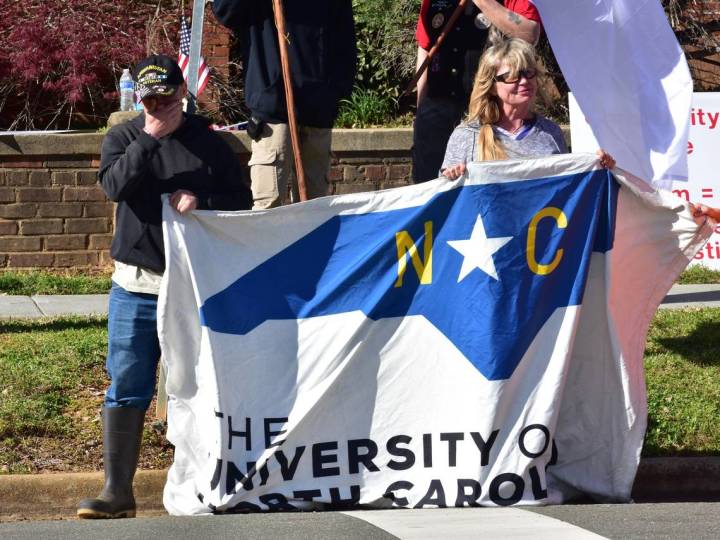
- From the “Heritage, Not Hate” files, two people were charged with defacing a monument and art exhibit at the University of North Carolina back in March. Both are (or were) members of “Heirs to the Confederacy,” an activist group that has staged many protests over the university’s handling of the “Silent Sam” monument. Although the university said early on that they had suspects they were investigating, it probably helped that the two were photographed the day after the vandalism at another rally displaying a custom-made UNC flag matching the one stolen from campus on the same night as the vandalism (above, photo by Tony Crider).
- The American Civil War Museum opened in Richmond last month to good reviews, merging the collections and roles of American Civil War Center and the Museum of the Confederacy. It’s an entirely different sort of museum. Here is Glenn Brasher’s review.
Got any more stories that I missed? Put ‘em in the comments below.
______





 Dead Confederates, A Civil War Era Blog
4 comments