Make a Place on the Shelf for This One


Congratulations to my friend and colleague Kevin Levin, whose new book Searching for Black Confederates now has a cover and an August release date. It’s been a long time coming, this one.
______

Moving Day at the MoC, and Other Stuff
Last week the Museum of the Confederacy in Richmond began moving its collections from its old location in the middle of the VCU Medical Center to its new location at Tredegar, where a new, expanded exhibition facility will open in May 2019 under the aegis of the American Civil War Museum. The MoC closed that location to the public in September, although the adjacent “White House of the Confederacy” remains open for tours. Although this move has been an obvious and inevitable part of the consolidation of the MoC and the American Civil War Center at Historic Tredegar that was announced five years ago, and referenced many times since, the actual sight of moving vans outside the old MoC facility has set off the usual bluster and shouty nonsense it did back then. Longtime readers may recall that in August 2014 the Virginia Division of the SCV was soliciting funds to fight that merger in court; I wonder whatever became of that, because as far as I know they never actually, you know, filed a lawsuit. So what happened to the money?
As Kevin notes, the Battle Flag taken down from the State House grounds in Columbia, South Carolina in 2015 has gone on display in the South Carolina Confederate Relic Room and Military Museum, with an accompanying caption that completely ignores the events and rationale that led to its removal in the first place. Kevin calls this a “betrayal of the Charleston Nine,” and he’s right. I’ll add only two additional descriptors: cowardly and dishonest.
Also in South Carolina, the South Carolina Secessionist Party, which has been the most prominent and vitriolic heritage group in the state, has formally dissolved because — well, it’s not quite clear why. Based on a close reading of the article, it sounds like the group may have become too extremist for its long-time chairman, James Bessenger, who said that “the organization was taking a turn I didn’t want it to take.” Lie down with dogs, etc.
A few weeks ago the Texas State Preservation Board voted to remove the “Children of the Confederacy” plaque in the Capitol in Austin, which was done shortly thereafter. While the plaque had been the subject of controversy for some time, the move by the Preservation Board caught some folks off-guard. This past Friday, the board convened a meeting to discuss what should become of the plaque, and they got an earful from folks opposed to the move, particularly without having had a period for public comment before making their decision to remove it in the first place. In Friday’s meeting, the board ended up putting off a final decision on the disposition of the plaque until after a 90-day waiting period for public comment. Perhaps the way forward was suggested by Martha Hartzog of the UDC, who argued since the plaque was never formally gifted to the State of Texas, it should be returned to the UDC are the parent organization of the Children of the Confederacy group. That seems workable to me. (Full disclosure here: Martha is a friend of mine.)
In 2017 the City of Dallas removed a large equestrian statue of Robert E. Lee from a local park. Recently the city began removing the granite plinth on which it sat, prompting a new lawsuit by Warren Johnson, head of a group called “Return Lee to Lee Park.” (Johnson is apparently a plaintiff in a separate lawsuit over the removal of the statue itself.) Johnson claims that the removal of both the statue and the base violates his own First Amendment rights, which seems to me to be a non-starter; no government or organization is obligated to place or maintain a monument simply because Johnson (or you, or I) think they should. Johnson also argues that the City of Dallas is “exercising viewpoint discrimination against works of art,” which reflects a recent narrative among the heritage folks that Confederate monuments should be preserved irrespective of their subject or content, simply for their aesthetic properties as works of art. I honestly doubt that argument will stand in court, given the Supreme Court’s 2015 ruling in Walker v. Texas SCV that states (and presumably their subdivisions, like counties and cities) have their own autonomy to decide what message they will convey through their own property.
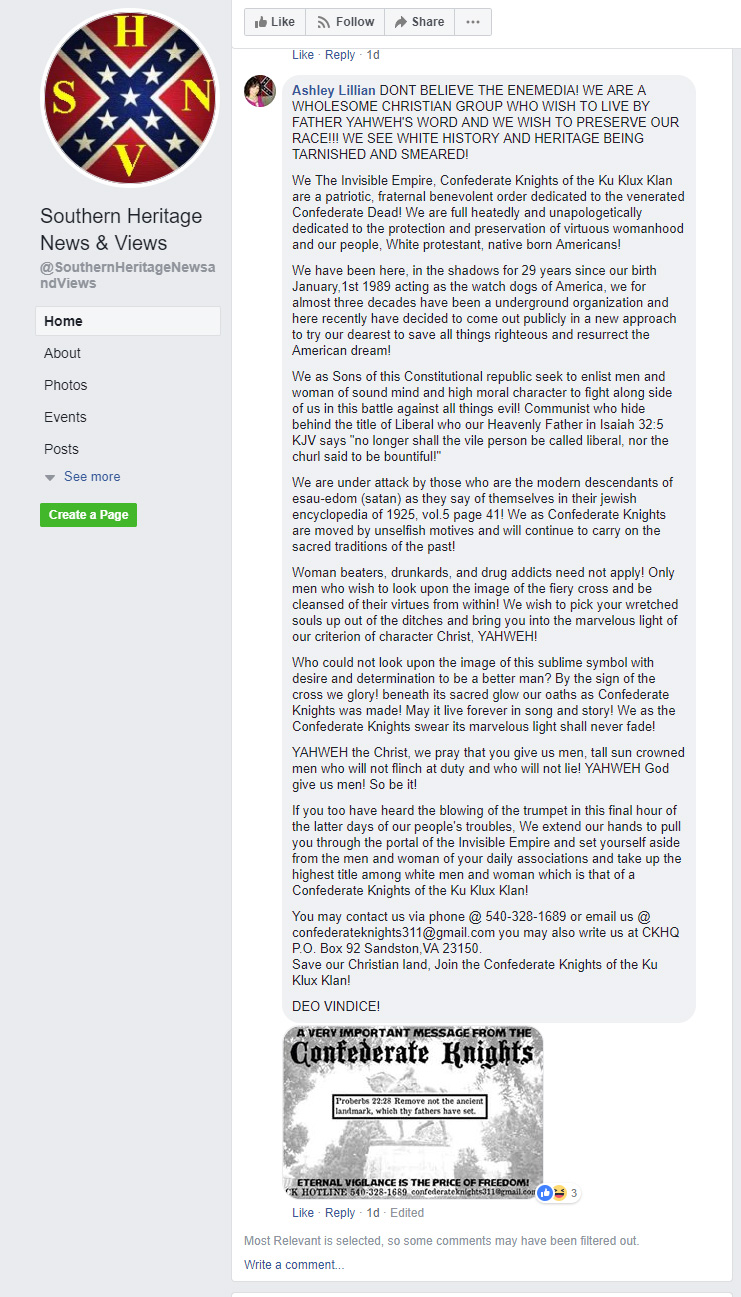
Finally, in response to a posting about the Dallas lawsuit at the Southern Heritage News & Views, there are a long series of responses promoting the white identity movement, rancidly anti-Semetic tropes, and straight-up advertising for the Confederate Knights of the Ku Klux Klan. (Here’s a screen shot of that last one, in the event it gets taken down.) Useful to know who these folks are, what they believe, and who they are willing to have in their ranks.
______

Happy Birthday, General!
Today, January 19, we celebrate the birthday of a famous Confederate general: Edgar Allan Poe.
If you haven’t read it, and enjoy alt-fiction, I recommend Walter Jon Williams’ short story/novella, “No Spot of Ground,” available on Kindle. In Williams’ alternate history, Edgar Allan Poe does not die in a dissipated, incoherent condition in a Baltimore charity hospital in 1849, but recovers to conquer his alcoholism with the help of a wealthy Maryland widow, marries the widow’s beautiful young daughter, and founds a successful literary magazine. With the coming of the war, Poe goes south and obtains a commission as a Colonel in the Confederate army.
Poe is old for field command — just two years younger than Robert E. Lee, to the day — but he manages to advance in spite of his prickly relations with his fellow officers. Poe is personally brave enough, but hardly an heroic figure. As depicted by Williams, Poe is vain, dismissive of the skills of other officers, considering them to be his social and intellectual inferiors. They are, he believes, mere vulgar prose in contrast to his elevated poetry. Poe is utterly paranoid about their plots against him. Every burble of disorganization or mislaid communication in the field — things that a later generation would refer to with the acronym SNAFU –Poe views as part of a larger plot to make him look like an incompetent. Poe has little regard for the common Confederate soldier and, one imagines, the feeling is mutual. Poe imagines the entire Federal army facing him across the lines. Williams also gives the reader a glimpse of Poe’s obsession with romantic death, and his inability to move past the loss of his first wife, Virginia Clemm (1822-47), even though he assures himself he’s moved on. Unlike the Confederate officers of another recent bit of Civil War fiction, here Poe carries all the prejudices and attitudes of his day and place.
The main action of Williams’ tale takes place in late May 1864, when Poe unexpectedly takes command of George Pickett’s division at Petersburg, and moves with them into the line north of Richmond near Hanover Junction, just after the Battle of North Anna during the Overland Campaign. But much of the story is told in flashback, including a segment where Poe commands one of Pickett’s brigades in the famous assault on the third day at Gettysburg:
______
The sound was staggering, the banging and the clanging of the guns, guns, guns, but fortunately Poe had nothing to do but keep his feet moving forward, one after another. The officers had been ordered to stay dismounted, and all had obeyed but one: Dick Garnett, commanding the brigade on Poe’s left, was too ill to walk all that way, and had received special permission to ride.
Garnett, Poe knew, would die. The only mounted man in a group of twelve thousand, he was doomed and knew it.
Somehow there was an air of beauty about Garnett’s sacrifice, something fragile and lovely. Like something in a poem. The cemetery, their target, was way off on the division’s left, and Pickett ordered a left oblique, the entire line of five thousand swinging like a gate toward the target. As the Ravens performed operation, Poe felt a slowly mounting horror. To his amazement he saw that his brigade was on the absolute right of the army, nothing beyond him, and he realized that the oblique exposed his flank entirely to the Union batteries planted on a little rocky hill on the Yankee left.
Plans floated through his mind. Take the endmost regiment and face it toward Yankees? But that would take it out of the attack. Probably it was impossible anyway. But who could guard his flank?
In the meantime Pickett wanted everyone to hit at once, in a compact mass, and so he had the entire division dress its ranks. Five thousand men marked time in the long grass, each with his hand on the shoulder of the man next to him, a maneuver that normally took only a few seconds but that now seemed to take forever. The guns on the rocky hill were plowing their shot right along the length of the rebel line, each shell knocking down men like tenpins. Poe watched, his nerves wailing, as his men dropped by the score. The men couldn’t finish dressing their ranks, Poe thought, because they were taking so many casualties they could never close the ranks fast enough, all from the roaring and the soaring of the guns, guns, guns. . . He wanted to scream in protest: Forward! Guide center! but the evolution went on, men groping to their left and closing up as the shells knocked them down faster than they could close ranks.
Finally Pickett had enough and ordered the division onward. Poe nearly shrieked in relief. At least now the Yankees had a moving target.
But now they were closer, and the men on the Yankee ridge opened on Poe’s flank with muskets. Poe felt his nerves cry at every volley. Men seemed to drop by the platoon. How many had already gone? Did he even have half the brigade left?
The target was directly ahead, the little stand of trees on the gentle ridge, and between them was a little white Pennsylvania farmhouse, picture-book pretty. Somewhere around the house Poe and his men seemed to lose their sense of direction. They were still heading for the cemetery, but somehow Garnett had gotten in front of them. Poe could see Garnett’s lonely figure, erect and defiant on his horse, still riding, floating really, like a poem above the battle.
The cemetery was closer, though, and he could see men crouched behind a stone wall, men in black hats. The Iron Brigade of Hancock’s Corps, their muskets leveled on the stone wall, waiting for Garnett to approach. . . .
And then suddenly the battle went silent, absolutely silent, and Poe was sitting upright on the ground and wondering how he got there.
______
“Children of the Confederacy Creed” to be Removed from Texas Capitol
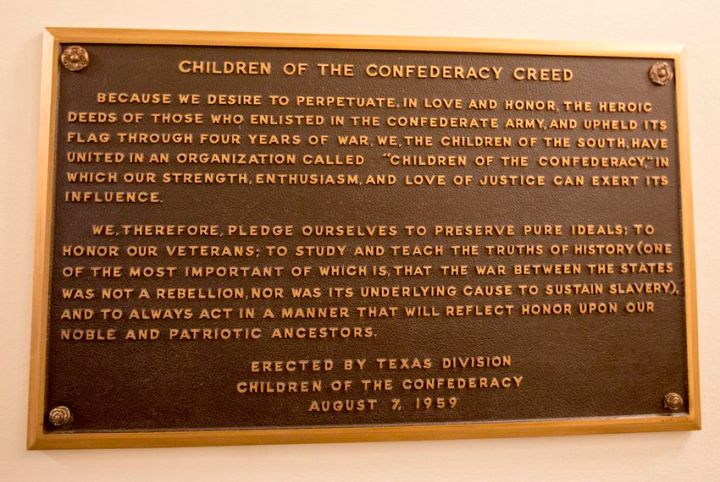

AUSTIN, Texas (AP) — Texas Gov. Greg Abbott agreed Friday to remove a plaque in the state Capitol that rejects slavery as the underlying cause of the Civil War, bending after years of resistance by state Republican leaders in the face of Confederate monuments falling nationwide.
A unanimous vote by the State Preservation Board, which Abbott chairs, ordered the removal of the 60-year-old plaque that pledges to teach “the truths of history,” adding that “one of the most important of which is that the war between the states was not a rebellion, nor was its underlying cause to sustain slavery.”
The push to do this has been building for a while. Unlike other Confederate monuments on the Capitol grounds in Austin, this plaque was not placed by actual Confederate veterans; it was put up in 1959, coincident with a lot of pushback against the growing Civil Rights Movement.
It’s notable, I think, that half of the six-member State Preservation Board, that voted unanimously for removal of the plaque, is composed of the three most powerful elected officials in the state, and all of them Republicans — Governor Greg Abbott, Lieutenant Governor Dan Patrick, and House Speaker Dennis Bonnen. Although the plaque itself is obscure and probably goes unnoticed by almost all of the thousands of people who visit the Capitol every day, it’s nonetheless an important milestone, evidence that now the rejection of Confederate iconography is bipartisan.
________
h/t Al Mackey




 Dead Confederates, A Civil War Era Blog
4 comments