Guerrilla Memorial

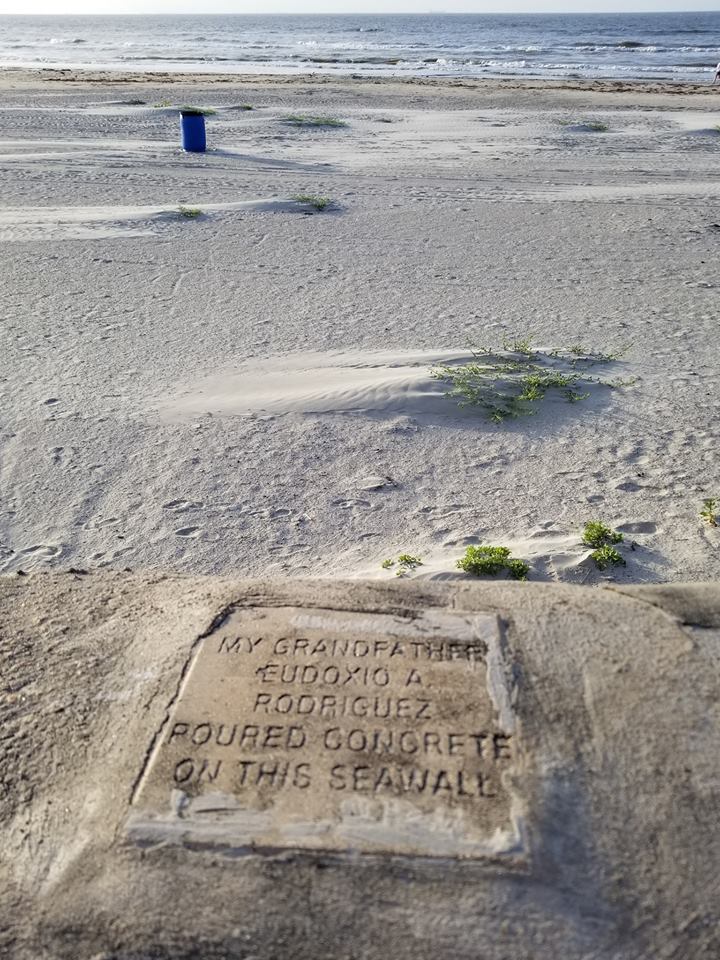
Recently a local FB user posted this image of a tiny (about eight inches square) marker set into the top of the Galveston Seawall. It’s totally unofficial. A quick check of online genealogy resources and newspapers tells us that Eudoxio “Eddie” Rodriguez was born in Mier, Tamaulipas, Mexico in November 1881, emigrated to the United States in 1899 or 1900, and soon thereafter was working as a laborer on building the Galveston Seawall, around 1902-03. In 1910 he was still in Galveston, working as a day laborer. He was apparently active in community affairs, as in 1926 (still living in Galveston), he was elected to the post of Treasurer of the a local Woodmen of the World lodge. By 1940 he was head of a large family, owned his own home at 3814 Sealy, and was working as a bottler at the Galveston-Houston Brewery. It was a solid job, that he reported in the 1940 Census had paid over $1,800 the previous year – not a small thing, coming out of the Great Depression. (His eldest son, 26-year-old Philip, lived with the family and made almost as much as a tank cleaner at the brewery.) The average income reported in the census in 1940 (the first to record that information) was $1,368, which places the Rodriguez pretty squarely in the lower middle class. In 1942, at the age of 60, Eudoxio registered for the “old man’s draft” for military service. Eudoxio Rodriguez died in Houston in 1959. A funeral mass was held Sacred Heart Catholic Church in Galveston, and he was interred at Old Catholic Cemetery, just off Broadway in Galveston.
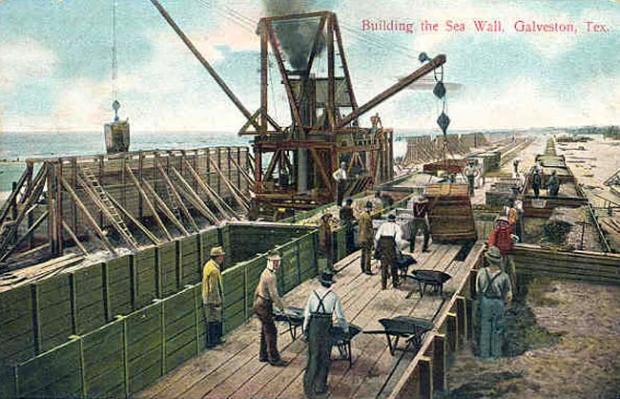
Eudoxio Rodriguez is not a famous person, nor did he lead the sort of life that attracts a lot of headlines or notoriety. But one of his many grandchildren thought he should be remembered, and that’s pretty awesome.
_________
Marker photo by Barry Landry.

Talkin’ Steamboats, Thursday in Houston


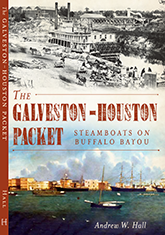
This coming Thursday, July 12, I’ll be speaking on the history of steamboating on Buffalo Bayou, and the competition between Galveston and Houston for commercial dominance in 19th century Texas. My hosts will be the Harris County Chapter of the Texas German Society, that will meet at 6:45 p.m. Thursday at the Trini Mendenhall Sosa Community, 1414 Wirt Road.
Hope to see y’all there!
______
Image: Buffalo Bayou Sidewheeler DIANA at Galveston, via Richard Eisenhour.
Paroled at Vicksburg
From 2010:
__________

Sunday marked the 147th anniversary of the end of the siege of Vicksburg. One of the Confederate soldiers taken prisoner that day was 26-year-old William C. Denman (1836-1906), a private in Company B, 30th Alabama Infantry. William Denman grew up with four younger siblings in Calhoun County, Alabama, where his widower father, Blake Denman, was a well-to-do farmer. The elder Denman was a slaveholder. William enlisted in the 30th Alabama on March 5, 1862. The regiment served in the western theater and, as part of S. D. Lee’s Brigade, saw action in several skirmishes. It suffered heavy casualties at Champion’s Hill (May 16, 1863), where it suffered 229 killed, wounded and missing — roughly half its numbers. Retreating in the face of Union General Grant’s army, Confederate forces including the 30th Alabama withdrew into Vicksburg, where they were quickly trapped between the Federal army to the east and the Federal Navy on the Mississippi. As part of S. D. Lee’s brigade, the 30th Alabama was assigned the defense of the Railroad Redoubt, one of the strong points in the Vicksburg defenses. The fort was overrun in a bloody assault on May 22, but eventually recaptured after Confederate troops regrouped and counterattacked.
After a hard siege lasting several weeks, the Confederate general commanding at Vicksburg, John C. Pembeton, surrendered his force to Grant on July 4. Private Denman, along with about 18,000 other Confederate soldiers, was paroled a few days later.Grant described this process in his memoir:
Pemberton and his army were kept in Vicksburg until the whole could be paroled. The paroles were in duplicate, by organization (one copy for each, Federals and Confederates), and signed by the commanding officers of the companies or regiments. Duplicates were also made for each soldier and signed by each individually, one to be retained by the soldier signing and one to be retained by us. Several hundred refused to sign their paroles, preferring to be sent to the North as prisoners to being sent back to fight again. Others again kept out of the way, hoping to escape either alternative. . . .
As soon as our troops took possession of the city guards were established along the whole line of parapet, from the river above to the river below. The prisoners were allowed to occupy their old camps behind the intrenchments. No restraint was put upon them, except by their own commanders. They were rationed about as our own men, and from our supplies. The men of the two armies fraternized as if they had been fighting for the same cause. When they passed out of the works they had so long and so gallantly defended, between lines of their late antagonists, not a cheer went up, not a remark was made that would give pain. Really, I believe there was a feeling of sadness just then in the breasts of most of the Union soldiers at seeing the dejection of their late antagonists.
The 30th Alabama, like several other surrendered units from Vicksburg, was reorganized a short while later, and it appears that Denman continued with this reconstituted regiment. (The reorganization of these units using men who had been paroled became a subject of dispute between Union and Confederate forces, which the following year caused the Union to suspend almost all parole for captured Confederate soldiers.) In January 1864, Denman transferred to a cavalry regiment, in which he remained to the end of the war.
After the war Denman married Sarah Crankfield (1847-1932), of South Carolina. They lived in Alabama and Louisiana before settling in Marion County, Florida in 1875. There they farmed and, in their later years, operated a boarding house. They had ten children together, but only two survived to adulthood. In 1900 Denman applied for a pension based on injuries received in the war, claiming he was “incapacitated for manual labor” as a result of eating pea bread, an ersatz bread made of ground stock peas and cornmeal, during the siege of Vicksburg. It resulted, Denman claimed, in chronic gastritis and bilious dyspepsia. He died in 1906.
________




 Dead Confederates, A Civil War Era Blog
4 comments