For the Ferroequinologists
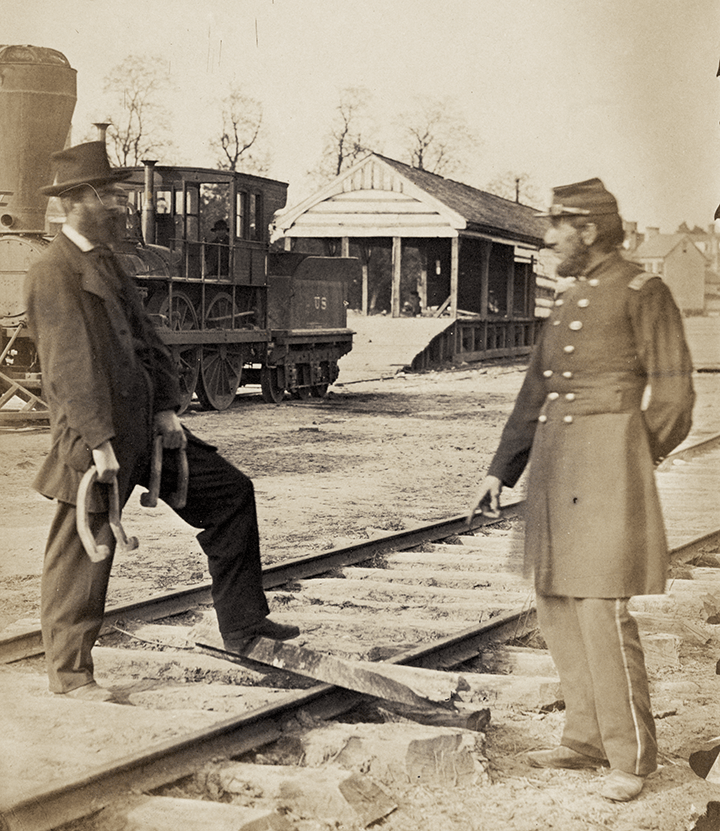

A few years ago I happened on this Library of Congress image, and wondered what the implements carried by the man at left were. My guess was that they were handles of some sort for carrying rail. I was on the right track (so to speak), but thanks to a colleague on Facebook, the answer is even more interesting for CW train buffs. It’s described (and this same image included) in Herman Haupt’s memoir:
Other experiments were made on old sidings near Alexandria to determine the best mode of rapidly destroying tracks. The usual mode adopted by the enemy had been to tear up the rails, pile the cross ties, place the rails upon them, set the pile on fire, and bend the rails when heated. I found this mode entirely too slow, as several hours were required to heat the rails sufficiently and, when bent, we could generally straighten them for use in a few minutes, in fact, in less than one-tenth of the time required to heat and bend them.
We had been experimenting for some time with no results that I considered satisfactory, when one day [E. C.] Smeed came into my office with a couple of U-shaped irons in his hands (see illustration on page 111) and exclaimed: “I’ve got it!” “Got what?” I asked. “Got the thing that will tear up track as quickly as you can say ‘Jack Robinson,’ and spoil the rails so that nothing but a rolling mill can ever repair them.”
“That is just what I want,” was my reply; “but how are you to do it with that pair of horseshoes ?”
He explained his plan. The irons were turned up and over at the ends so as firmly to embrace the base of the rail. Into the cavity of the U a stout lever of wood was to be inserted. A rope at the end of the lever would allow half a dozen men to pull upon it and twist the rail. When the lever was pulled down to the ground and held there, another iron was to be placed beside it, and another twist given, then the first iron removed and the process repeated four or five times until a corkscrew twist was given to the rail. After hearing the explanation, I said: “I think it will do; let us go at once and try it.” Smeed’s plan was found to answer perfectly, and the problem of the simplest and quickest mode of destroying track was satisfactorily solved.
I don’t know if the men shown are Smeed and Haupt, but I suspect they are.
_________

July 4, 1863: Vicksburg Falls


One hundred fifty-four years ago today, Vicksburg fell to General Grants army after a siege of 46 days. My great-great-grandfather, William Colder Demnan of the 30th Alabama Infantry, was one of the 18,000 Confederate troops surrendered on that day. The Confederate commander, Pemberton, later said he chose Independence Day to surrender because he felt he could get better terms of surrender on that day than on any other.
Grant wrote of the aftermath in his memoirs:
Pemberton and his army were kept in Vicksburg until the whole could be paroled. The paroles were in duplicate, by organization (one copy for each, Federals and Confederates), and signed by the commanding officers of the companies or regiments. Duplicates were also made for each soldier and signed by each individually, one to be retained by the soldier signing and one to be retained by us. Several hundred refused to sign their paroles, preferring to be sent to the North as prisoners to being sent back to fight again. Others again kept out of the way, hoping to escape either alternative. . . .
As soon as our troops took possession of the city guards were established along the whole line of parapet, from the river above to the river below. The prisoners were allowed to occupy their old camps behind the intrenchments. No restraint was put upon them, except by their own commanders. They were rationed about as our own men, and from our supplies. The men of the two armies fraternized as if they had been fighting for the same cause. When they passed out of the works they had so long and so gallantly defended, between lines of their late antagonists, not a cheer went up, not a remark was made that would give pain. Really, I believe there was a feeling of sadness just then in the breasts of most of the Union soldiers at seeing the dejection of their late antagonists.
The painting above hangs in the Governor’s Suite of the Minnesota State Capitol in St. Paul. (It was one of several paintings that were recently threatened with relocation, but I understand that plan was shelved after public outcry.) It depicts the Fourth Minnesota Volunteer Infantry leading Federal troops into the city. It was painted by Francis D. Millet (1846-1912) sometime after 1905. Millet, one of the best-known American artists of the period, was himself a Civil War veteran. Millet died in April 1912 in the sinking of Titanic.
h/t Kevin Dally
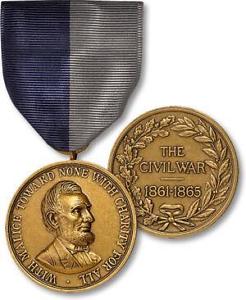
Update: A blog reader notes that Millet also designed the Army Campaign Medal issued to CW veterans:
_______

Faugh A Ballabh – Clear the Way!

On the 154th anniversary of the Battle of Gettysburg, an Irish Brigade flag flies on a private residence in Galveston.
_____
Presentation Thursday — “Sailing a Square-Rigger”

Join us this Thursday evening, July 6, at Fisherman’s Wharf Restaurant in Galveston for guest speaker, Jamie White, past director of the Texas Seaport Museum and the historic 1877 Iron Barque Elissa and an Admiral in the Texas Navy Association. Captain White will give a presentation on “Sailing Elissa ~ a Square Rig Primer.” Captain White will present a lecture on the dynamics of setting sail aboard and maneuvering the official tall ship of Texas, Elissa, and how ships of the Texas Navy would have been similarly handled underway during battle.
Having worked in the traditional rigging and square-rig sail training industry since the early 1980s, Captain White has built an extensive knowledge and understanding of traditional sailing ships and their operational and restoration/maintenance and educational outreach requirements. He has sailed over 30,000 miles as bosun, mate, or master on many square-rigged & traditional vessels including: HMAV Bounty, the three-masted barque Elissa, topsail schooner Californian, galleon Golden Hinde, barque Star of India, brig Pilgrim, schooner Adventuress, 3 masted schooner Jacqueline, square-topsail ketch Hawaiian Chieftain, brig Lady Washington, schooner Atlantis, and the brigantine Soren Larsen. He served as Chief/Master Rigger on the three-masted barque Glenlee, the four-masted barque Moshulu, the three-masted ship Balclutha, and the three-masted schooner C.A. Thayer. Captain White has served as a rigging consultant on the the four-masted ship Falls of Clyde, the three-masted ship Discovery, and the three-masted barque Polly Woodside. Most recently he spent much of 2016 supervising and directing the $3.5 million rigging restoration of the largest wrought iron sailing ship in the world, the full rigged ship Wavertree, launched 1885. He has served as both Master and Education Coordinator on the brig Lady Washington in 1988-89.
The event will begin with a meet-and-greet and cash bar at 6:30 p.m., with dinner and the presentation beginning at 7:30. Attendees can order from the regular Fisherman’s Wharf menu, and will be responsible for purchasing their own food and drinks. Those wanting to attend should RSVP to Adm. Butch Spafford, (409) 239-three one eight two, or by e-mail to admspafford-at-gmail-dot-com
The planned agenda for the July 6 meeting is available here.
The Texas Navy Association is a private, 501(c)(3) organization, dedicated to preserving and promoting the historical legacy of the naval forces of the Republic of Texas, 1835-45. In Galveston, the Charles E. Hawkins Squadron was organized in the fall of 2016, and meets on the first Thursday evening in odd-numbered months at Fisherman’s Wharf Restaurant.
______




 Dead Confederates, A Civil War Era Blog
9 comments