Talkin’ Blockade Runners, and the Texas Navy, Too

On Saturday, August 13, I’ll be one of the speakers at the 5th Annual Civil War Symposium in Jefferson, Texas. I’ve never been to the symposium before, but they’ve had some wonderful speakers in the past, and Jefferson itself is a great town, full of historic structures and a tremendous amount of history. It’s a steamboat town, which is like a railroad town, but better. (I kid, I kid!) My presentation is titled, “Captain Dave and the Yankees: A Tale of the Texas Blockade.” Other speakers include Mark K. Christ, “The Camden Arkansas Expedition of 1864;” Vicki Betts, “Pray for this War to End: The Civil War Letters of William Smith Herndon, 13th Texas Infantry, and Mary Louise Herndon, Tyler, Texas;” and Charles D. Grear: A Trying Time for All: Texas Indians During the Civil War.” Grear is a prolific author and (as we learned at the Houston CWRT) an effective speaker. I’ve never met Vicki Betts, but have corresponded with her, and she’s done yeoman’s work transcribing and cross-referencing many hundreds, probably thousands, of period newspapers and documents. This event should be great fun.
Then on Saturday, September 17, I’ll be giving a short address for Texian Navy Days at the Battleship Texas, at the San Jacinto Battleground in La Porte. The event there starts at 10 a.m., and should be done around 11:15 — plenty of time to explore the last surviving World War One dreadnought in the world.
_______

That’s One Tough Old Bird. And the Plane’s Not Half Bad, Either.
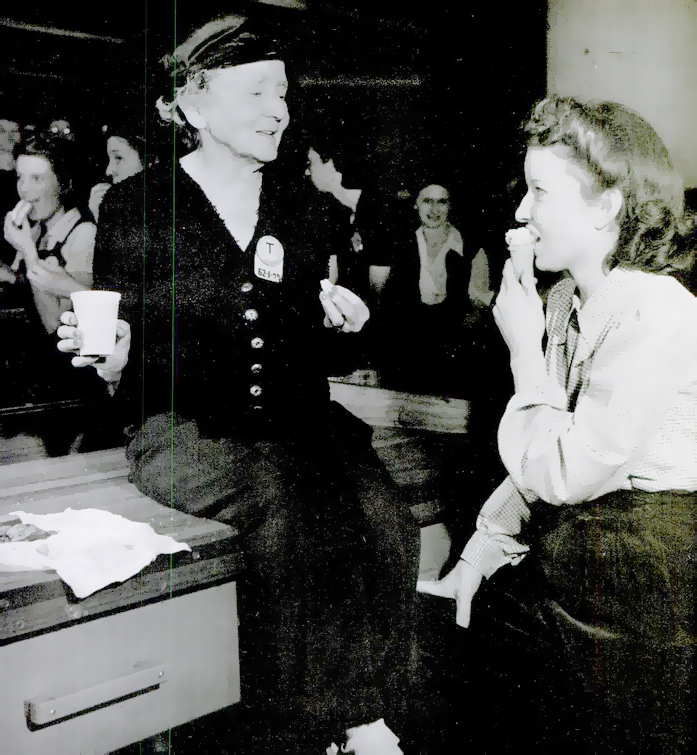

Did you know that Helen Dortch Longstreet, the widow of Old Pete Longstreet, helped build B-29 Superfortresses during World War II? Neither did I.
________
Image: Life Magazine, December 27, 1943.

Celebrating Independence Day in Vicksburg, 1877


It’s an old saw that the citizenry of Vicksburg, Mississippi, did not celebrate the Fourth of July until well into the 20th century. While it’s certainly true that the anniversary of the fall of that city to Grant in 1863 continued to resonate with Vicksburg residents down through the years, in fact the date was observed by plenty of local residents, white and black, even if the celebration was unofficial and somewhat more muted there than elsewhere. And they were celebrating it even when the war itself was a recent memory. From the Vicksburg Daily Commercial, July 3, 1877:
To-morrow being the anniversary of our Nations independence, all patriotic citizens of this great Republic are expected to observe it as a holiday. We desire to be reckoned among this class of patriotic citizens, consequently no paper will be issued from this office to-morrow. The glorious Fourth happens to come in hot weather this year, and we are glad to be able to observe it ‘neath the shade of country forests.
And a follow-up, on July 5:
The people of Vicksburg came nearer celebrating the glorious Fourth yesterday than they have done for several years. True, there was no general suspension of business, as indicated by closed doors, but so far as the profits of trade were concerned doors might as well have been closed, for the salesrooms were deserted almost entirely. Everybody was out of town, apparently, enjoying the holiday in some way. Several hundred people attended the Hibernian picnic at Newman’s Grove, and not withstanding the extreme heat, all seemed to enjoy the festivities of the day. The colored population turned out in large force, fully one thousand men of them going down the river on excursion boats to picnic-grounds, yet there were enough of them left in the city to form a very respectable procession of colored Masons, and a very large audience to listen to the oration of Judge J. S. Morris, and to assist in laying the corner-stone of King Solomon’s Church. There was no prolific display of fire-works on the streets, but occasional reports from fire-crackers and large torpedoes could be heard, accompanied now and then by a patriotic cry, “rah for the Fourth of July!” We do not wonder at the lack of patriotic enthusiasm displayed on our streets. No amount of patriotism could have induced any sane man to exert himself very considerably on such a day when the thermometer registered very nearly 100° Farenheit [sic.] in the shade. However, the observance of Independence Day yesterday, slight as some may have thought it, was yet sufficient to indicate the prevalence of a broader National sentiment and a determination to at least partially forget the past which renders the Fourth of July especially distasteful to Vicksburgers, and make it in future “The Day We Celebrate” as much as any other National holiday.
To be sure, the Fourth of July remained a bitter date for many Vicksburg citizens, for a long time. Undoubtedly there are some who still reject the date as one for celebration. But in this, as in so much else about the legacy of the war, the reality is more complex than some would have us believe.
_____________
A version of this post originally appeared here on July 4, 2011.
Southern Home Front Online Collection Moved
Some of you will be familiar with the online newspaper archive that Vicki Betts, a researcher and librarian at the University of Texas at Tyler, has been diligently transcribing for years. It is a valuable resource, and deserves to be better known.
Vicki recently shifted the archive to a new, more reliable server, that should stand it in good stead going forward. The new address is:
http://scholarworks.uttyler.edu/cw_news/
This is the introduction to the new site:
The following files of transcribed articles from Civil War era newspapers are predominantly from the South, and focus on the homefront, including women, Confederate industry, and material culture. The scattered military articles usually relate either to camp life or to Texas units or events. These articles do NOT include foreign affairs, politics, monetary policy, or general battle accounts. All were gathered in the course of researching various topics of personal interest and do not reflect any systematized indexing.
The articles under “By Title” are listed by newspaper title and then within each file, chronologically. The articles under “Special Topics” have been pulled from those files, across newspaper titles, then arranged chronologically.
If these excerpts are to be used for published research, authors are urged to double check with either the microfilm or the originals to verify the transcription, especially when the quotations include numbers or proper names. The combination of the deteriorating ink and paper of Confederate newspapers and poor microfilming has made some issues difficult to read.
As usual, researchers are also encouraged to approach the “truth” in historic newspapers cautiously. Even more so than now, nineteenth century newspapers often expressed extremely partisan positions. Editors gathered reports and rumors from correspondents, travelers, and other newspapers, usually with little or no verification. At the same time, these papers do reflect what people of the period were reading and perhaps believing. As such, they remain a valuable source, used wisely.
Vicki has done a remarkable job compiling this resource, a slow and laborious process that has made research so much easier for the rest of us.




 Dead Confederates, A Civil War Era Blog
4 comments