Mercy Street, Episode 2
 Now we know why the real-life Anne Reading was re-imagined as a fictional Ann Hastings. Ahem.
I was surprised at Ann Hastings’ reaction to the efforts to open the windows to get fresh air on the wards, because her mentor, Florence Nightingale, was as committed to fresh air and sunlight as anyone possibly could be. Here is what Nightingale had to say about ventilation in her Notes on Hospitals (3rd edition), published during the Civil War:
3. Deficiency of Ventilation. — The want of fresh air may be detected in the appearance of patients sooner than any other want. No care or luxury will compensate indeed for its absence. Unless the air within the ward can be kept as fresh as it is without y the patients had better be away. What must then be said when, as in some town situations, the air without is not fresh air at all ? Except in a few cases well known to physicians, the danger of admitting fresh air directly is very much exaggerated. Patients in bed are not peculiarly inclined to catch cold,* and in England, where fuel is cheap, somebody is indeed to blame, if the ward cannot be kept warm enough, and if the patients cannot have bed-clothing enough, for as much air to be admitted from without as suffices to keep the ward fresh. No artificial ventilation will do this. Although in badly-constructed hospitals, or in countries where fuel is dear, and the winter very cold, artificial ventilation may be necessary, it never can compensate for the want of the open window. The ward is never fresh,and in the best hospitals at Paris, artificially ventilated, it will be found that, till the windows are opened, the air is close. A well-waged controversy has lately been carried on upon this very point, in Paris. Eminent authorities in England had decried the pavilion system, on the ground that the atmosphere of a certain Paris pavilion hospital was ” detestable,” not because of the pavilion architecture, but because of its artificial ventilation defying the best pavilion building to ventilate its patients. What is all that luxury of magnificent windows for but to admit fresh air? To shut up your patients tight in artificially warmed air, is to bake them in a slow oven. Open the Lariboisiere windows, warm it with open fires, drain it properly, and it will be one of the finest hospitals in the world.
Natural ventilation, or that by open windows and open fire-places, is the only efficient means for procuring the life-spring of the sick — fresh air. But to obtain this the ward should be at least fifteen to sixteen feet high, and the distance between the opposite windows not more than thirty feet. The amount of fresh air required for ventilation has been hitherto very much underrated, because it has been assumed that the quantity of carbonic acid produced during respiration was the chief noxious gas to be carried off. . . .
One would think the inference in people’s minds, from these just (and unjust) terrors, would be to remove instantly every hindrance to the foul air being carried off ; but, instead of that, their inference is to shut it up or to run away from the sick.
One would think that the first and last idea in constructing hospitals would be to contrive such means of ventilation as would be perpetually and instantly carrying off these morbid emanations. One would think that it would be the first thing taught to the attendants to manage such means of ventilation. Often, however, it is not even the last thing taught to them.
I’m beginning to think — or at least hope — that Ann Hastings is ultimately going to be revealed in the end as an impostor, who never got closer to the Crimea than reading The Times.
Silas Bullen will probably die violently, mourned by no one, because that’s how these shows work.
__________

Jefferson Davis’s America Conference, Rice University, February 19-20
From the School of Humanities, Rice University in Houston:
Description:
In 1890, W. E. B. Du Bois pointed to Jefferson Davis as “a representative of civilization” as it had developed over the previous century. Scholars have often remembered the 19th century as the Age of Emancipation, as an age of liberal nation-building or even as the Age of Lincoln. But according to the latest scholarship, 19th-century American civilization was dependent on slave-based capitalism, racism and imperial conquest. Seen in that light, Jefferson Davis, as a soldier in the Mexican-American War, a U.S. secretary of war and senator, a Mississippi cotton planter, and leader of a slaveholding breakaway republic with imperial ambitions of its own, was much more than an anomaly.
This conference coincides with the completion of “The Papers of Jefferson Davis” documentary editing project. A group of leading American historians will look unblinkingly on the 19th-century U.S. as a nation in which Jefferson Davis, more than Lincoln, was in many ways the typical figure. Like Du Bois in 1890, we “wish to consider not the man, but the type of civilization which his life represented,” with papers on the forces — territorial expansion, slavery, capitalism, nationalism, Civil War memory and empire — with which Jefferson Davis’s life intersected at crucial moments in U.S. history.
Location:
Herring Hall 100
Schedule:
Friday, Feb. 19
7 p.m. Keynote opening address: Amy S. Greenberg, Penn State University: “From Mexico to Washington: Jefferson Davis’s 1848”
Saturday, Feb. 20
9 a.m. Kimberly Welch, West Virginia University: “Black Litigants: Rethinking Race and Law in the Cotton South, 1800–1860”
10 a.m. Caitlin C. Rosenthal, University of California, Berkeley: “Slavery’s Scientific Management: Plantation Accounting and American Capitalism”
11:30 a.m. Matthew Karp, Princeton University: “Architects of Empire: Jefferson Davis, the Proslavery South, and the U.S.
2 p.m. Robert E. Bonner, Dartmouth College: “Jefferson Davis and the Reactionary Atlantic”
3:30 p.m. K. Stephen Prince, University of South Florida: “Robert Charles in Jefferson Davis’s America: Race and Violence in Jim Crow New Orleans”
5 p.m. Closing keynote address: William J. Cooper, Louisiana State University: “Jefferson Davis and His Country”
______
It’s a Small (Confederate) World After All
Monday, in my post on the premiere of Mercy Street, I wondered aloud if the character of Frank Stringfellow — who will appear in later episodes of the series — had any connection to Henry Martyn Stringfellow, a Confederate artillery officer who later settled here in Galveston County. I didn’t realize that Frank Stringfellow was a real person, and a relatively famous one at that. It turns out that he and Henry were first cousins, and separated by only three years in age. Henry grew up in Petersburg and Hanover County, while Frank was born in Culpeper County, further north. Both attended the Virginia Theological Seminary in Alexandria, Henry before the war and Frank, after.
Neat. Thanks to commenter David Corbett for pointing me in the right direction.
__________
Mercy Street, Episode 1
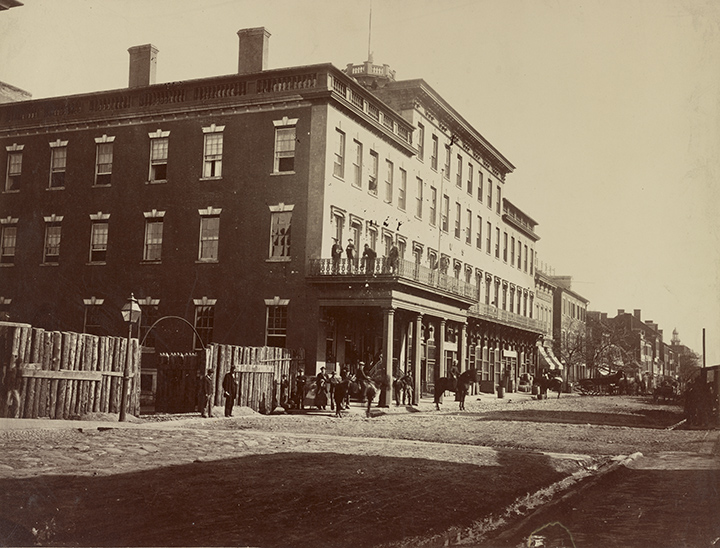

I just finished watching the first episode of Mercy Street online. I liked the episode, and I do think it’s a promising start. Others Everyone else has weighed in on the show already, but here are a few thoughts on the first episode (with some minor spoilers), in no particular order:
Dick Dowling Has to Go, But Jeff Davis Might Stay? Really?
This past week Houston ISD voted to change the names of four schools named after Confederates. The move was not unexpected, but I was a little disappointed to see that the list included R. W. “Dick” Dowling Middle School. Dick Dowling is famous for his successful defense of Sabine Pass in 1863, but entirely apart from that he was an up-and-coming community leader in Houston, a real-life sort of rags-to-riches story of an Irish immigrant. He is generally credited as one of the founders of the Houston Fire Department. Had he not died in 1867, at age forty, I’m certain that he would have gone on to prominent elective office, and his military service during the war would be just one chapter in a long biography.
As I said, not unexpected. But what makes this bizarre to me is that the school board decided to postpone action on the names of Albert Sidney Johnston Middle School, John H. Reagan High School, and Jefferson Davis High School, all three of which are named after Confederates far more prominent than Major Dowling. I understand the desire to re-evaluate the way we view Confederate leaders today, in 2016, but Dowling is far more relevant and creditable to Houston’s early history than Davis, Jackson, or Lee are.
Seriously, if HISD wants to make a public gesture aimed at emphatically underscoring the moral onus of the Confederacy, Jefferson Davis is your guy. Removing Dick Dowling’s name while retaining Davis’ is simply inexcusable.
_____

“The Fight of the Hatteras and Alabama”
The other day we heard the South African folk song, “Daar Kom die Alibama,” a tune reportedly inspired by the visit of that ship to Cape Town in 1863. In fact, as one of the most famous ships of the war — or infamous, according to one’s predilections — C.S.S. Alabama has been the subject of many tunes over the years. Here’s one describing her fight with U.S.S. Hatteras, about thirty miles over that-away from where I sit typing, 153 years ago today. Enjoy.
______

Canister!

Short items that don’t warrant full posts of their own.
- The New York Public Library has released a massive collection of non-copyrighted images online, in high-resolution, free for anyone to download. Included in this are many Civil War period images, including original sketches prepared for Frank Leslie’s Illustration Newspaper (above, “Capture of a Contrabandist on Lake Pontchartrain,” by Francis H. Schell).
- At least two dozen people attended Saturday’s big Confederate flag rally in Columbia, South Carolina. Can you feel the momentum?
- Speaking of Columbia, it didn’t get much attention at the time, but the criminal case against Bree Newsome, the activist who took down the Confederate flag in front of the State House last summer, was dismissed back on December 10.
- The trailer for Free State of Jones is out, and it looks exciting. It’s based on Vicki Bynum’s book, and I can’t wait to see it. Matthew McConaughey even looks like the real Newt Knight.
- Over at Defending the Heritage, the vindication of the South through Facebook memes continues apace. This week, it’s a melacholy image of Confederate soldiers, huddling for warmth around a campfire during the “last desperate days” of the war. Of course, it’s actually part of a painting by Winslow Homer of U.S. cavalrymen, with the more obvious Federal uniforms cropped out of the image. More specifically, it depicts the camp of the First Division of the Second Corps of the Army of the Potomac, in the Spring of 1862. Details, details. Full-resolution image here.
- Did the South’s rapid rise out of decades of grinding poverty in the last fifty years contribute to the high incidence of heart disease prevalent across the region today? Researchers from Ohio State think maybe it did.
- In election news, it looks like the white nationalists are going all-in for Donald Trump in Iowa.
- The six-part PBS miniseries Mercy Street, set in a military hospital in Alexandria, Virginia, starts next Sunday.
- In Savannah, archaeologists and the Corps of Engineers made the difficult decision to return 135 tons of redundant artifacts from the recovery of C.S.S. Georgia to the river, where they can be retrieved at a later date. Another 142 tons has already gone to the conservation lab at Texas A&M University; that’s more than the mass of two M1A1 Abrams tanks. It’s not an ideal solution, but given the tremendous volume of material involved, it may be the only practical solution.
- Next weekend the Virginia Flaggers will be headed to Lexington to celebrate Lee-Jackson Day. They’ve toned down their chest-thumping about their boycott of city businesses — you know, the one they don’t themselves observe — which is probably just as well, considering that city tax revenues from restaurants were up almost 16% over the previous year, coming in at a over a million dollars. You can download the full financial report here; the revenue figures are on p. 23.
Got any more? Put ’em in the comments.
_________
“The Regiments are frequently practiced at firing ball at marks.”
 It’s a different war, but over at the Journal of the American Revolution, Don Hagist calls BS on the old saw that British regulars were not taught to aim their weapons.
I love history like this.
________
Image: Private of the 17th Regiment of Foot, 1777, by Don Troiani.
Ed Bearss at the Houston CWRT, January 21
The incomparable Ed Bearss will be speaking to the Houston Civil War Round Table on Thursday, January 21, 2016. Mr. Bearss will speak on the Kentucky Campaign and the Battle of Perryville.
Non-members are welcome to attend. The cash bar opens at 6 p.m., dinner is at 7, with the Mr. Bearss’ presentation to follow. As always, reservations are required. The charge for dinner is $30, with a limited number of lecture-only seats for $10. Call Don Zuckero at (281) 479-1232 or email him at Reservations@HoustonCivilWar.com by 6:00 PM the Monday preceding the Thursday meeting (i.e., January 18). The Hess Club’s address is 5430 Westheimer, a short distance west of the Galleria. The club is situated on the corner of Westheimer Way and Westheimer Court. Free, convenient, and handicap-accessible parking is across the street. Valet parking is also available.
For those who have not heard Mr. Bearss speak in person, it’s a memorable experience. Don’t miss it!
______
“Daar Kom die Alibama”

There’s always something new out there you didn’t know, isn’t there?
Recently, thanks to user SquirrelHudson at Civil War Talk, I discovered the traditional South African folk song, “Die Kom die Alibama,” which is generally credited to have been inspired by the visit of the Confederate raider Alabama to Cape Town in late 1863. While that origin is disputed by some, it’s nevertheless a song that catches the ear, which undoubtedly attests to its popularity after all these generations.
So here we have a song ostensibly inspired by a Confederate ship, built in the United Kingdom, with Afrikaans lyrics, sung by South Africans of Malay descent, played on traditional African instruments. What a crazy world this is, and how better we all are for it.
I’ve already had seconds on the black-eyed peas; 2016 is gonna be a good year. Y’all have a Happy New Year, too.
__________




 Dead Confederates, A Civil War Era Blog



8 comments